한국어
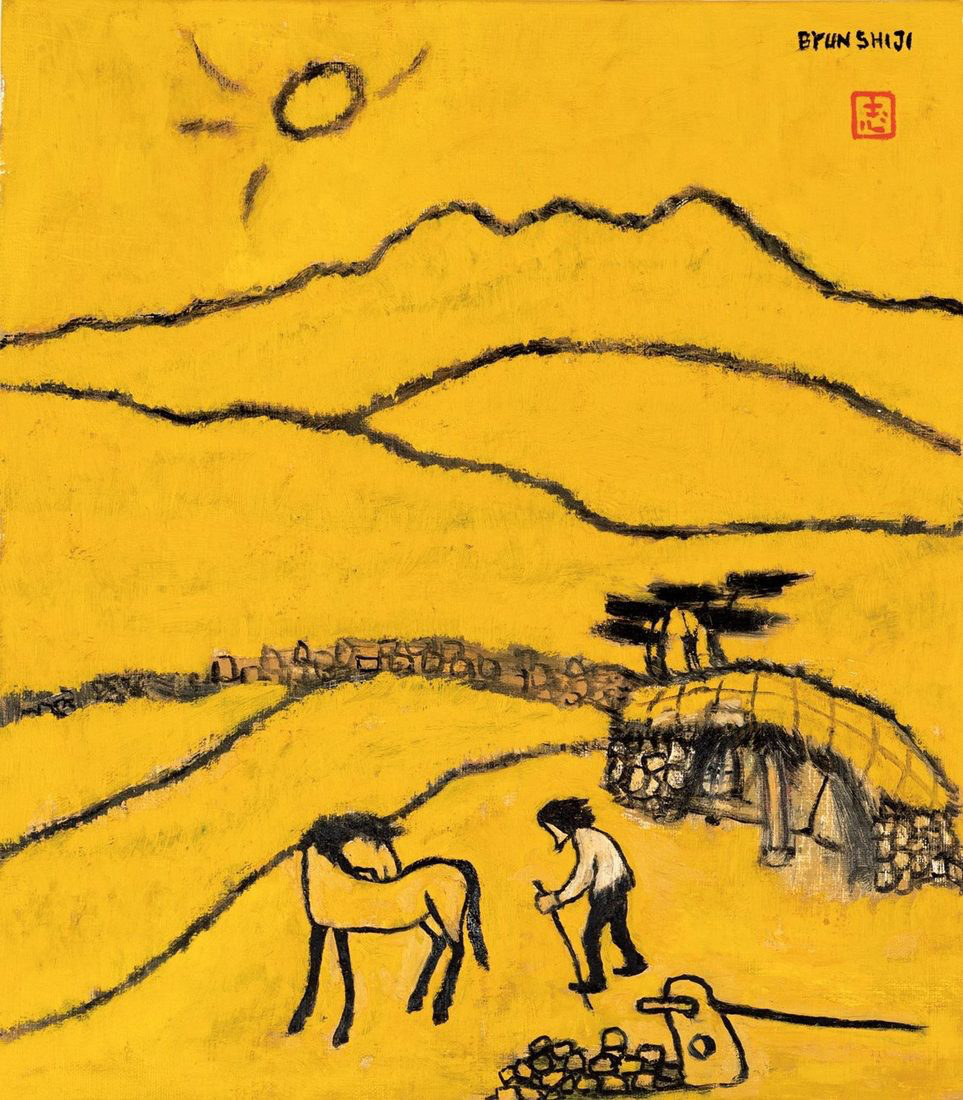
온 화면이 노랗다.
위에는 둥근 고리 같은 해가 떠 있고, 그 아래로 산줄기가 검은 선 몇 개로 겹쳐
누웠다. 한라산이다.
봉우리의 높이도, 골짜기의 깊이도 그는 자세히 그리지 않았다. 산을 다 그리지
않아도 산은 온전히 서 있다.
언덕 아래 초가 한 채가 낮게 엎드려 있고, 돌담이 그 둘레를 감싼다. 그 앞에 말 한
마리와 등 굽은 사람 하나.
말은 고개를 숙이고, 사람은 허리를 굽히고, 초가는 더 낮아져 바람을 받아낸다. 낮은
것들이 서로 곁을 지키며, 저마다의 방식으로 굽어 있다.
산만이 굽지 않는다. 천 년 전에도 그 자리에 있었고, 오늘도 같은 자리에 있다. 굽은
것들은 그 큰 침묵에 기대어 산다.
그는 제주를 설명하지 않았다. 바람이 지나간 자리에 선 하나를 그었을 뿐이다.
사람을 자세히 그리지 않아도, 그가 견딘 날들이 보인다.
이곳에서 풍경은 사람 뒤의 배경이 아니다. 사람이 살아온 자세다.
English
The whole surface is yellow.
Above hangs a sun like a round ring, and below it the mountain ridges lie
overlapped in a few black lines. This is Hallasan.
He did not draw in detail the height of the peaks or the depth of the valleys.
Below the hill, a thatched house lies low, and a stone wall wraps around it. Before it
stand a horse and a stooped figure.
He did not explain Jeju. He only drew a single line where the wind had passed.
Even without drawing the whole mountain, the mountain stands complete.
Even without drawing the figure in detail, one can see the days the figure has
endured.
The horse lowers its head, the figure bends at the waist, and the thatched house
sinks lower to receive the wind.
Here, landscape is not a background behind the human being.
It is the posture in which a person has lived.