Artwork text
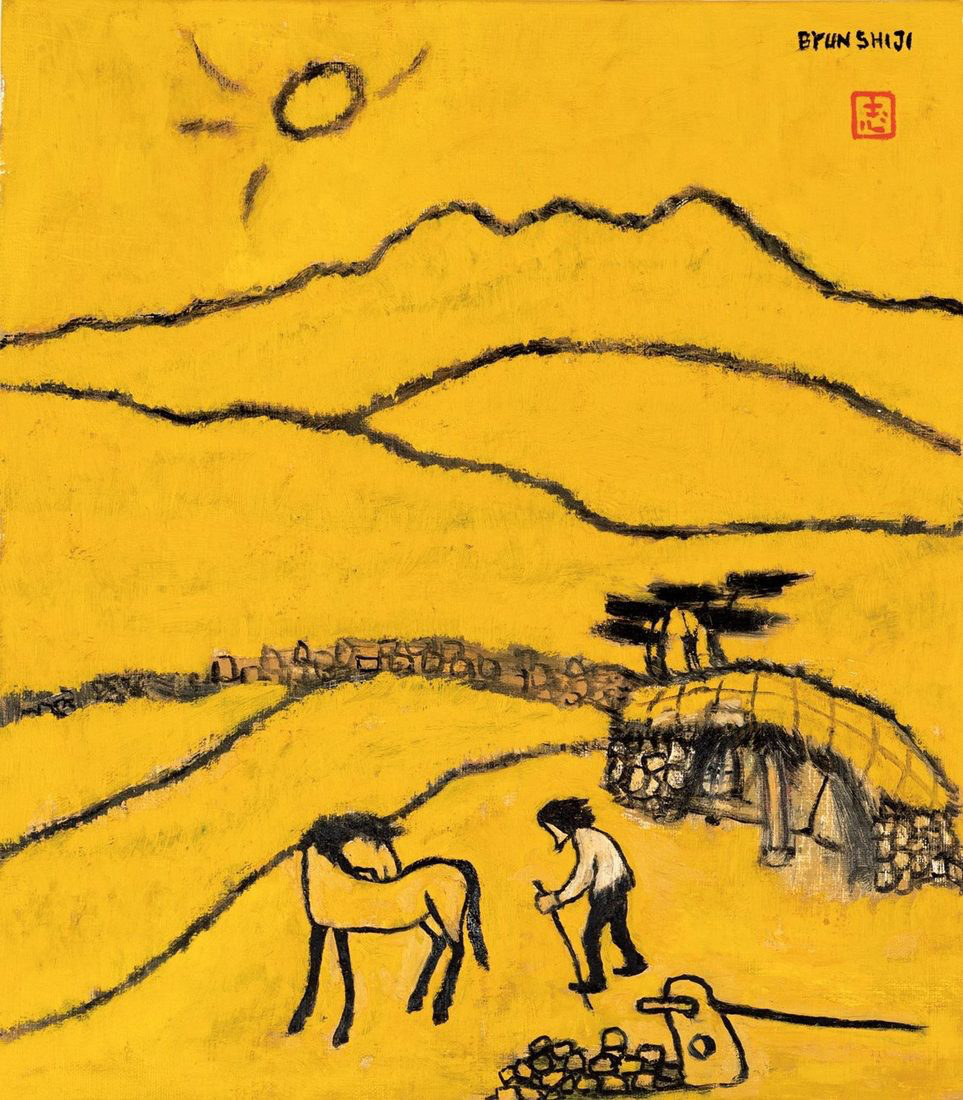
The whole surface is yellow.
Above hangs a sun like a round ring, and below it the mountain ridges lie
overlapped in a few black lines. This is Hallasan.
He did not draw in detail the height of the peaks or the depth of the valleys.
Below the hill, a thatched house lies low, and a stone wall wraps around it. Before it
stand a horse and a stooped figure.
He did not explain Jeju. He only drew a single line where the wind had passed.
Even without drawing the whole mountain, the mountain stands complete.
Even without drawing the figure in detail, one can see the days the figure has
endured.
The horse lowers its head, the figure bends at the waist, and the thatched house
sinks lower to receive the wind.
Here, landscape is not a background behind the human being.
It is the posture in which a person has lived.
Key context
Byun Shi-Ji was a Korean modern and contemporary painter who treated Jeju’s Fūdo not as scenery but as a condition of existence. Through solitude, waiting, wind and the colour of dried grass, his art formed a glocal modernism rooted in Korea and open to the world.