한국어
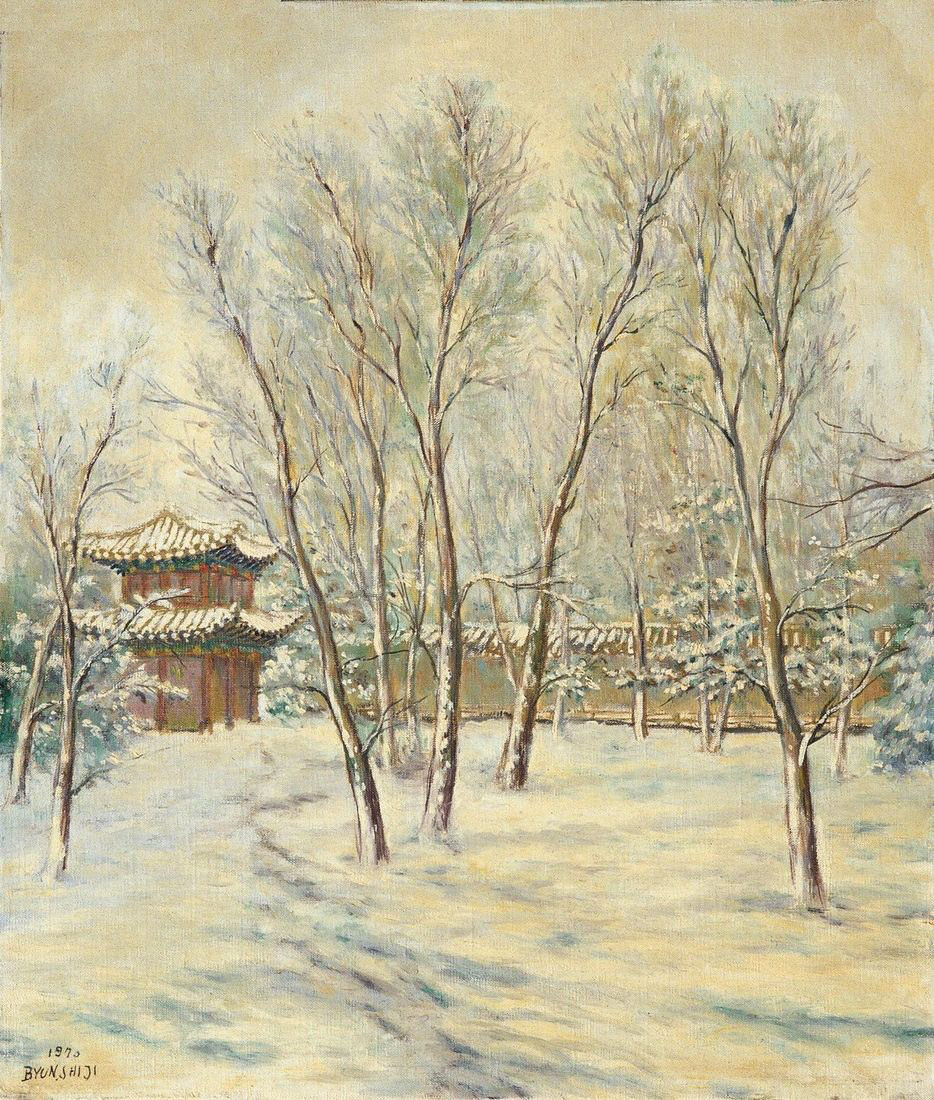
눈 덮인 뜰에 나무들이 곧게 서 있다.
가지의 갈라짐과 기와의 곡선, 눈 위로 번지는 푸른 그림자까지 세심하게 그려졌다.
화가는 이미 보이는 것을 그리는 법을 알고 있었다. 대상의 비례를 잡고, 공간의
깊이를 만들고, 겨울빛의 미세한 차이를 화면에 옮길 줄 알았다. 아카데미즘이
가르친 정확한 눈과 숙련된 손이 화면을 지키고 있다.
그러나 그의 길은 여기에서 멈추지 않았다.
그는 점차 나무의 가지보다 그 가지를 흔드는 바람을 그렸고, 집의 형태보다 그 집이
품은 그늘과 견디는 자세를 그렸다. 사람의 얼굴보다 세월 앞에서 굽어진 등을
그렸고, 눈앞의 색보다 볕과 바람을 오래 견딘 마른 풀잎색을 남겼다.
이 겨울 풍경은 아직 모든 것이 또렷하다. 나무는 나무이고, 집은 집이며, 눈은 눈이다.
그러나 훗날 그 경계들은 바람 속에서 흐려진다. 나무는 바람의 몸이 되고, 집은
견딤의 자세가 되며, 사람은 풍토 안에 놓인 작은 존재가 된다.
그는 그리는 법을 버린 것이 아니다.
너무 잘 알았기에, 마침내 덜어낼 수 있었다.
재현에서 존재로. 형태에서 자세로.
이 눈 덮인 뜰에서, 그 먼 길이 시작되고 있었다.
二部 · 이야기 — 살아가는 사람들 (Part Two · Tales — People
Who Live On)
二部
이야기
살아가는 사람들
그 풍토 안에서,
사람들이 살아간다.
English
1970 — Seoul years — essay
Changdeokgung (昌德宮): a royal palace of the Joseon dynasty, Seoul.
In a snow-covered courtyard, the trees stand straight.
The splitting of the branches, the curve of the tiled roof, even the blue shadow
spreading over the snow — all are rendered with care.
The painter already knew how to paint what is seen.
He knew how to set the proportions of his subject, to build the depth of space, and
to carry the faint gradations of winter light onto the surface.
The exact eye and trained hand taught by academicism still sustain the surface.
But his path did not stop here.
Little by little, rather than the branches of the tree, he painted the wind that shook
those branches;
rather than the form of the house, he painted the shade it held and its posture of
endurance.
Rather than a person's face, he painted the back bent before the years;
rather than the color before his eyes, he left the color of dry grass that had long
endured sun and wind.
In this winter scene, everything is still distinct.
The tree is a tree, the house is a house, and the snow is snow.
But in later years, those boundaries blur within the wind.
The tree becomes the body of the wind,
the house becomes a posture of endurance,
and the person becomes a small being set within the Fūdo.
He did not abandon the art of painting.
Because he knew it so well, he could at last strip it down.
From academicism to Fūdo.
From a hand that depicts objects to a body that endures the world.
And so his painting moved from representation to being,
from form to posture.
Part Two
Tales
The People Who Live On
Within that Fūdo,
people live on.