Artwork text
1970 — Seoul years — essay
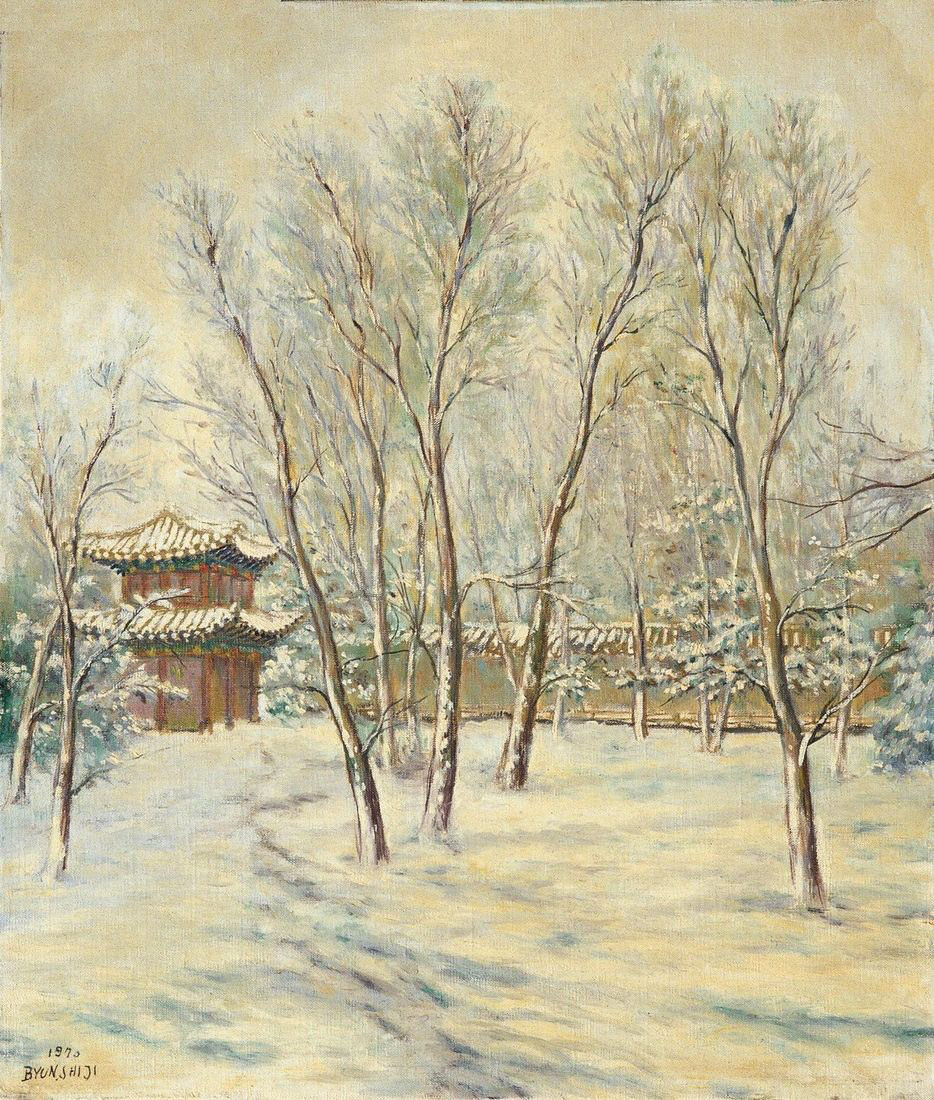
Changdeokgung (昌德宮): a royal palace of the Joseon dynasty, Seoul.
In a snow-covered courtyard, the trees stand straight.
The splitting of the branches, the curve of the tiled roof, even the blue shadow
spreading over the snow — all are rendered with care.
The painter already knew how to paint what is seen.
He knew how to set the proportions of his subject, to build the depth of space, and
to carry the faint gradations of winter light onto the surface.
The exact eye and trained hand taught by academicism still sustain the surface.
But his path did not stop here.
Little by little, rather than the branches of the tree, he painted the wind that shook
those branches;
rather than the form of the house, he painted the shade it held and its posture of
endurance.
Rather than a person's face, he painted the back bent before the years;
rather than the color before his eyes, he left the color of dry grass that had long
endured sun and wind.
In this winter scene, everything is still distinct.
The tree is a tree, the house is a house, and the snow is snow.
But in later years, those boundaries blur within the wind.
The tree becomes the body of the wind,
the house becomes a posture of endurance,
and the person becomes a small being set within the Fūdo.
He did not abandon the art of painting.
Because he knew it so well, he could at last strip it down.
From academicism to Fūdo.
From a hand that depicts objects to a body that endures the world.
And so his painting moved from representation to being,
from form to posture.
Part Two
Tales
The People Who Live On
Within that Fūdo,
people live on.
Key context
Byun Shi-Ji was a Korean modern and contemporary painter who treated Jeju’s Fūdo not as scenery but as a condition of existence. Through solitude, waiting, wind and the colour of dried grass, his art formed a glocal modernism rooted in Korea and open to the world.