Artwork text
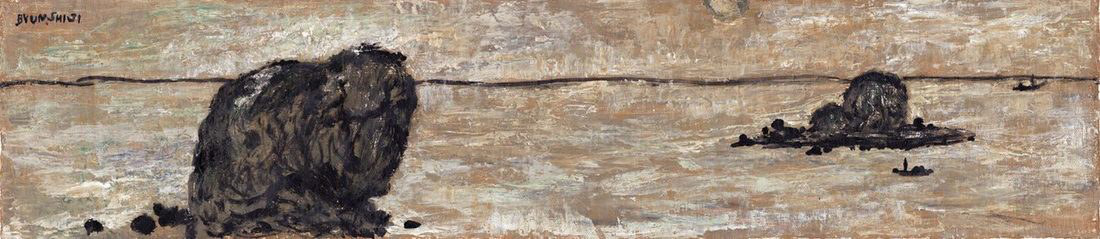
A canvas lying long and horizontal.
All a faded earthen color.
A single line of horizon
quietly divides the world.
On the left, one large rock;
far to the right, another mass.
The two are not things within a scene.
Do not call this a background.
The rock does not recede.
It is there before the human being
and stands before the eyes.
Not a background.
A condition.
Before this color,
this wind,
this rock,
only then does a person become a person.
Fūdo is not an ornament around the human being.
It is the place where one finds one's own stance.
The world is there first,
and before it
one learns who one is.
Key context
Byun Shi-Ji was a Korean modern and contemporary painter who treated Jeju’s Fūdo not as scenery but as a condition of existence. Through solitude, waiting, wind and the colour of dried grass, his art formed a glocal modernism rooted in Korea and open to the world.