Artwork text
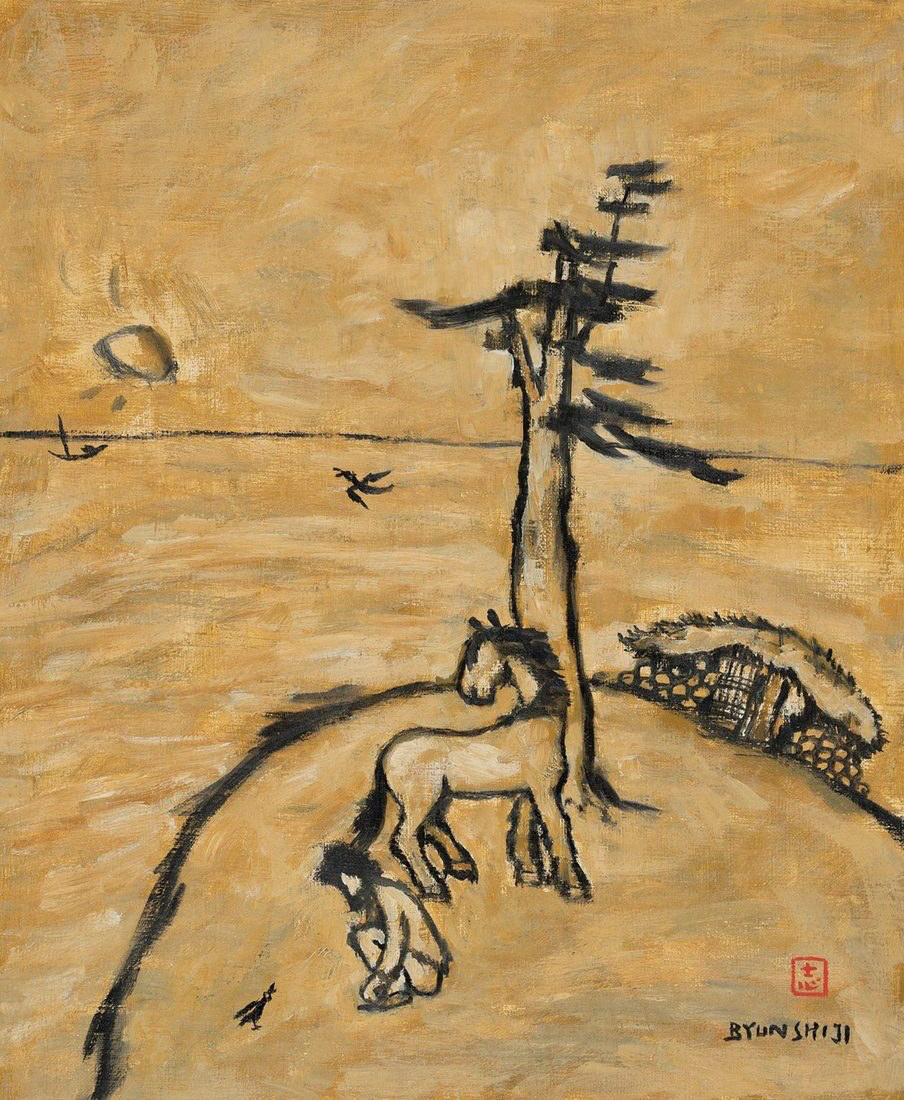
The whole surface is the color of dry grass.
In the center stands a single tree. Its branches all lean to one side, revealing the
direction of an unseen wind.
On the hill below are a horse and a crouching figure.
The two are near each other, yet they exchange no words. But the silence is not
empty.
Far off, beneath the horizon, a small boat passes, and a bird flies low. Sky and sea
alike lie quietly steeped in the same light.
For Watsuji, Fūdo was not an environment outside human life, but a way in which
human beings come to discover themselves.
What this painting shows is no different.
The figure and the horse receive the same wind, remain in the same place, and
bend under it in the same way.
They do not explain each other. They only endure together in the same Fūdo, and
stand together.
Dialogue is not made of words alone.
To stand in the same wind together, to pass through the same silence together —
that too is dialogue.
Even without words, it is dialogue.
Key context
Byun Shi-Ji was a Korean modern and contemporary painter who treated Jeju’s Fūdo not as scenery but as a condition of existence. Through solitude, waiting, wind and the colour of dried grass, his art formed a glocal modernism rooted in Korea and open to the world.