Artwork text
Empty House on the Left, Empty House on the
Right
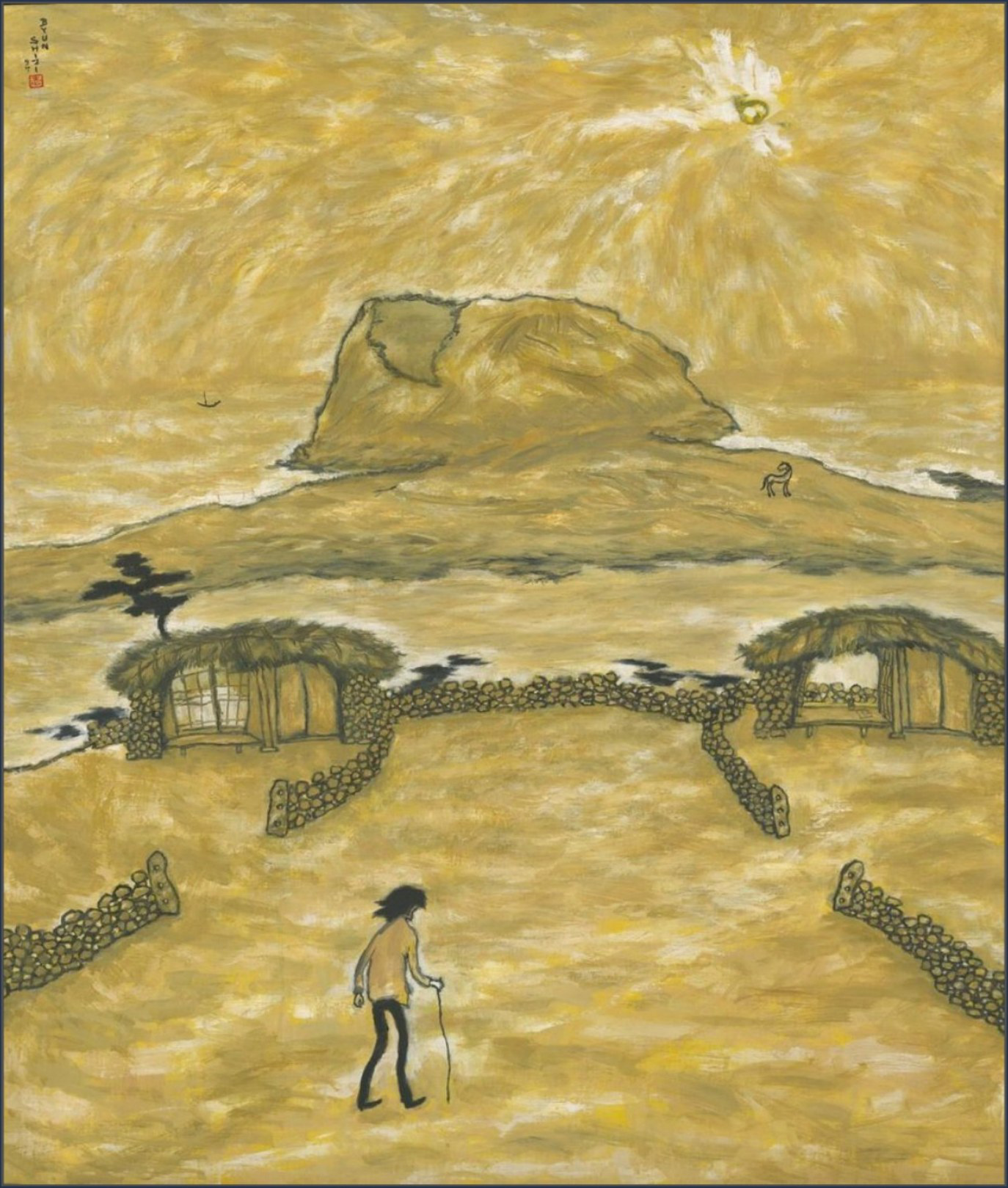
High in the sky, a single sun is afloat. Far out at sea, a small boat. In the middle, a
rocky islet that has long stayed still. On its slope, a horse stands alone.
Below, there are two houses. One has shut its door and holds the days that have
passed. The other, empty inside, waits for someone not yet come.
The stone walls around the two houses join and part, seem to block the way, then
open it again.
Between them, an old figure comes walking, leaning on a staff.
The sun is in the sky, the rock remains, the horse waits, the houses are empty.
Only the old figure walks.
No one tells them which house is right. Behind the closed door, there is life. Inside
the open, empty room, there is time not yet lived.
The old figure stands before a fork in the road. But a road is not a road from the
beginning.
The moment they move their body to one side, a single line becomes a path, and
one empty house at last becomes their dwelling.
Perhaps life is not finding an answer already given, but choosing one empty place
between two houses and filling it, little by little, with one's own warmth.
Key context
Byun Shi-Ji was a Korean modern and contemporary painter who treated Jeju’s Fūdo not as scenery but as a condition of existence. Through solitude, waiting, wind and the colour of dried grass, his art formed a glocal modernism rooted in Korea and open to the world.