Artwork text
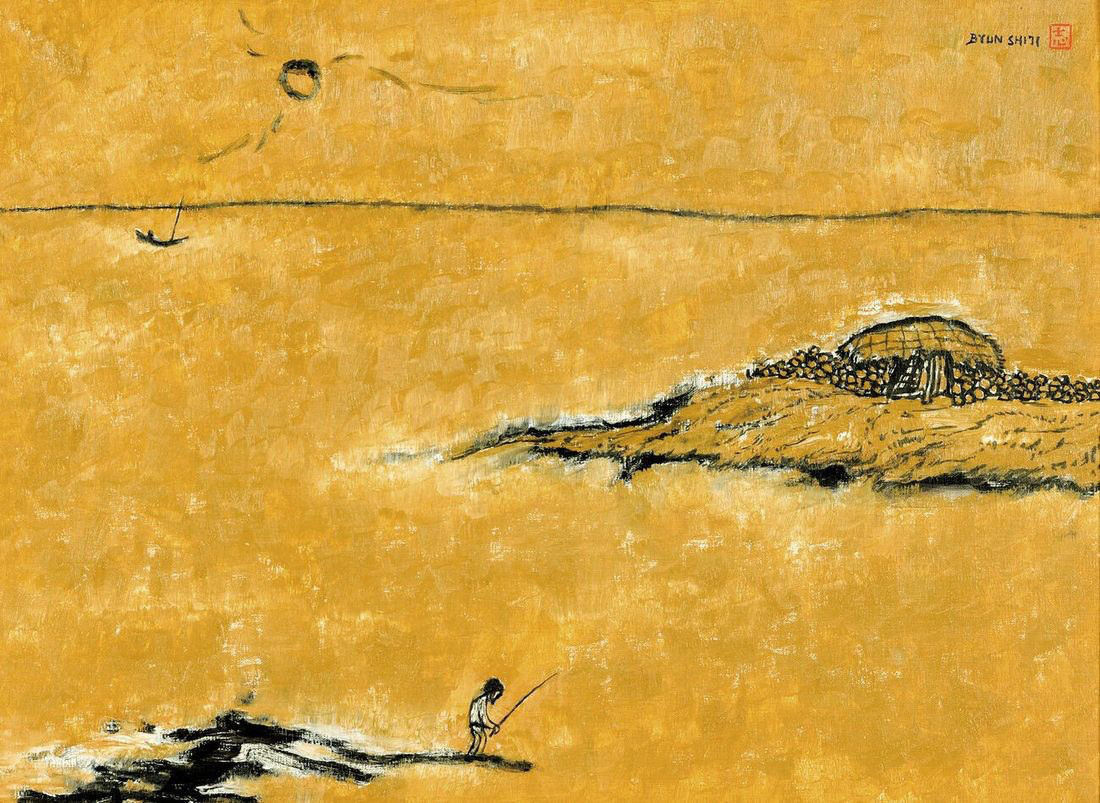
The sun floats over the sea,
and a skiff passes along the horizon.
On the cape to the right, a thatched house lies low, keeping its place together with
the stone wall.
Below, at the water's edge, a person stands holding a fishing rod.
The boat goes far out,
the house remains on the land,
and between them the person gazes at the sea.
A sea village does not mean only a place where houses gather.
It is the place where the departing boat and the remaining house,
the life gained from the sea and the life that waits on land
are joined within one Fūdo.
Someone goes out to sea,
and someone keeps the place of return.
Between the two, the village lives its day.
Key context
Byun Shi-Ji was a Korean modern and contemporary painter who treated Jeju’s Fūdo not as scenery but as a condition of existence. Through solitude, waiting, wind and the colour of dried grass, his art formed a glocal modernism rooted in Korea and open to the world.