Artwork text
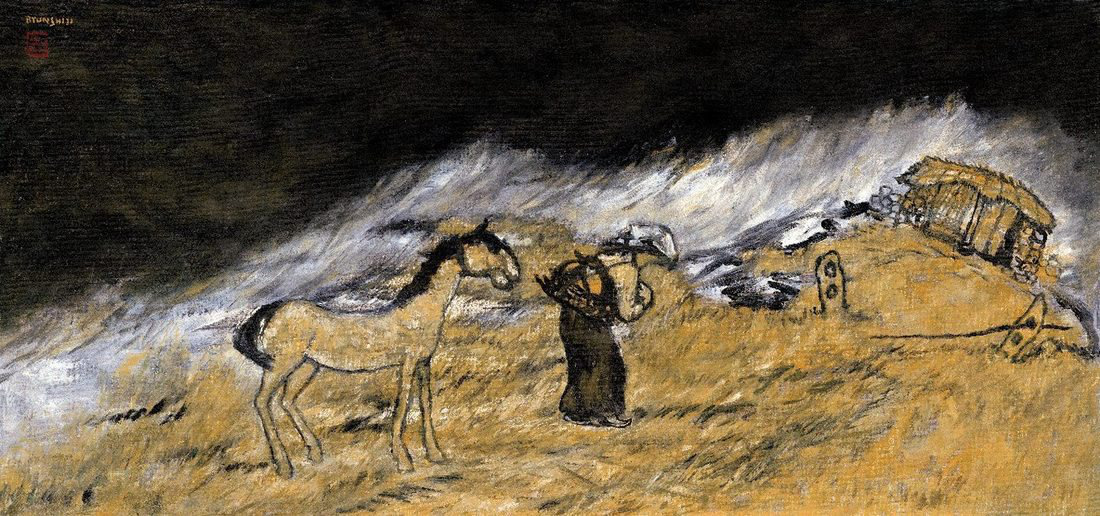
Under a black sky, a white wind sweeps across the field. On a path the color of dry
grass, a woman and a horse lean forward as if they were one body. The woman
carries a mulheobeok, a Jeju water jar borne on the back, and the horse follows
silently at her side. The wind tugs at the hem of her clothes and erases the path
beneath their feet, yet the two do not stop. Far away, a single thatched house. Small
and faint, but a place to return to still remains. The way home is not a road walked
after the wind has died down. It is to head toward home, even with a weary body,
until the end. The path continues as if about to break, and the woman and the horse
return along that thin line.
Key context
Byun Shi-Ji was a Korean modern and contemporary painter who treated Jeju’s Fūdo not as scenery but as a condition of existence. Through solitude, waiting, wind and the colour of dried grass, his art formed a glocal modernism rooted in Korea and open to the world.