Artwork text
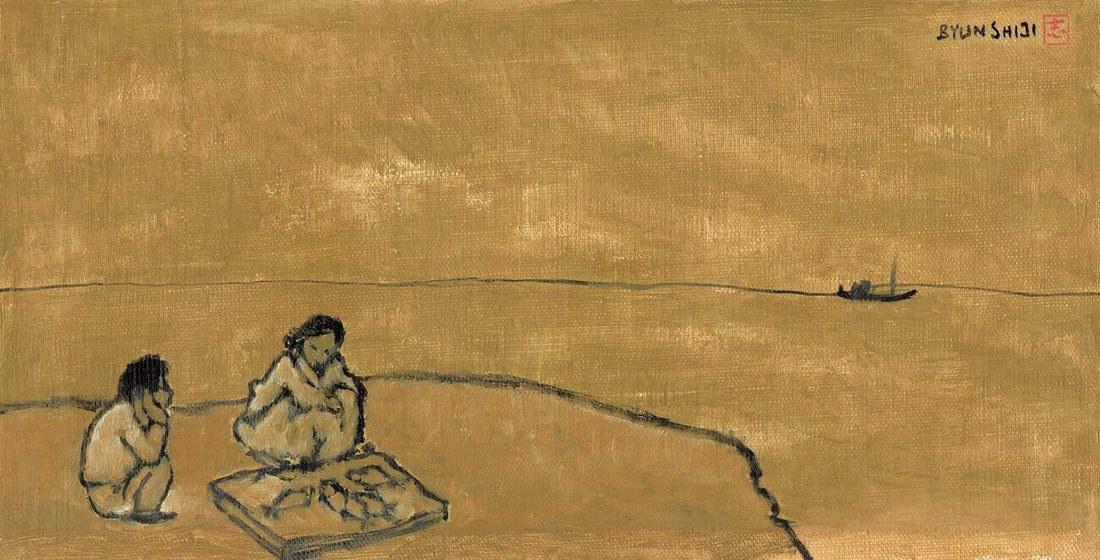
On the stall, four fish.
They lie like gifts from the sea.
The mother and the child are silent.
Each sinks into a private thought.
Seated side by side, they are two small islands.
They wait for a customer who does not come.
Worry seeps into the mother's heart.
The child's eyes follow, far off, a single boat on the far edge of the horizon.
Beyond that line is the father.
A single boat floats upon the water.
In the middle of the wide sea, it is yet another small island.
The father, too, is silent.
He pulls the net, and pulls again.
The wind blows without direction.
Still he does not let go of the oar.
Those four fish,
having left his hands, lie here on this near shore.
That one meal is the reason for his day.
Suddenly he lifts his head.
At the edge of the horizon, a faint dot.
Even unseen, he knows.
There his wife is, and there his child.
The horizon is the distance between the two,
a line that cannot be reached yet is never broken.
On this side, the mother follows the boat;
on the far side, the father longs for the shore.
Unable to see each other, they gaze at the same line.
The fish are silent.
Yet they carry the story of the deep sea.
The father's sweat,
the family's one meal,
the time of return.
The longer the silence, the deeper the waiting grows.
At the small spot before the stall, the family's day flows on.
Until someone's footsteps come to a stop,
today, too, the day goes by.
Key context
Byun Shi-Ji was a Korean modern and contemporary painter who treated Jeju’s Fūdo not as scenery but as a condition of existence. Through solitude, waiting, wind and the colour of dried grass, his art formed a glocal modernism rooted in Korea and open to the world.