Reading / 3 / 5
Essay 3
The Bent Line
The shape of a body that has met the wind
The pine leans.The person beside it bends his back.The two stand on the same hill.
The question Why do the lines of people and trees lean?
1 Trunk and Back
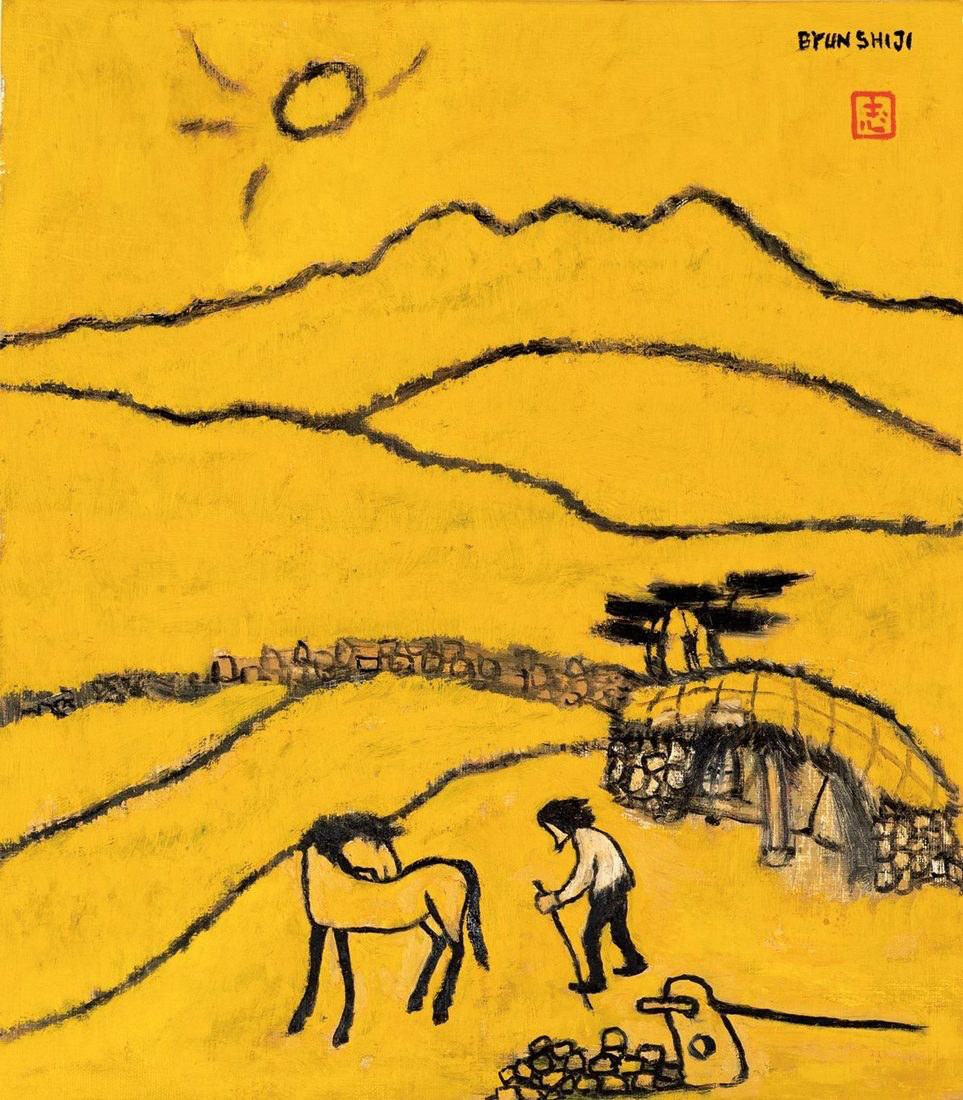
The Old Pine and the Old Man is from 1987. An old man stands on a hill the color of dried grass. The pine beside him and the old man's back both lean to one side. Leaning a little, they stand a long time.
In his Jeju paintings the black line bends and leans more than it runs straight. The trunk of a pine, the back of a person, the line of a low roof: all of them. The direction of the bend is matched, more or less, across the picture. The line is not smooth. Its thickness and darkness are uneven, and the trace of the brush is left rough. That uneven line gives more of a sense of movement and tension than a smooth outline would.
A single black line does three things at once. It divides: in a picture where the color of dried grass binds everything together, it is the line that tells things apart. It records: when the lines bend in a similar direction, a direction appears in the picture, as if one force were acting on many things. It raises: a line that goes on while leaning makes not the shape of something fallen, but the posture of something holding on.
The wind itself cannot be seen. What can be seen is what has met the wind. Byun Shi-Ji did not paint the wind. He painted the posture of having met it.
2 The Horse and the Haenyeo
The horse in In the Wind has lowered its head, and its mane is swept to one side. The person stands beneath the horse's head, head lowered too. The body in Haenyeo sits at the water's edge with knees drawn up, thin and long. On the far sea floats one boat.
These bodies are not bent for the same reason. There is a tree that takes the wind, a body that has come back from work, the back of someone grown old. The painter did not draw bodies carelessly. He said he did not paint fat haenyeo, and that he did not paint running horses. The horses in his pictures stand, or walk slowly. A body that could run stops beside a person.
He also said why he chose black. From old times we wrote even our letters in ink, and a person's hair and the pupils of the eyes are black. Once he had found the yellow ground, he began to try painting with black alone.
3 Bending and Falling
A bent line changes direction and goes on; a broken line stops. His line is rough, as if about to break, yet it holds the form to the end. The body grows small but is not erased. A leaning tree is not a fallen tree. Its roots are in the ground, and its trunk stands, leaning.
That is no reason to raise every bend into the posture of a hero. The bent body is not a body pushing straight back against the wind. It lowers itself, shifts its center, and finds a relation to a stick, a horse, a tree. It neither wins nor loses. It only remains.
Byun Shi-Ji's line does not draw a form. It raises the strength to endure.
In The Old Pine and the Old Man, the old man's back and the trunk of the pine both lean. But both remain in the picture. The eye follows the way the line leans. That direction goes on beyond the edge of the picture.
Text, planning and editing · Byun Joung Hoon