Reading / 2 / 5
Essay 2
The Color of Dried Grass
The color that binds the sky and the sea
The sky and the sea are one light.The small person between themis also in a place that has long taken the sun.
The question Why are the sky, the sea, and the land all within one color?
1 Within One Color
Solitude is from 1995. A tree stands on a hill, and a person sits beneath it. Far off, one boat; near, one bird. And yet the sky, the sea, and the hill are all one color. Brushstrokes like dried grass sweep across the whole surface. Sky, land, and sea are not divided into different colors. One color, changing only between light and dark, wraps the entire picture.
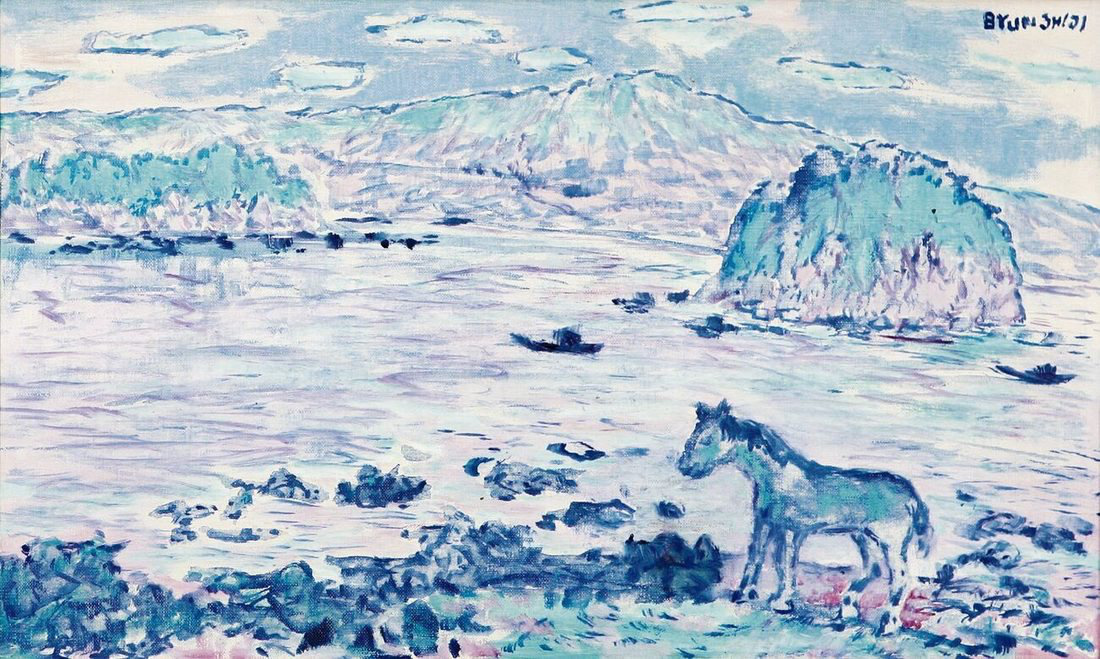
His Jeju paintings do not let us recognize things by their own colors. An apple is not painted red, nor a leaf green. Sky, sea, and land, house, bird, and person are all set within the same color. Things are told apart not by color but by dark shapes and black lines. In Solitude the hill is divided from the sky by a single black line, the tree stands as a black shape, and the person sitting beneath it is one black dot.
Color binds; line divides. That is the first key to reading this picture.
2 A Name
This color is often called hwangto, the color of yellow earth. Call it that, and soil comes to mind first. The meaning of the color leans toward the ground, toward place.
This archive calls it the color of dried grass. It is the color of grass standing in an autumn field. The grass was alive; it took the sun, it took the wind, and it dried. If yellow earth is the name of a material, the color of dried grass is the name of a color that has passed through time.
The painter himself looked back on the beginning of this color this way. After coming down to Jeju he had given up the brilliant colors he had used until then, and was troubled over what to do, when one day on the shore he saw something white turn, under the sun, past white into yellow. On an island where the sun is this strong, every color of its own changes. When someone suggested the color came from galot, the persimmon-dyed clothes of Jeju, he said no. If it were the color of galot, ten paintings would all be the same; but in his pictures the yellow tone differs a little each time he paints.
The color differs a little from painting to painting. There is a yellow close to white, and a yellow close to brown. All of it is the color of dried grass, and no two paintings are the same.
It is not the sunlight of one moment. It is sun that has returned and gathered over a long time.
3 Brightness
In Tropical Sun the sun is painted. At the upper left, black strokes reach out like rays from a small yellow disc. Yet the shadow this sun should cast is nowhere in the picture. There is no shade beneath the pine, none beneath the horse. The brightness does not enter from one side. It spreads across the whole broad field of dried-grass color. Darkness comes not from shadow but from black as a color. So the contrast of light and dark is strong, and yet no direction of light can be seen.
On that bright ground, black lines raise the pine, raise the horse, and enclose the house. The world that color has bound together, line divides one thing at a time.
The color of dried grass is not a dead color. It is the color of a life that has long endured.
At first you see the person under the tree. Look again, and you see the color the person is sitting in.
Text, planning and editing · Byun Joung Hoon