Reading / 1 / 5
Essay 1
The Road to His Own Painting
Through Japan and Seoul to Jeju
There was a hand that painted faces.There was an eye that counted roof tiles one by one.That hand and that eye came to Jeju.
The question How did a painter who worked in fine detail come to leave only a few lines?
1 The Face
Self-Portrait is from 1944. He painted it as a student at the Osaka School of Fine Arts, before he turned twenty. A dark jacket, a white collar. The face is almost straight on, and the eyes look out of the picture. The light comes from the upper left. The forehead and one cheek are bright; the other cheek lies in shadow. That brightness and that shadow shape the face into a round form.
Figure painting at an art school is training in seeing. Where the light comes from, where the bone rises: the eye is trained to carry these over exactly. His teacher in Tokyo, Terauchi Manjirō, did not teach in the studio. When a student brought a painting, he would only say what was wrong and where. The student went back, corrected it, and brought it again. This went on until the word came that it was good.
He said later: a figure allows no tricks. A landscape can be painted a little larger or smaller and such a landscape might still exist, but if a human body is off even slightly, the eye catches it. The sense that the body cannot be cheated settled into his hands at this time.
2 Roof Tiles
In 1957 he came to Seoul. For years he went every day to Biwon, the garden behind Changdeokgung Palace. He painted about three hours a day. He counted the roof tiles one by one as he set down his brush, and a single No. 10 canvas took a month. A single leaf carried five or six layers of paint.
Autumn at Aeryeonjeong is from those years. A pavilion by a pond. The roof tiles are painted one by one, and each slat of the railing stands on its own. The pavilion is reflected upside down in the water. Behind it, trees dense with yellow and red. Asked why he had painted mostly landscapes after his return, he answered briefly: that was because of Biwon.
In the same years, porters bent under their A-frame loads also appeared in his pictures. The eye that counted the palace tiles and the eye that watched a back on the road were in one person. Later the two eyes went to Jeju together.
3 Jeju
In 1975 he went to Jeju. He meant to stay eleven days. It became a semester, then a year, then thirty-eight years.
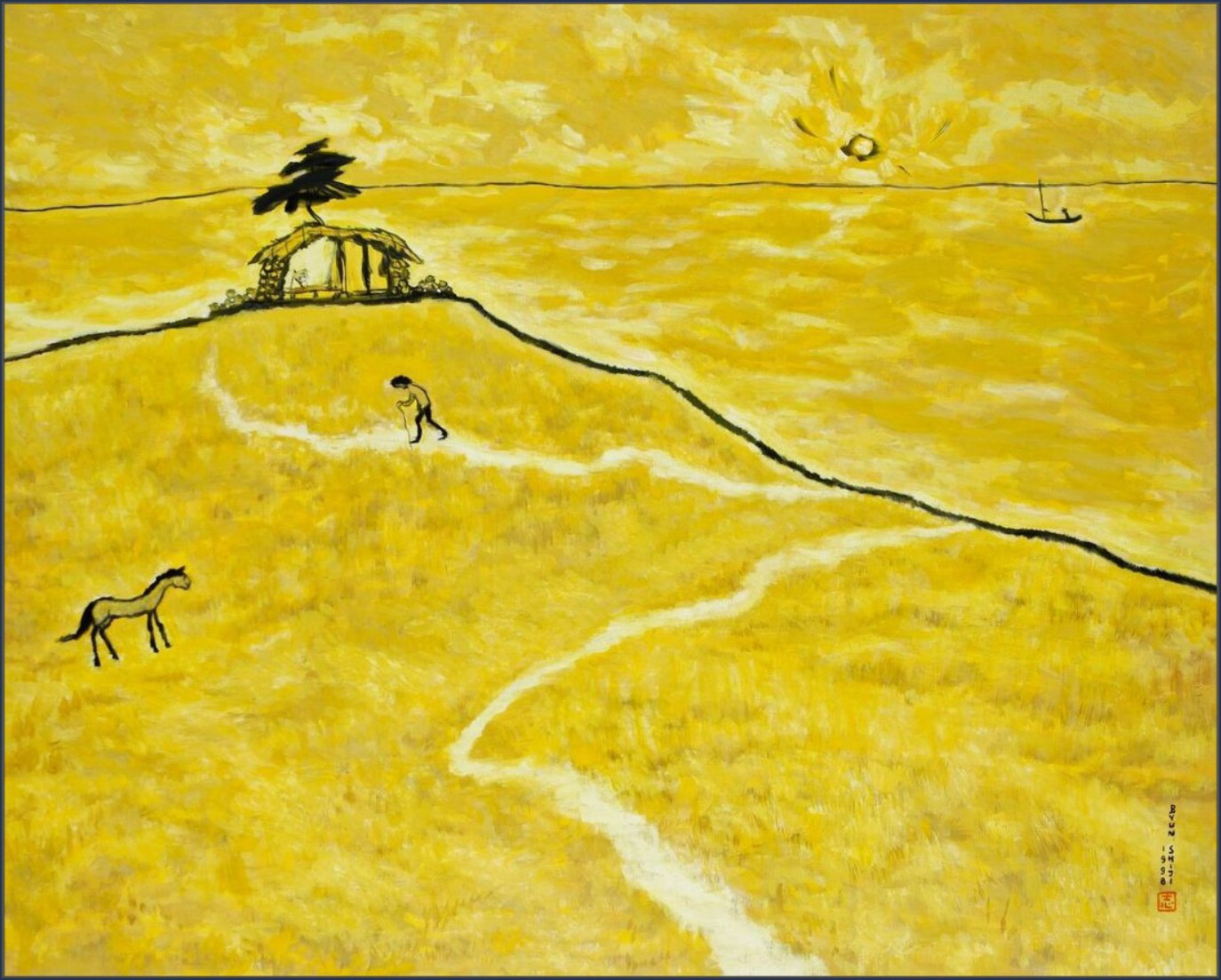
At first he painted Jeju the way he had painted Biwon. In Jeju, from the year after his return, the mountains are violet and the sky is tinged with pink. The sea is blue, and so is the horse. But living there, he came to feel it: this is Jeju only on the surface, not in substance. A Jeju subject did not make a Jeju painting.
He gave up all the graceful, brilliant colors of Biwon. In their place came the color of dried grass. But the eye that had counted roof tiles he kept. In Jeju too he watched a storm, went home, and painted it. Looking and looking again, holding it in the head: that way of working had settled into him at Biwon. The black he had wiped from his palette in Tokyo came back as well — not as shadow, but as the line that draws a person or a tree. One line along a bent back carries the weight of that body. The hand that learned the body in Tokyo draws that line.
In 1988, thirteen years after coming to Jeju, he wrote: Jeju has now become for me less an artistic space than an aesthetic ground and a method.
What he had learned was not thrown away. It became the weight of a single line. Behind Byun Shi-Ji's Jeju paintings was a hand that had looked long and painted long.
Text, planning and editing · Byun Joung Hoon