Reading / 4 / 5
Essay 4
The Space Left Open
Why a painting with little in it stays long
One boat is far away.Around it,nothing more was placed.
The question How does one small boat make the sea wide?
1 A Small Boat
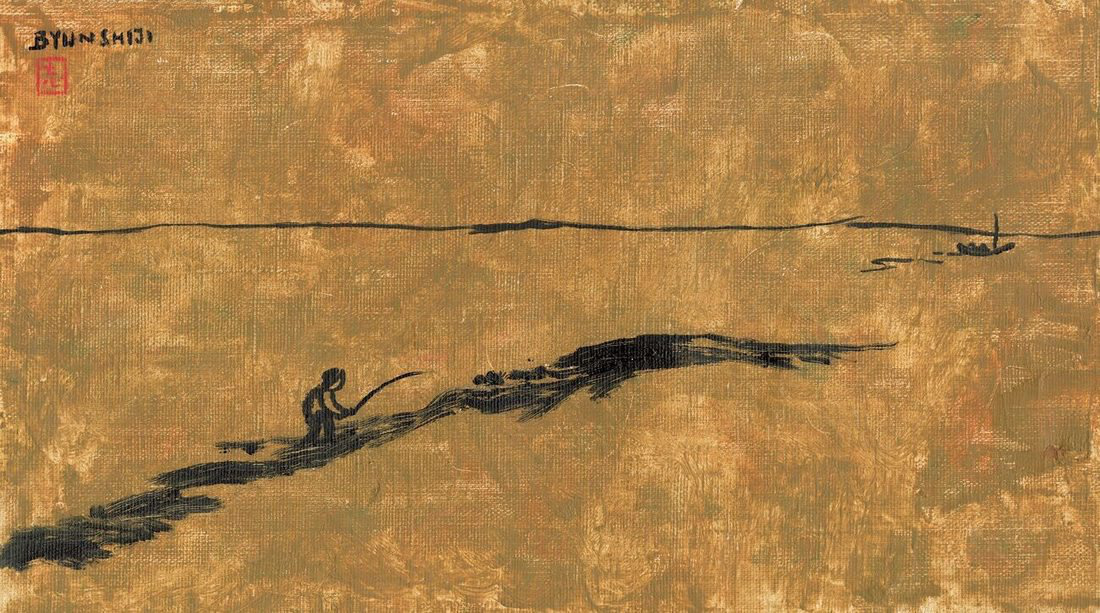
The Sea of Jeju is from 2011. Almost the whole surface is a pale yellow. At the lower right a black rock lies long, and at its tip a small person stands, extending a long fishing rod toward the sea. Far off at the upper left, one small boat. No horizon is drawn.
The person is the size of a fingernail. Even so, it is the first thing the eye finds. The emptier the surroundings, the sharper a small thing becomes. The boat is smaller still. The simplest principle — far things look small — is at work here. One small boat makes the sea far. Because there is only one boat, a wide sea is left around it. One boat is the mark by which the width of the sea is measured.
A Single Dot leaves even less. The surface is all bright yellow. About a fifth of the way down from the top, one thin black line runs across. It is not ruler-straight; it wavers a little, as a hand drew it. Just below that line is one boat, close to a dot. Apart from the boat there is nothing. The painter said: I want to express Jeju with a single dot. The moment the dot enters the eye, the yellow surface is read as sea.
2 An Empty Place That Has Color
To be empty does not mean that nothing is there. That place is a surface painted the color of dried grass. It is only that there is almost no form and almost no line. It differs from the blank of older painting, where the paper was left unpainted. His empty places have color: the color of sun and wind gathered over a long time.
The empty place does three things. It reveals: when the surroundings are empty, the small boat and the small person become sharper, not fainter. It leaves open: the eye follows where the fishing rod points, and that direction goes on beyond the empty place. It sets the scale: before a wide empty place, people, houses, and trees become small.
A sentence remains in the painter's notes: what is not painted holds up what is painted. The empty place is not where the painting ends. It is the place that lets the painted things be seen, be joined, and have their proper size.
Taking away is not poverty. It is a way of gathering the work into what remains. The less is left, the more each remaining thing does. One boat takes charge of distance, one color of binding, a few black lines of posture, a wide empty place of brightness.
3 Beside
In Ieodo (1980), an empty boat is drawn up on land, and beside it is a crow. Not in the boat. Not on it. Beside it. The boat is a small empty place enclosed by black lines, and the crow is a small place where black has gathered. One is empty; the other is filled with black.
If the crow were in the boat, the boat would no longer look empty. Beside it, the two do not hide each other. The empty boat is seen as empty, and the crow as a crow. Being beside leaves what is empty empty. It is a composition that does not fill, but leaves a place at the side.
His empty space is not empty. It is full of wind and silence.
Before reading, you saw the boat. Look again, and you see the sea around the boat.
Text, planning and editing · Byun Joung Hoon