Reading / 5 / 5
Essay 5
From Jeju to the World
Paintings begun on one island, reaching into different lives
Someone who does not know Jejucan still stop before a small boat.A heart that has waited for someonestays a little longer before it.
The question What do these paintings hand to someone who knows nothing of Jeju?
1 The Person Before the Painting
In 2007, two of his paintings were hung in the Korea Gallery of the Smithsonian National Museum of Natural History in Washington: Going On as It Is and Wild Dance. They stayed there for ten years and came home in 2017. Going On as It Is was introduced in English as 'Going the Way as It Is'. Acceptance and going on are both in that one title.
Most of the people who stood before them would not have known the word fūdo. Some would not have known where Jeju is. And yet the paintings were there before them without that word. A low hill with several pines. A white road. A person walking with a stick. A horse ahead. One boat on the far sea. The leaning line and the single color, the small person and the far boat can be seen by eyes that know nothing of Jeju.
Stopping before a small boat needs no explanation. A heart that has waited for someone is enough.
2 What Knowing Adds
To see is not necessarily to read the same meaning. Carole Neves of the Smithsonian Institution read the wind in the stone walls, the bent pines, and the waves of his paintings. That reading is possible without knowing much of life on Jeju. But the empty boat and the crow of Ieodo are a little different. Ieodo is the island where, it is said, those who went out to sea and did not return have gone; it was also the good place that people dreamed of. The painter said in his oral history: when a typhoon came, the fishing boats sank, and the men did not come back. Know this story, and the empty boat looks different.
He held that seeing a work is not completed by the passing on of knowledge alone, and that the viewer adds their own experience. And he also said this: the most local is the most universal. One does not reach the world by erasing the traces of a place. A concreteness that no other place can replace is, rather, the point of departure.
Someone who does not know Jeju sees waiting; someone who knows Jeju sees where that waiting came from. Both stand before the painting.
3 Whose Lively Day
A Lively Half-Day by the Sea is from 1979. And yet there is no one in it. On the left, one bare tree, with three crows on its branches. On the right the sun hangs low over the water, leaving light on the ripples, and beneath it is one small boat. There are no people, but the picture is not still.
The sea is the sea even with no one there. The liveliness of the title may not point only to a human mood. It may be a name for the movement of the world that goes on even where no one is. The ones having the lively day are the sea and the wind. At the center of the picture, the person steps back a pace.
He called his life exile, and the work of painting a blessing. Between the two lay the work itself. A long time lived out on one island became line and color and empty space, and that form stands before people who do not know the island. These are not paintings that move everyone in the same way. They are paintings where different lives can meet.
For those who want to read further, there is Fūdo Begets Form. Where Kiefer brought the German earth into his work and Goldsworthy the materials of a place, Byun Shi-Ji carried a body that had lived a place into line and color. That comparison is left to the book.
Text, planning and editing · Byun Joung Hoon
Also see
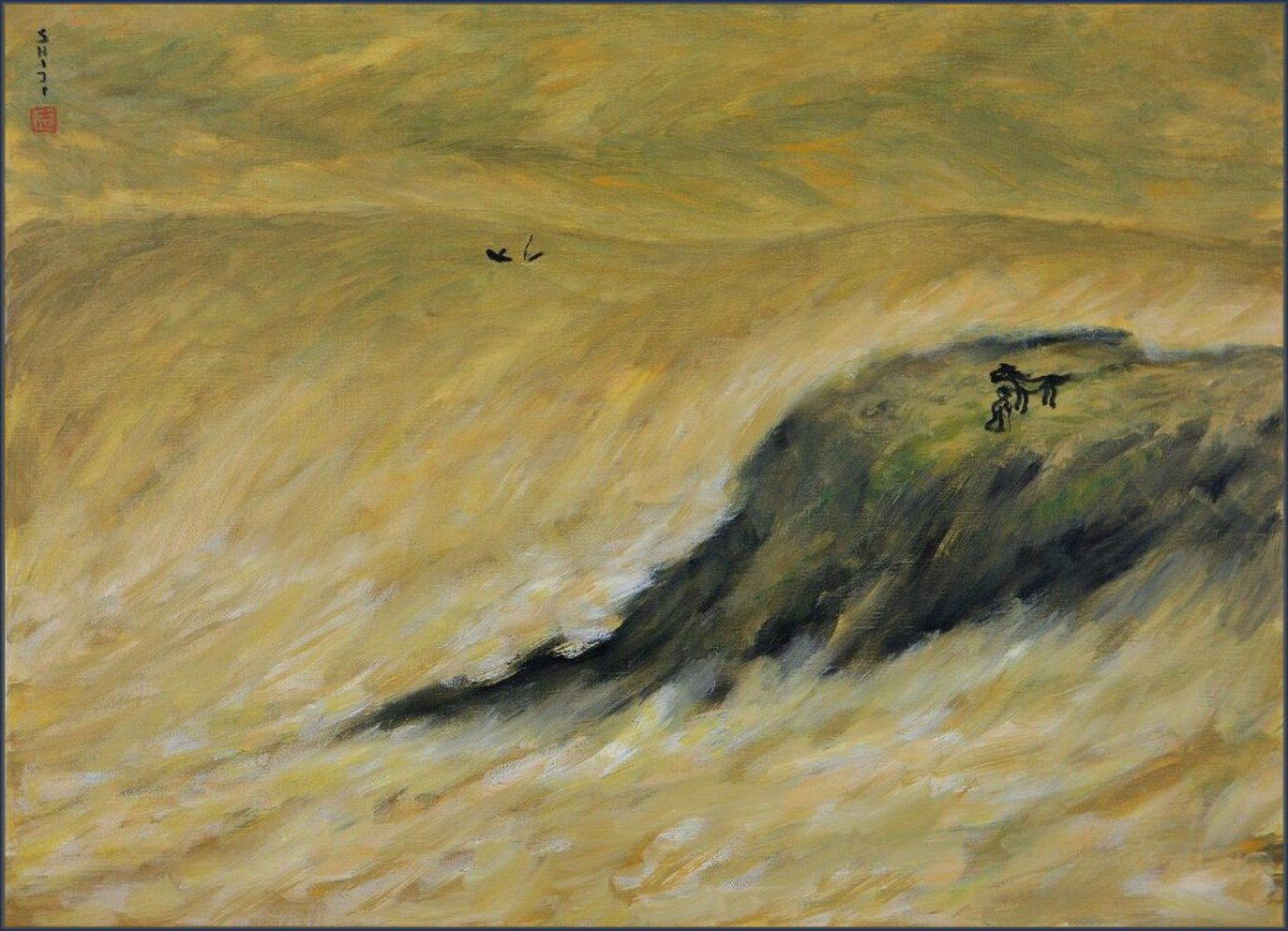 FŪDO 007 · 2005A Wavering HorizonAn old man and a single horse on a cliff, a far boat. A wavering horizon.See the work →
Story 25 of 50The Steps Still to WalkGoing On as It Is · 2006A story that begins with Going On as It IsRead the story →
FŪDO 007 · 2005A Wavering HorizonAn old man and a single horse on a cliff, a far boat. A wavering horizon.See the work →
Story 25 of 50The Steps Still to WalkGoing On as It Is · 2006A story that begins with Going On as It IsRead the story →
Read further Fūdo Begets Form — reading alongside sixteen painters →