Research/A Hundred Years of Wind/Ⅰ Nature & Fūdo
Ⅰ Nature & Fūdo · 8 / 100
The Phenomenology of the Sun
The Painted Sun and the Light of the Picture
태양의 현상학
A Sun with an Open Centre
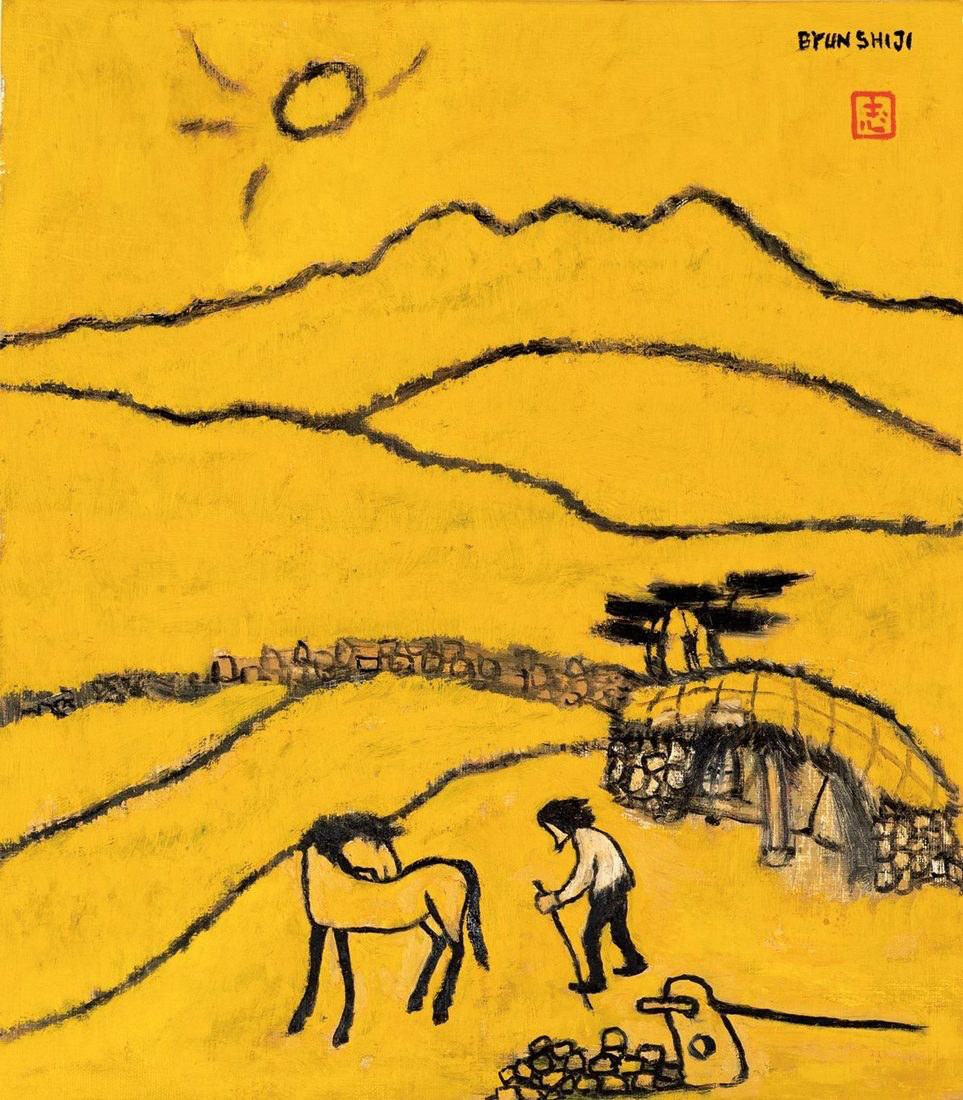
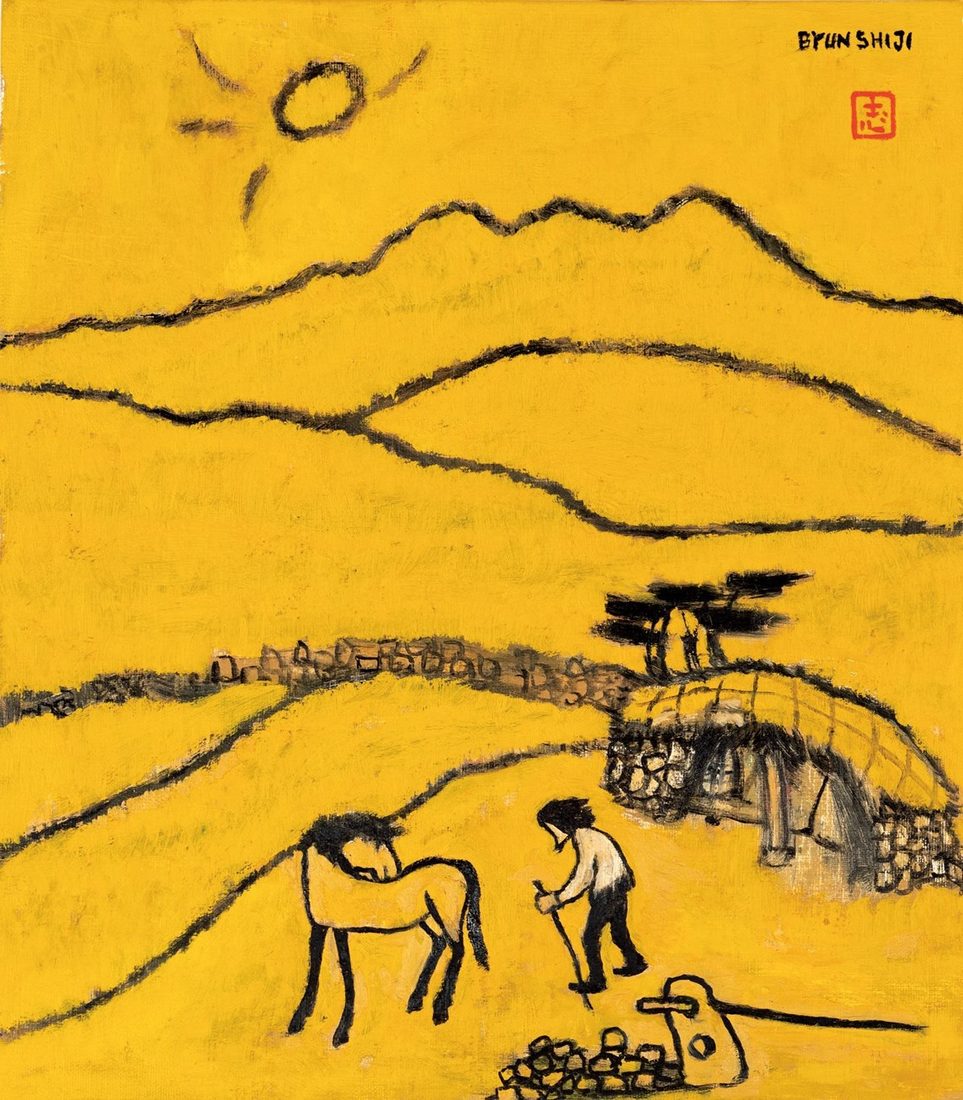
A round sun appears in the upper left of Hallasan (1987). Its dark outline encloses no separately painted patch of brilliance. A similar ground colour continues inside and outside the circle. Short marks around it help us read the form as a sun. Depicting a source of light does not necessarily require making that part of the picture its brightest point.
We first recognise a round form, then look again at the surrounding colour because of it. A ground without a sun and a sky containing one may feel different even when their colour is alike. The paint has not suddenly begun to emit light. A small mark has changed how the broad area around it is read. The sun is both an object within that area and a cue for interpreting it.
What is called a phenomenology of the sun here does not assign it an ultimate meaning. It asks where a round form is placed, what it contrasts with, and how these relations make it appear as a sun. It also asks how the light of the picture changes for us after that recognition. Before reading a predetermined symbol, we follow this brief process of seeing.
A Light Ground Beneath a Black Sun
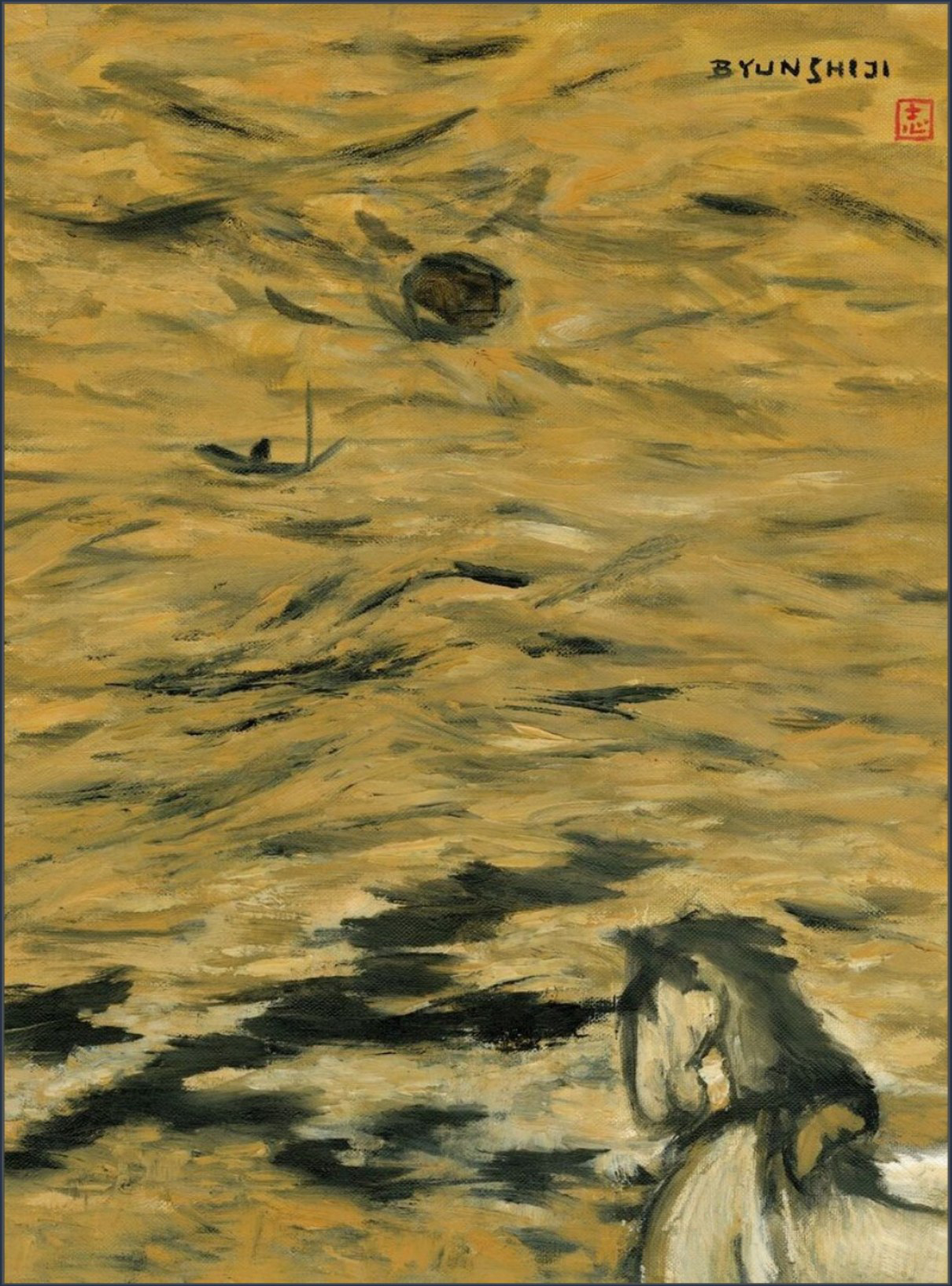
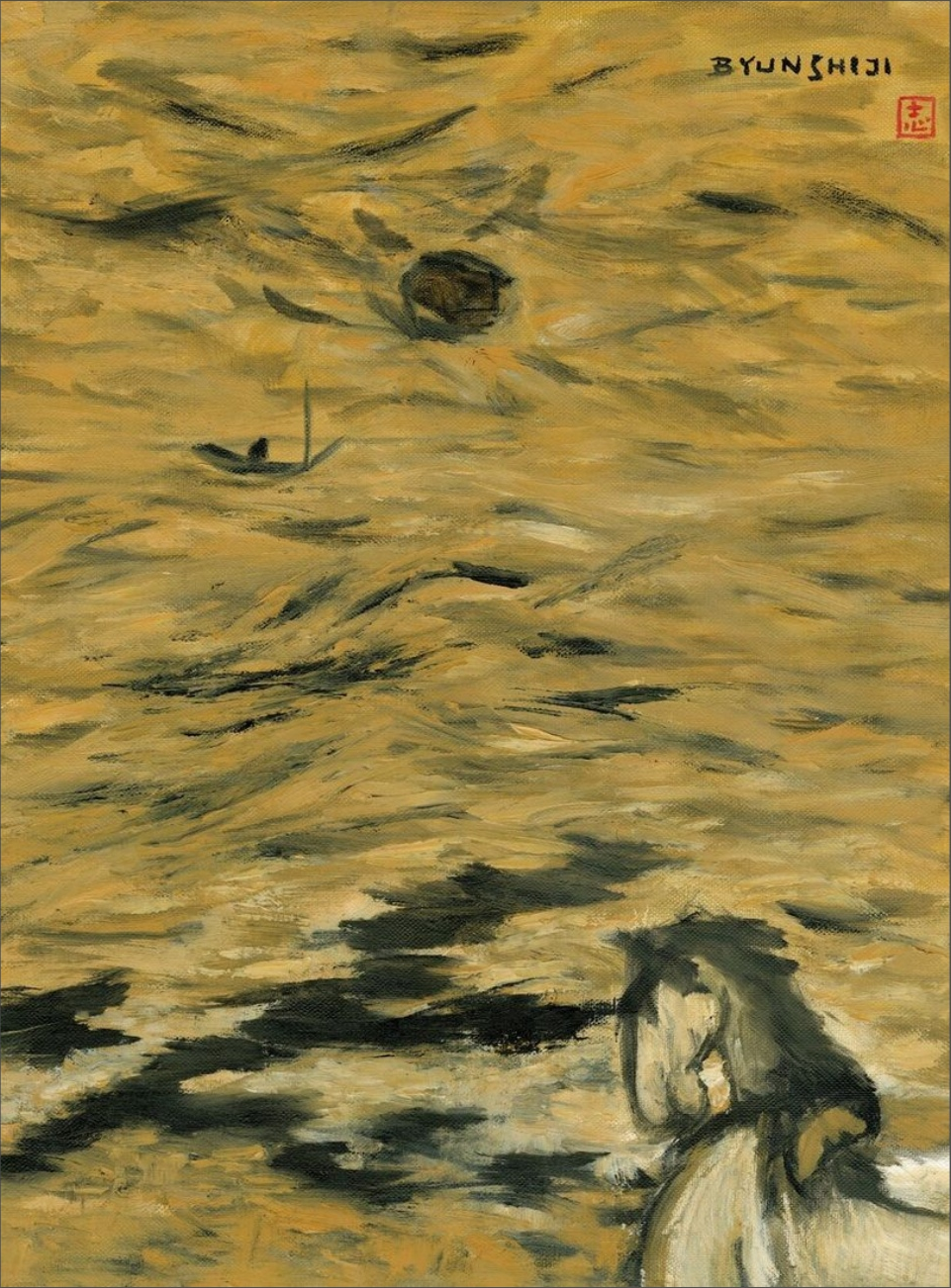
The Black Sun (1985) offers another starting point. A dark, rounded form occupies the upper portion, surrounded by overlapping strokes of lighter and muted colour. The ground remains light as we look down the picture. The form named as a sun by the title is dark, yet the whole painting has not turned black as night. The sun’s colour and the picture’s lightness are doing different things.
The dark circle makes the surrounding lightness noticeable, while the broad ground lends the circle weight. Neither explains the other in a single direction. Painting the sun black does not extinguish every light, just as a light ground does not remove unease. Light and dark arise here less through a single source of illumination than through the pull between areas and strokes.
A small boat also occupies this lighter field. Its destination is not established by the image alone, but its position is visible. It lies to the left beneath the dark sun, amid strokes extending well beyond its scale. Seen together, sun and boat keep the upper part from remaining a vacant background. It becomes an expanse occupied by a small presence.
To turn the black sun immediately into a record of death or an eclipse would bind the image too quickly to one event. The painting may permit such associations. But the possibility of an association differs from the depiction of a particular occurrence. What remains first is the tension of a dark sun within a light field. We need time to look without resolving it.
The Expanse Altered by a Small Form
The ring-like sun in Hallasan and the dark mass in The Black Sun are not identical signs. One leaves its centre open to the ground; the other establishes an area darker than its surroundings. How each circle is made matters more than their common roundness. A change in the treatment of edge and interior can alter the way the eye pauses.
Smallness does not in itself mean modesty or weakness. A small but dense form can hold the eye strongly within a broad area. A large form close in colour to its surroundings may emerge only gradually. The painted sun’s importance does not result from scaling down its size in the universe. It is a matter of contrast and placement within the picture.
Chapter 2 approached dried-grass colour as a ground connecting parts of a painting. Here we consider how one form placed upon that ground makes the whole legible anew. According to the position of a rounded mark, a similar field of colour may become sky, atmosphere, or a place in which light seems to linger. As colour supports form, form changes what colour means.
Between Midday and Evening
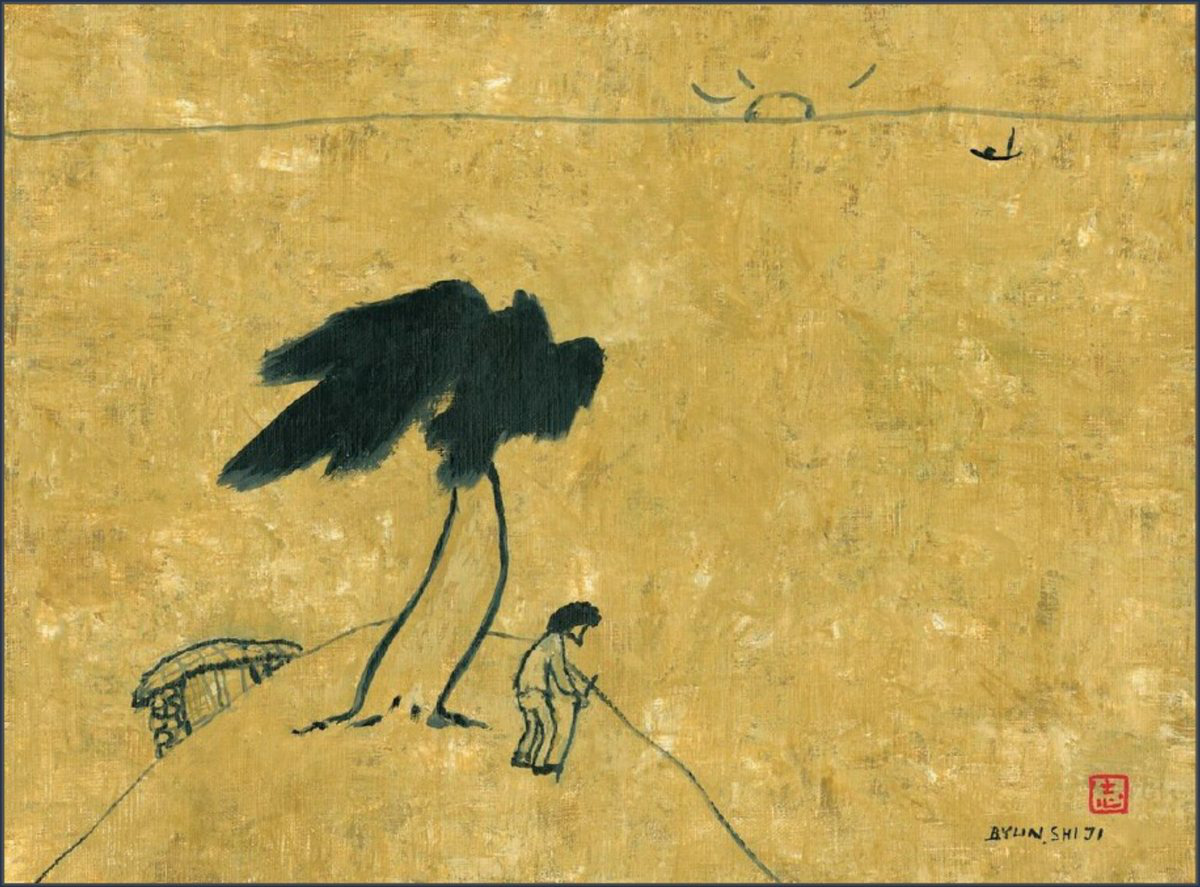
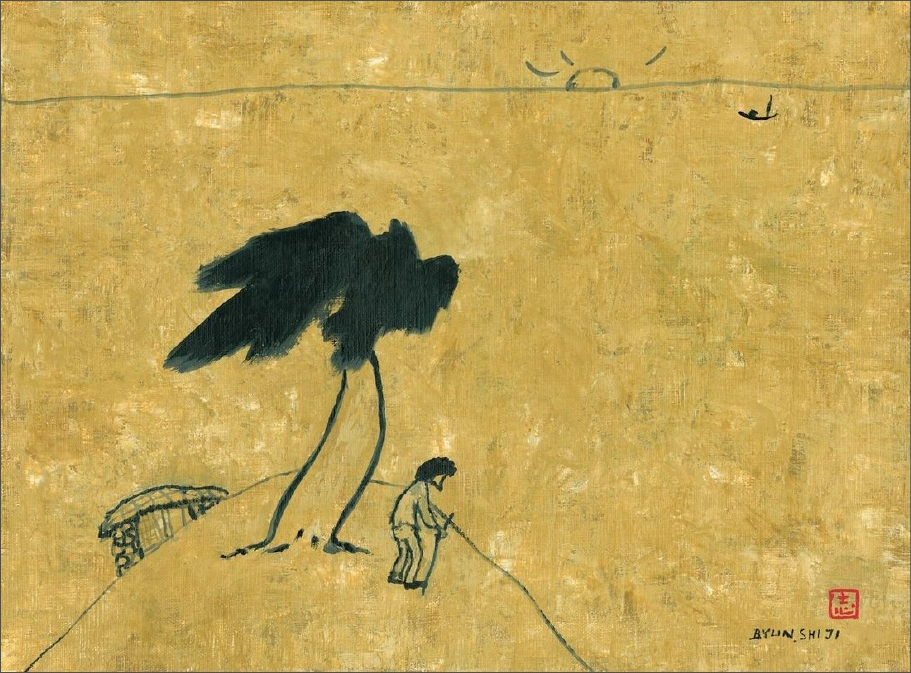
In The Old Pine and the Old Man (1987), a semicircle meets the horizon, with short marks above it. This arrangement suggests a sun rising or setting. One still image does not, however, establish which direction is taking place. The same semicircle can evoke both beginning and ending because the picture does not show the moments before and after.
This openness is less a deficiency than a time in which looking can linger. Moving between the old man’s body and the distant sun, we wonder where in the day we are. Because the painting does not specify the hour, the sun is not read like a numeral on a clock. What remains first is the relation of a nearby body to a distant sun.
The thought that the sun will rise again can suggest life’s continuation. Whether that thought necessarily consoles the figure is another matter. Another day may be an opportunity, but it may also mean labour continuing. Looking without giving Byun’s sun the single name of hope reveals a distance between the coming of light and the body that must live through it.
Meaning Does Not Precede the Form
Reading the sun as a source of life, or finding recurrence in a circular form, is possible. It does not require the assumption that every culture and every viewer gives it the same meaning. The first questions concern this sun’s position and appearance. A similar round shape creates different tensions among sharp lines and within a broad area where it stands alone.
It is also difficult to sustain a distinction in which a blurred sun is experienced while a clear sun is merely observed. Observation and experience do not operate separately, and a sharp contour can give form to a long memory. The eye following the edge of a dark ring undergoes an experience too. Depth of interpretation depends less on blur than on sustained attention to form.
An impression that the picture glows should not therefore become an explanation that light literally comes from inside its objects. Used critically, the term inner luminosity would first describe a quality of brightness felt in the painting. It would not establish the paint’s physical properties or the artist’s religious outlook. We can respect an impression while distinguishing what it does and does not demonstrate.
Looking Again at the Dark Circle
Returning to The Black Sun, the dark circle can look a little different. It may seem first like an opening interrupting the light ground, then like a point gathering the restless strokes around it. The form itself has not moved. Its weight changes as it is read together with its surroundings.
The sun need not bear every meaning of the world by itself. Boat and person, horse and the broad ground share that work. Within these relations, the dark sun lasts longer than a simple omen, and the open ring becomes more complex than an assurance of optimism. Returning the sun from a dictionary of symbols to the picture restores the particularity of its light and dark.
The eye moves down from the dark circle. A small boat rests among the lighter strokes. The field around it cannot be taken in all at once.