Research/A Hundred Years of Wind/Ⅰ Nature & Fūdo
Ⅰ Nature & Fūdo · 9 / 100
The Character of the Pine
Kindred Forms, Different Lives
소나무의 인격
The Directions of Tree and Person
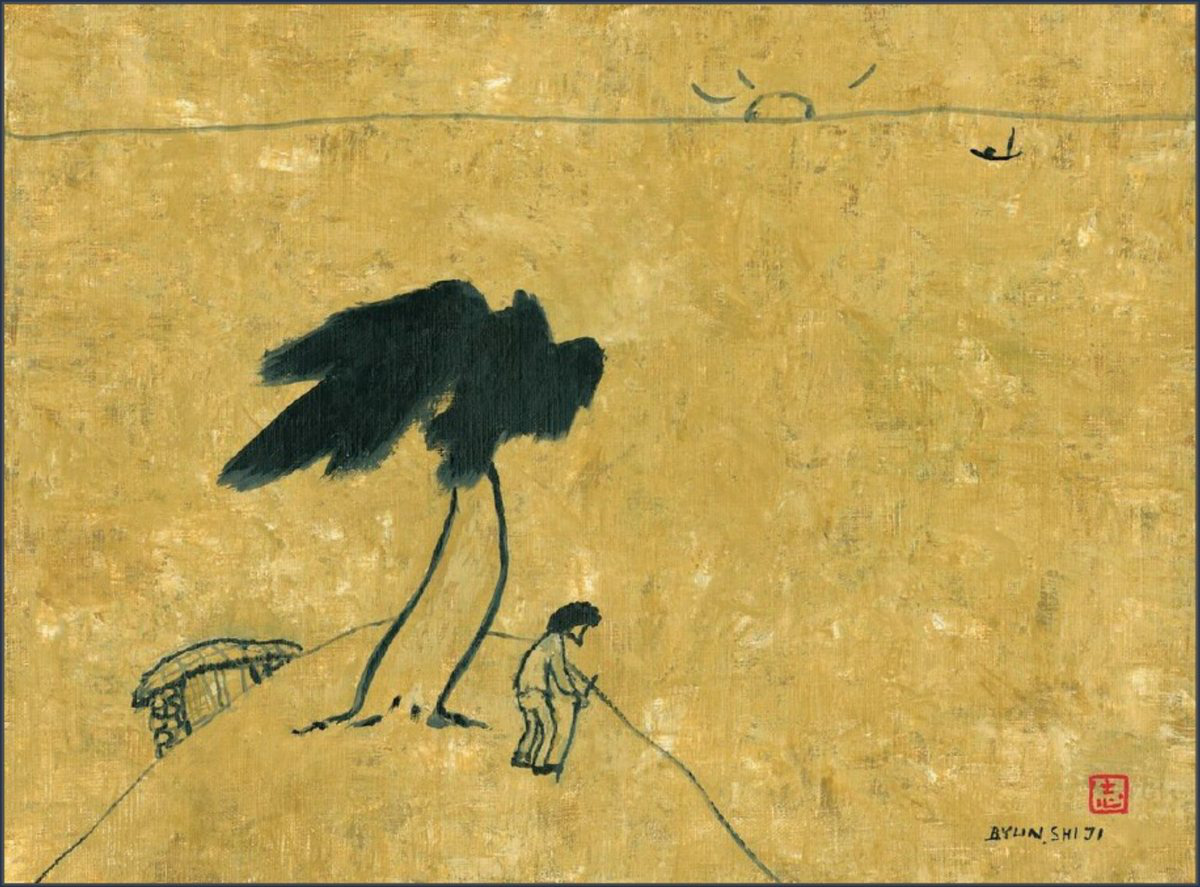
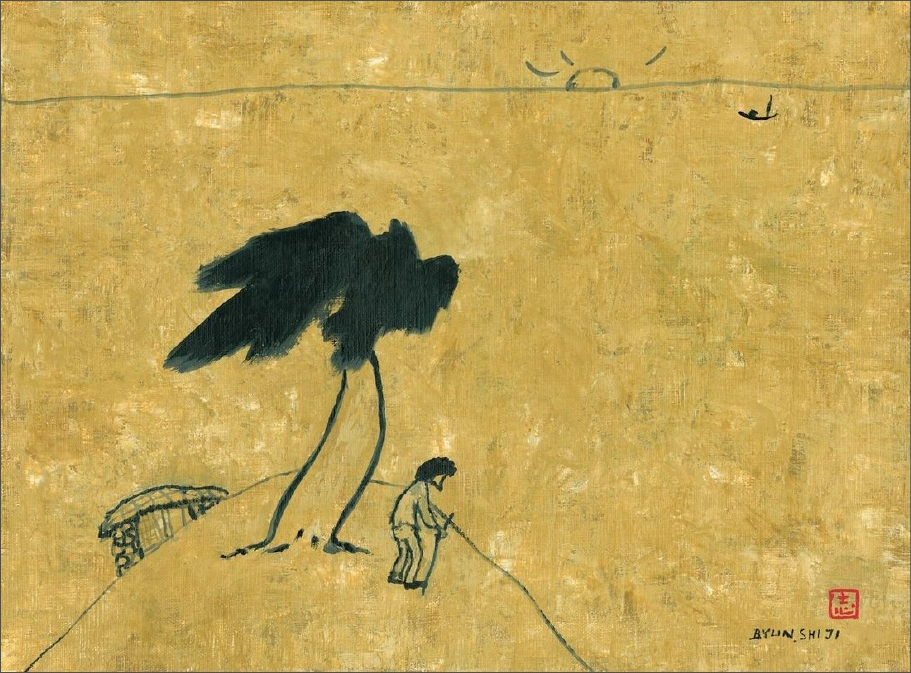
The Old Pine and the Old Man (1987) brings together a large dark crown and a human body drawn in fine lines. The mass of foliage and branches extends to the left, while the trunk curves beneath it. To the right, the old man lowers his body. Seen together, the two invite a sense of kinship, yet their forms do not lean in precisely the same way. A dark mass and a delicate contour occupy the setting with different weights.
Looking first at the tree makes the person seem small. Looking first at the person can make the trunk feel bodily. Neither is fixed as the sole protagonist. As the eye moves between them, difference of scale and resemblance of posture appear in turn. To speak of the pine’s character here is not to declare that a tree literally possesses a human personality.
Instead, the expression turns a question towards the viewer. What kind of line makes another life feel akin to our own body? After sensing that likeness, can we still distinguish the beings before us? Reading the pine as a figure for a person is not the end of the encounter. It begins an examination of what the comparison reveals and what it conceals.
An Eye for What Has Been Weathered
A curved trunk and an uneven crown bring time to mind. We imagine a course of growth different from that of a straight young branch. Yet this form alone cannot tell us how many storms the tree has encountered or how many centuries it has lived. The painting does not supply a complete record of growth. Sensing age differs from counting its years.
In The Old Pine and the Old Man, the sense of time does not arise merely from a profusion of surface wrinkles. The two curved contours supporting the broad dark crown, the small nearby body and the open field around them work together. The tree is not exhaustively described, but neither is it lightly passed over. A simple form holds attention for a long time.
Calling this the beauty of weathering requires care not to make pain a condition of beauty. A judgement that a wounded life is necessarily deeper can pass too readily from the painting to actual people. What deserves sustained attention here is less a quantity of suffering than the form that remains. The point is to look without diminishing a being’s value because it is marked or bent.
A tree may turn our thoughts towards endurance. This does not mean a fallen tree has been less diligent. When the image of a bent trunk surviving is not made a measure of human success or failure, the painting’s possible compassion broadens. We can attend to what endures without abandoning what has been unable to endure.
The Memory of Winter
An old sentence may come to mind before a pine. In the Zi Han book of the Analects, the coming of cold reveals that pine and cypress are slower to wither. What matters is a difference disclosed through the season. There is no need to turn this into a declaration that pines remain unharmed in every condition. Withering later and never falling are not the same claim.
A reading alongside Kim Jeong-hui’s Sehando (1844) also needs more than a comparison of trunk angles. The National Museum of Korea explains the work as an expression of gratitude to Yi Sang-jeok, who maintained his support during Kim’s exile on Jeju. The meaning of winter here includes not only one person’s fortitude, but the actions of another who did not break the relationship.
This context opens another way of seeing Byun’s tree and person. The two paintings need not be separated by assigning scholarly integrity to a straight tree and popular resilience to a bent one. We can instead ask what remains beside someone in difficult conditions. Such a comparison is a dialogue that extends interpretation, not proof of direct inheritance between the works.
Resemblance Does Not Mean Identity
Returning to Byun’s painting, the dark crown does not duplicate the old man. The trunk rises in two long contours; shorter bent lines gather in the human body. The two forms share a broad ground but retain distinct scales and directions. Their kinship arises not after the differences have been removed, but while those differences remain visible.
The gaze approaching the old man stays low beside the trunk, while the gaze following the crown reaches left. The open area between them belongs exclusively to neither. To say that tree and person inhabit a shared fūdo means less that one substitutes for the other than that different bodies share the conditions of a space. Being together is not the same as becoming one.
Retaining the difference gives the tree some freedom from its role as an instrument for explaining human feeling. It is not worth looking at only because it resembles a person. Its own form—the curve of the trunk and the spread of branches—remains. We can be reminded of human life while still trying to see a tree as a tree. The pine’s character becomes a more careful expression within this double attention.
The Reach of a Self-Portrait Reading
The old pine may prompt thoughts of the painter’s life. One reader may think of return, another of a body that has worked for a long time. But closing the interpretation with the statement that the pine is Byun narrows the relation between tree and old man to one person’s story. A self-portrait reading can open a door; it should not leave us with only that door.
The same applies to turning the figure’s posture immediately into the artist’s psychology. The picture does not record what this person lost on a particular day. It shows instead a lowered body, a large crown, a distant boat and sun. When we do not assume we already know the figure’s story, we can attend longer to the place in which that figure stands.
Nor is open space simply a blank inviting us to invent any story we please. It is also a place where something remains unknown. We can feel the smallness of the old man’s body without knowing the whole of his mind, and stay with the tree’s form without knowing its exact age. Acknowledging what we do not know need not weaken feeling. It can sometimes bring another being closer.
A Form That Remains Beside Another
The tree in The Old Pine and the Old Man does not seem to remove every solitude from the figure. The broad ground still surrounds them. Yet this is not a picture containing a person alone. The gaze has a place to pause at both tree and human figure. The possibility of moving from one, after looking for a while, to the other establishes their relation of being beside.
When the pine’s character is not reduced to one unyielding spirit, the painting can accommodate more kinds of body: one that has stood for a long time, one that bends for a moment, one that needs support. It does not command them all to endure in the same way. It offers time in which different postures can be seen together without any being discarded.
The dark crown reaches to the left. The old man bends to its right. The eye moves slowly across the light area left between them.