Research/A Hundred Years of Wind/Ⅰ Nature & Fūdo
Ⅰ Nature & Fūdo · 10 / 100
The Boundary Called the Horizon
The World Beyond the Edge of Sight
수평선이라는 경계
A Fine Line Across the Picture
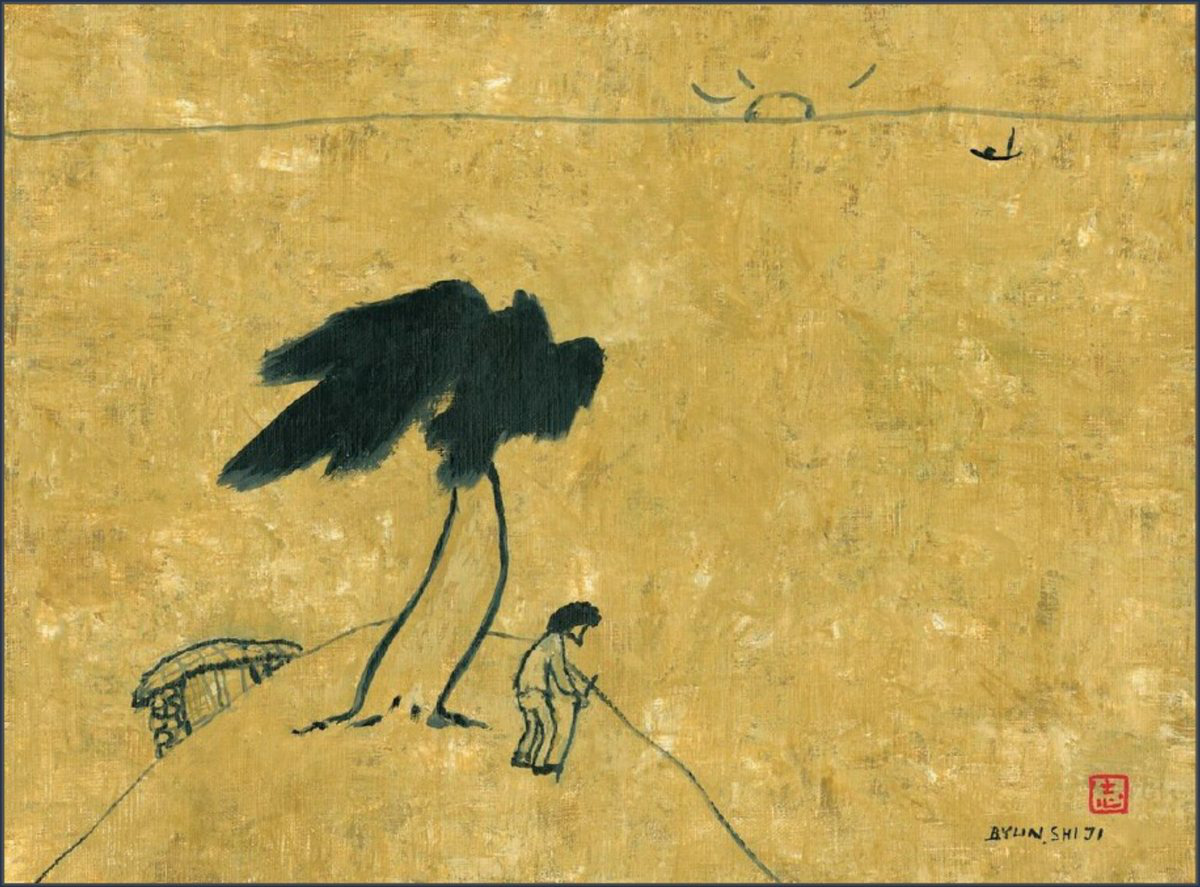
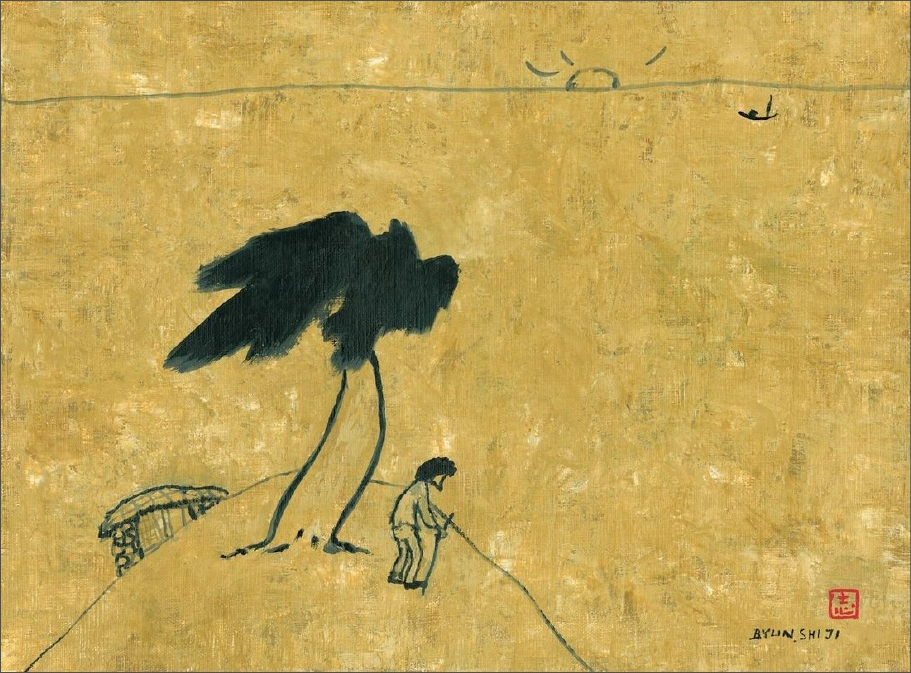
In The Old Pine and the Old Man (1987), a fine horizon runs near the top of the picture. A partly visible sun meets the line, and a small boat lies below it to the right. The eye moves from the foreground tree and person towards this distance. The broad area around the nearer forms then becomes legible as an expanse of sea. One line renews our sense of the scale and placement of other parts.
Above and below the horizon are not separated into entirely different colours. Even as a related ground colour continues, the fine line and the boat’s placement distinguish areas of space. Distance is therefore not produced by colour contrast alone. The scale and height of forms, and the extent left between them, work together.
Looking at the line, we do not think the world itself ends there. We sense instead that this is how far the present view extends. The limit belongs to a situation of seeing rather than to the world’s termination. This distinction allows the horizon both to close a view and to draw the gaze beyond it.
A Boundary Unlike a Wall
The United States Naval Observatory describes the visible horizon as the apparent boundary where sky and ground meet. A boat travelling across the sea is not approaching a dark line physically laid upon the water. A changed position brings a changed view. This does not make the horizon nothing. It belongs to the fact that we cannot see the world all at once.
The wall in Chapter 6 was a structure made by moving and placing stones. The horizon is not made in the same way. Crossing a wall involves an actual height and material; crossing a horizon means passing beyond the extent of a present view. Considering both reveals how different experiences can inhabit the single word boundary.
In a painting, however, the horizon also becomes an actual mark of paint. The line before us remains on the canvas while indicating the limit of a distant view. A mark available to close inspection produces a boundary that seems far away. The horizon’s pictorial force lies in the overlap of these two distances: the hand’s nearby trace and the distant sea followed by the eye.
Around What Is Visible
In phenomenology, horizon does not mean only a line at the sea’s apparent edge. Christian Beyer’s account of Husserl’s concept explains how seeing an object also involves anticipating appearances available from other positions. The currently visible side is not the whole object, yet through it we see one object. Possibilities not yet presented surround the present experience.
This concept is not identical to a painted sea horizon, but it offers a route for comparison. We do not suppose that the sea ends where a boat or a view is no longer depicted at the picture’s edge. Through the visible part, we sense an extent beyond it. Without filling every place, the painter can create conditions in which the picture is experienced as wider than its frame.
That extent is not a vacancy into which any story can be inserted. Sensing that something remains unseen differs from claiming that a particular person waits there. Longing prompted by a painting can belong to its experience without becoming evidence of the figure’s actual history. The horizon keeps a place open for the unknown without explaining it on its behalf.
An Indistinct Line Need Not Be Peaceful
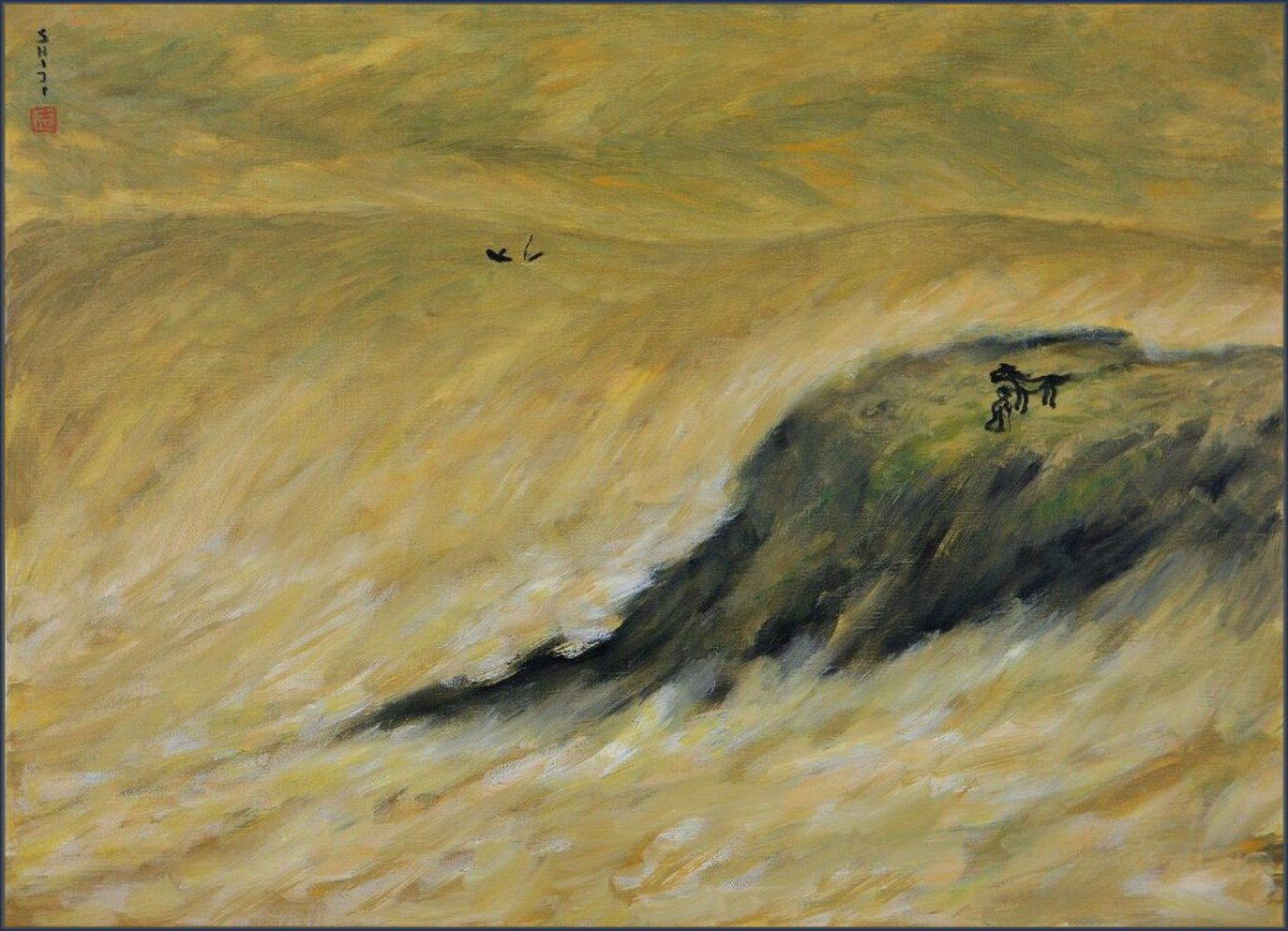
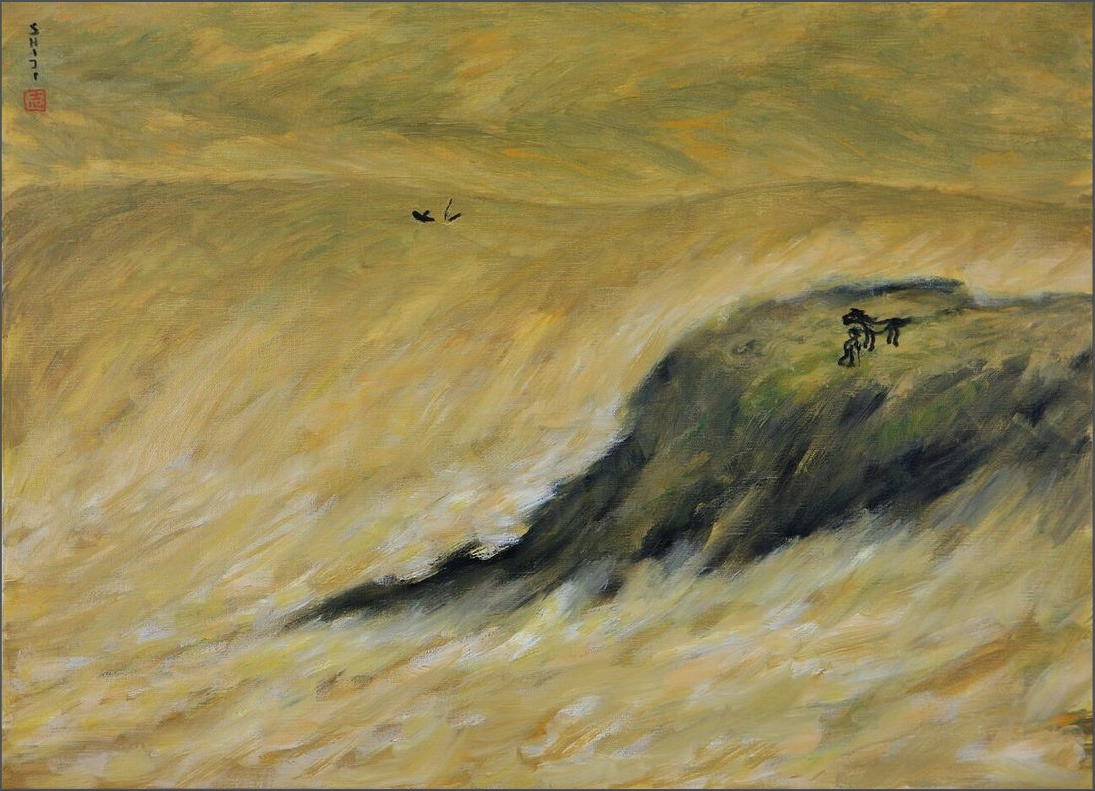
In A Wavering Horizon (2005), it is difficult to follow a single clear line. Light and dark strokes overlap diagonally, while a large rocky formation on the right descends into the lower picture. The distant boundary above belongs to this movement too. Rather than locating a division between sky and water at once, we follow unstable areas of paint.
This indistinctness does not necessarily signify peaceful union. The apparent speed and direction of the strokes make the picture less stable. As the boundary weakens, a sense of movement can intensify. A formula equating a clear horizon with conflict and an absent one with reconciliation has to pause before this work. The same omission can produce another experience when combined with different marks.
Small figures of a person and horse occupy the upper right. Against the larger areas around them, the place available to their bodies feels narrow. The far horizon is not the only cue by which the picture acquires direction. The rock’s edge and the positions of the small bodies help us gauge where footing might be possible. When one boundary becomes indistinct, other cues work together to establish space.
Placed beside the fine horizon of The Old Pine and the Old Man, this wavering boundary reveals two ways of seeing. In one, a line lets us locate the distance; in the other, we follow the movement of areas without readily securing that line. Their dates alone do not arrange them as steps from conflict towards serenity. Each painting makes something different happen before the eye.
The Position of the Viewer
We do not stand in exactly the old man’s position. We see both his body and the sea before it, while sensing the sea’s extent through that small body. Rather than simply lending us the figure’s eyes, the painting places a relation between person and world before us. We may approach that relation without possessing the whole of the person’s experience.
This distance is not a wall against feeling. It is an interval needed to look closely at another life without claiming complete knowledge of it. A person before a horizon can suggest waiting without necessarily waiting for someone who will never return. Staying with the act of looking allows rest and attention, distance and longing to enter together.
The sea may be an expanse to contemplate for the viewer and a condition to live within for the painted body. These are not quite the same position. Attending to their difference alters the response to a vast landscape. Alongside the impression of magnitude and beauty comes a way of looking that does not forget the small body within that space.
Looking Again from the Edge
What the horizon opens is not necessarily a better world beyond. It leaves room for the present view not to be everything. A painter can make that opening with a clear line or with a broken trace. What matters is less the quantity depicted than how far the eye travels and where it stays. In establishing a limit, a boundary also prepares the gaze’s next movement.
Moving our gaze from a stone wall to the horizon, we encounter another kind of boundary. A wall assembled by hand, a contour retaining a mountain, a circle recognised as a sun, a line distinguishing tree from person: these are not lines with a single meaning. Each differently establishes a distance between body and world. A painting of fūdo allows their differences to be seen together without covering them with one explanation.
Half a sun meets the fine line. Beneath it, the boat is small. The eye follows the line to the edge of the picture, then returns to the person by the water.