Research/A Hundred Years of Wind/Ⅰ Nature & Fūdo
Ⅰ Nature & Fūdo · 7 / 100
The Silence of Hallasan
The Line That Keeps the Mountain in View
한라산의 침묵
A Mountain That Is Not Faint
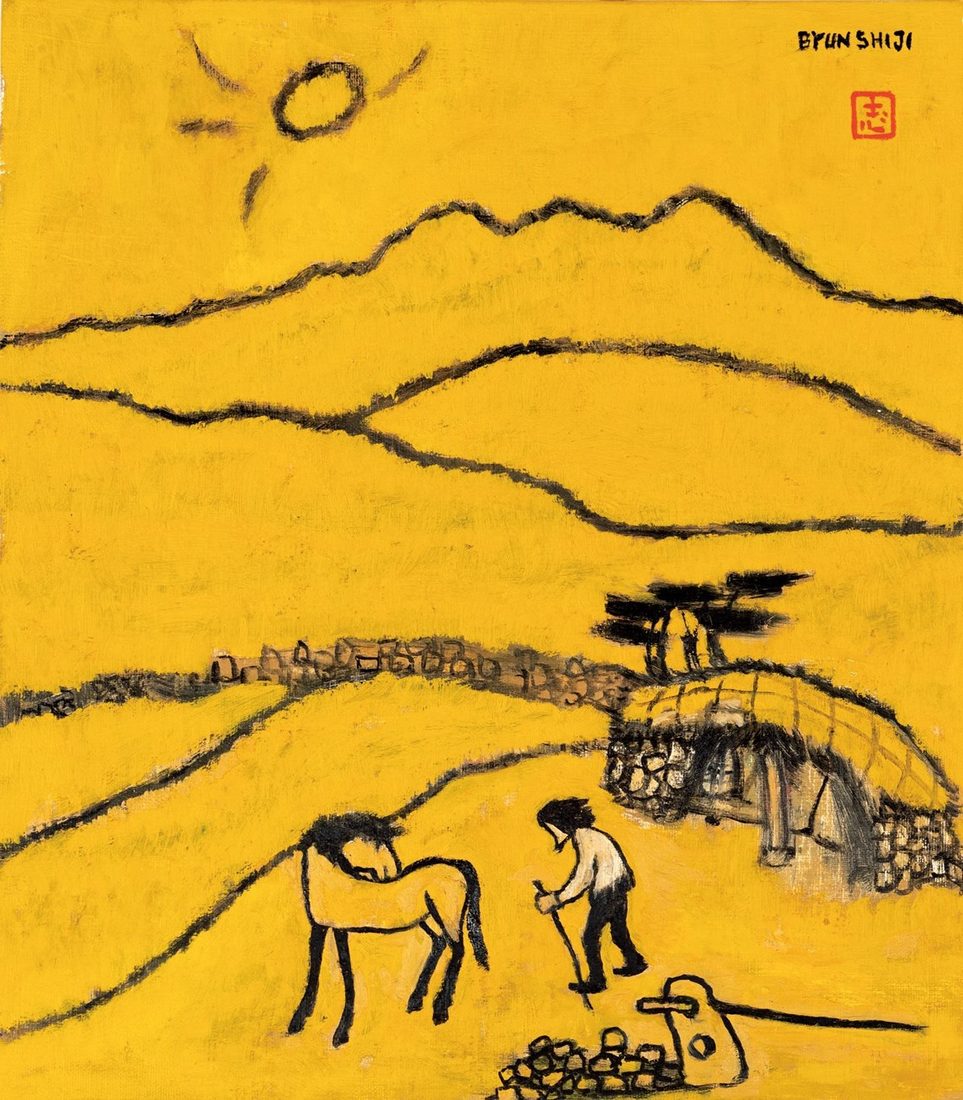
The mountain in Hallasan (1987) is not faint. A dark contour extends across the upper part of the painting, rising and falling to form a ridge. There is little detail of trees or rocks within it, yet its presence is unmistakable. To find silence here, we should look not for a vanished line but for a line that remains while detail recedes.
Below it lie the curves of hills, and lower still the wall, house, horse and person. The eye descends from the high contour to these smaller forms. Looking back up, we become aware of the mountain’s broad interior. Its scale does not depend on an accumulation of details. A sparsely divided area and a long line invite a duration of looking different from that demanded by the small forms below.
Silence therefore does not mean that the mountain does nothing. Its line holds the upper portion together and changes the distance at which the scene of everyday life below is encountered. A quiet presence need not have a minor role. Nor does that make the mountain an absolute ground supporting all human existence. It is enough to examine the work it performs in this particular painting.
Distance Has More Than One Direction
A comparison with distance in Chinese landscape painting requires care with its terms. In the three distances set out in the Linquan gaozhi, which transmits Guo Xi’s writings on painting, distance is not a single faraway view. High distance looks up from a mountain’s foot towards its summit; deep distance looks past the near mountain into what lies behind; level distance looks from near mountains towards distant ones. A mountain is not an instance of high distance merely because it is far away.
This distinction is not evidence that Byun followed that treatise. It instead sharpens the questions we put to his painting. Are we looking up at a mountain, looking through to what lies beyond it, or sending our gaze from low ground towards a distant ridge? A mountain’s position high on the canvas is not identical to the experience of looking upward from its base. Position within the picture should not be converted too quickly into the viewer’s posture.
In Hallasan, the lines of mountain and hill lie one above another, while the dwelling and bodies gather below. Yet this is not a space that can be measured at a glance as though it were a photograph. Looking at the nearby person and following the distant mountain take place together. Rather than fixing our feet at one point and measuring everything from there, we read the landscape by moving between different indications of distance.
Omission Is Not Disappearance
Guo Xi’s account also describes distant mountains without texture strokes, distant water without waves, and distant people without visible eyes: these things are not absent, but appear as though absent. We can read this as a recognition that fidelity does not require every part of a landscape to be filled in equally. What is omitted with distance concerns not simply the object but the manner of its appearance.
Returning to Hallasan with this distinction in mind, the mountain’s sparsely detailed interior is not an empty shell. Its broad area meets the stones and house below at a different density. What animates the picture is not a shortage of detail but its unequal distribution. Because the distance is less subdivided, the small divisions closer to us become more noticeable.
Removing the mountain would make this a different painting. That does not mean a painting without a mountain is impossible. This mountain works with the other elements of this picture. Instead of making silence a formula that every image requires, we should examine the balance established by particular lines and areas. The meaning of omission changes with what has been retained.
A Shared Colour, a Distance That Remains
A related ground colour runs through mountain and sky, hill and human body. Yet we do not see mountain and person as occupying the same position. Their placement, overlapping contours and differences in scale still suggest distance. To say that perspective has disappeared simply because the colour is continuous is to overlook other cues actively at work in the picture.
The tension here does not require us to choose between flatness and depth. Attending to the continuous field of colour brings the painted surface close; attending to the relation between house and mountain restores a sense of distance. We move between seeing a surface and seeing a landscape. The same painting allows both ways of looking.
The dried-grass colour can thus be read less as an eraser of distance than as a ground on which separated things remain in relation. The mountain is still far away and the person close. Yet a related hue continues inside and outside the lines distinguishing them. Distance remains without becoming an absolute severance. Fūdo can be approached where these two conditions coexist.
The Mountain’s Name and Its Form
The title provides part of the basis for calling the mountain in this work Hallasan. A mountain in another Jeju painting, however, should not automatically receive the same name. Recognisable terrain, pictorial transformation and the work’s record need to be considered together. A place-name can assist interpretation without replacing the image.
Knowing the name Hallasan leaves plenty to see. How often does the ridge turn? How far does one flank extend? How much open area remains beneath it? If recognition ends the encounter, landscape painting becomes an exercise in naming locations. Byun’s mountain refers to a real place while being remade through decisions about line and area.
Nor must these choices be explained immediately as the serenity of old age. Reduced detail in a work does not establish reconciliation within the painter’s mind. Silence can first be approached as a pictorial relation rather than a psychological diagnosis. The question is not only what has been painted less fully, but how that restraint changes the appearance of other parts.
How the Distant Changes the Near
After following Hallasan’s ridge, we return to the person below and may find the figure standing in a more extensive space. Its size has not changed. Distance has emerged around it during the eye’s journey to the mountain and back. The distant mountain does not erase the person. It renews our sense of the extent surrounding that small body.
Silence here is more restrained than a promise that voiceless nature will console us. The mountain does not resolve the person’s affairs, and the person does not occupy the whole mountain. Beings of different scales inhabit one picture as the eye passes between them. What remains is a sense of distance in which seeing something large need not mean forgetting something small.
The mountain’s line runs to the edge of the picture. The house below is low. The eye follows the distant ridge once more, then comes back down beside the person.