Research/A Hundred Years of Wind/Ⅰ Nature & Fūdo
Ⅰ Nature & Fūdo · 6 / 100
The Geometry of Stone Walls
A Place Made by Different Stones
돌담의 기하학
A Low Wall Beneath the Distant Mountain
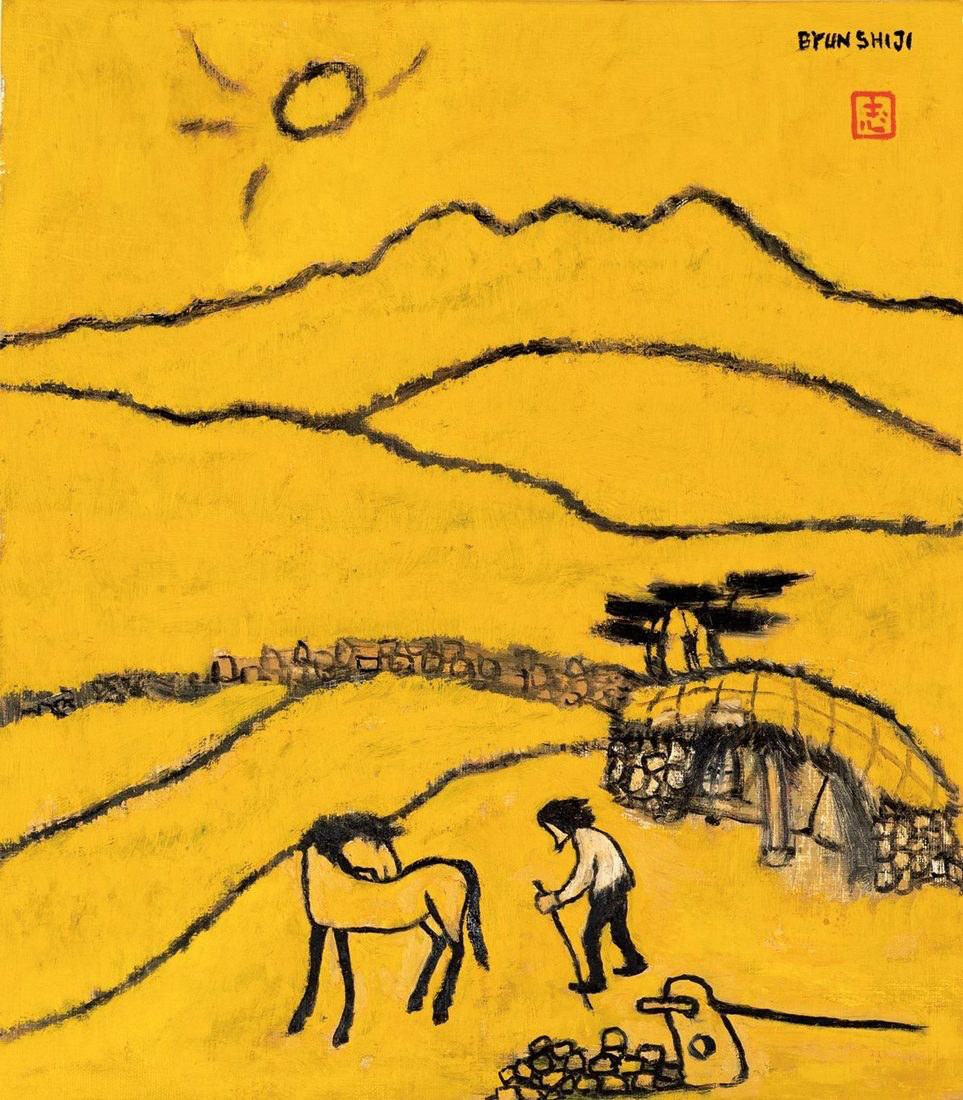
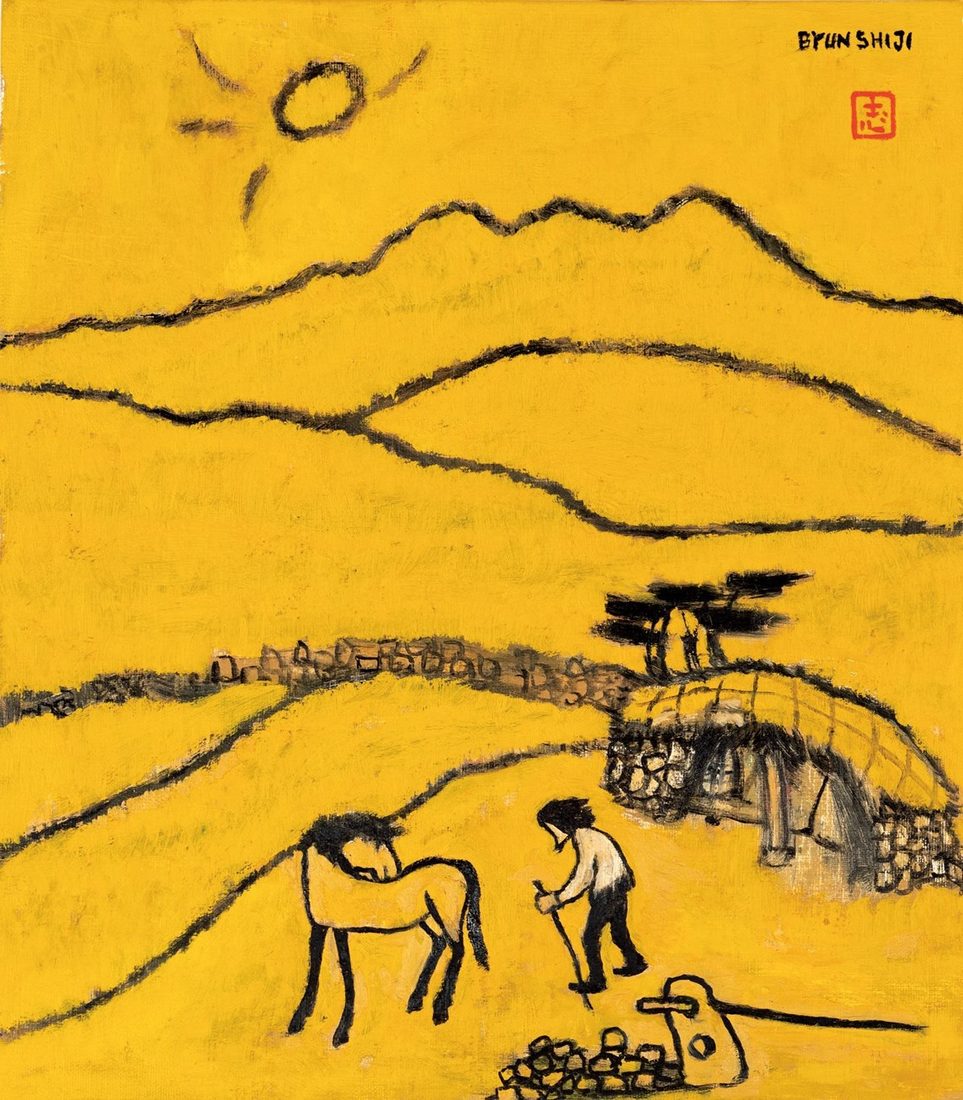
In Hallasan (1987), the eye first follows the mountain’s long contour. Lower down, a wall appears, its stones differing in size. It curves low across the picture from the left towards the thatched house. Between the large mountain and the small human figure, this modest structure marks out inhabited ground. While the mountain’s outline opens the distance, the wall gives everyday life a place in the foreground.
The small forms composing the wall are not aligned like bricks of uniform size. Dark edges and shaded patches follow one another, leaving areas of the lighter ground between them. Above, the mountain ridge extends in a long movement; below, the wall is articulated into shorter units. Two distinct rhythms inhabit one painting. Their difference slows the glance that had travelled along the mountain.
The geometry of the stone wall is not a search for regular figures. It asks how unlike shapes join to form a boundary. We attend to individual stones without losing the wall’s direction, and to the whole without overlooking the difference of a single stone. When these two ways of looking work together, the low wall becomes more than a minor detail: it helps organise the picture.
Gaps and Support
Jeju’s batdam are field walls made from stones cleared from agricultural land, serving both as boundaries and as windbreaks. The Food and Agriculture Organization describes their roles in sheltering crops, reducing soil erosion and restricting livestock movement. Batdam refers specifically to walls associated with fields, not to every kind of stone wall. Knowing these practical functions keeps the painted wall from becoming merely a vague sign of local identity.
Admiring the gaps alone is not enough. Openings through which air can pass coexist with places where stones support one another’s weight. Leaving as much space as possible is not the purpose. First, separate stones must find positions in which they form a standing wall. Passage and support are accommodated within the same structure.
There is therefore no need to declare dry-stone construction superior to every other kind of wall. Height, thickness and the placement of stones vary with use and conditions. The Jeju National Museum likewise emphasises the concrete purposes of field walls: protecting crops and keeping animals out. Endurance is not a result magically produced by a gap. It depends on attending to materials and place in making a boundary that is needed.
This practical structure offers a way into the painting. Leaving one area empty does not automatically open the whole picture. A remaining line helps give open space its extent. In the wall in Hallasan, the edges of small stones and the ground between them make one another visible. Joining differences and allowing differences to remain happen in the same place.
Making a Boundary
A wall obstructs passage, but it also makes routes legible. It indicates where to turn, where a house stands and how ground is divided. This does not mean that everything inside belongs to humanity while everything outside is pure nature. A field remains exposed to weather and soil, and a house receives the wind. The wall can be read less as a line separating nature from human life than as one adjusting the extent of life within it.
In Hallasan, the wall does not seal the house off from everything else. Among the long lines of mountain and hill, and the figures of horse and person, it leads the eye towards the dwelling. It has not only vertical height but a direction extending sideways. It is a standing structure and also a route the gaze can follow.
A low boundary does not invariably signify a harmonious community. Boundaries belong to the practical realities of using and dividing land. In the painting, however, those realities reappear through the disposition of lines. When divided ground and open space remain visible together, we sense a place that belongs to someone without constituting a world that is theirs alone. Dwelling cannot be explained solely by a mark of possession.
Differences Left by the Hand
Painting a wall is not a literal repetition of building one. An actual wall must bear weight; a painted wall stands through the arrangement of paint. The artist can make a wall recognisable without explaining the construction of every stone. Yet decisions are still needed about where to connect a mark and where to break it. Building and painting meet not in an identical result, but in this work of selection.
The wall in Hallasan has a texture unlike an even band. Small dividing marks turn in different directions. Dense dark areas and exposed ground are not distributed uniformly either. Following these differences, we do not take in the wall at once as a single emblem. Its length emerges through several pauses of the eye.
A rough line does not establish that the painter’s hand shook in the wind. The marks on the picture and the circumstances of their making are different kinds of evidence. We can nevertheless examine how breaks and variations in thickness alter the eye’s pace. The hand’s results can be read closely without inventing its biography. Those results contain differences that a smooth repetition would not supply.
Before Building Again
Rebuilding a wall does not celebrate its collapse. Watching for weaknesses, repairing loose sections and adding support where needed also belong to its duration. An exclusive interest in dramatic reconstruction overlooks the modest work that precedes failure. A structure that remains includes not only the moment of its making but the time spent tending it.
The image of Sisyphus’s stone may convey the burden of repetition. Yet tending a field wall is not equivalent to a punishment that always returns to its starting point. It serves the concrete purpose of protecting crops and everyday life. Before asking whether repetition gives life meaning, we should ask what the work preserves and for whom it matters. Philosophy need not begin by erasing a task’s practical purpose.
Repetition in painting cannot be judged simply by the diligence with which many pictures are made. What matters is what becomes visible when a subject is taken up again. A change in the wall’s length, the density of its marks or its distance from the house makes the same motif part of another pictorial situation. Repetition may confirm an answer already found; it may also reveal that the answer was not enough.
The Place of One Stone
There is no need to turn Byun’s wall into an image of a pure art built only from the stones of one’s native soil. That would risk erasing what the painter learned elsewhere. What matters is not only where a stone came from, but what it now supports and where it is placed. Reworking what has been received within a new set of relations is also a way of making a painting one’s own.
Seen this way, the wall’s geometry is concerned less with grand completion than with adjustment. Placing one stone changes how it meets its neighbour. A small alteration touches the direction of the whole. In a painting, too, the thickness of a line and the breadth of an opening are not independent. The low wall makes this interdependence visible at a scale close to the hand.
Beneath the distant mountain, the wall continues. Between the dark edges of its stones, a little of the light ground remains. The eye moves from one stone to the next.