Research/A Hundred Years of Wind/Ⅳ Technique & Medium
Ⅳ Technique & Medium · 52 / 100
The Ethics of Composition
What Kind of Place Is Given to Each Being
구도의 윤리학
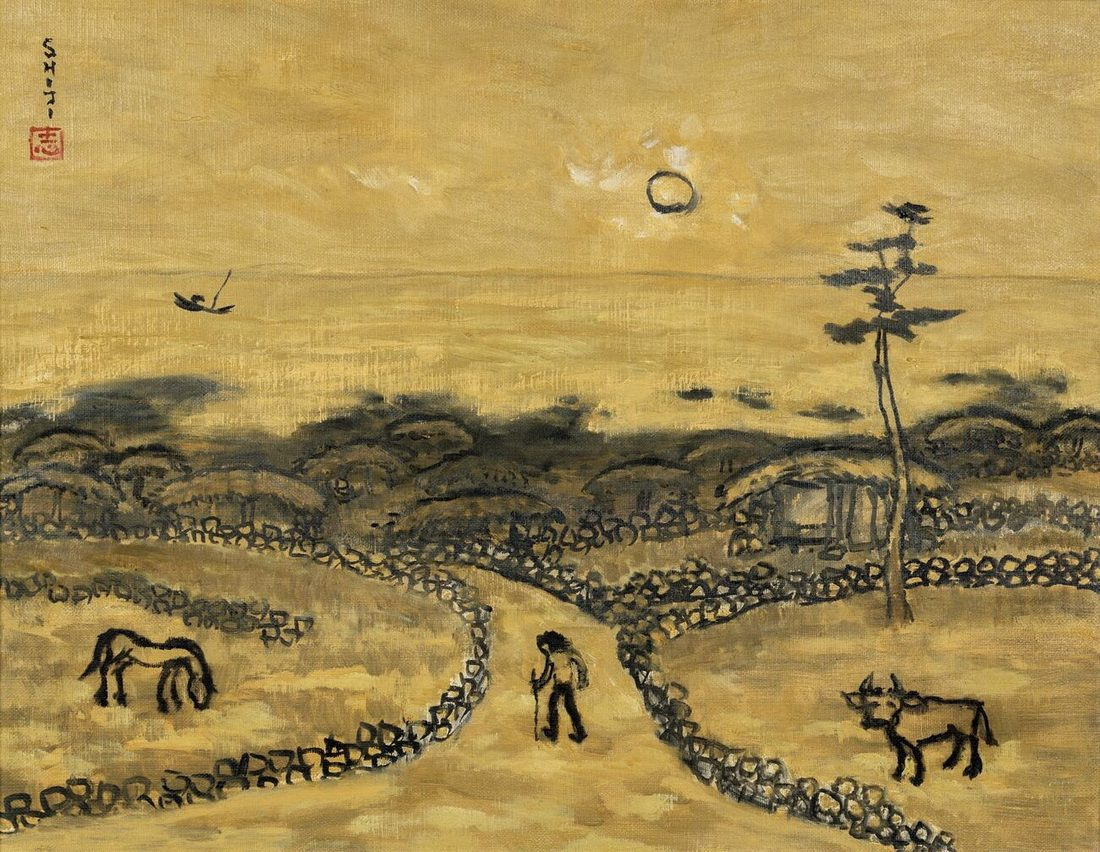
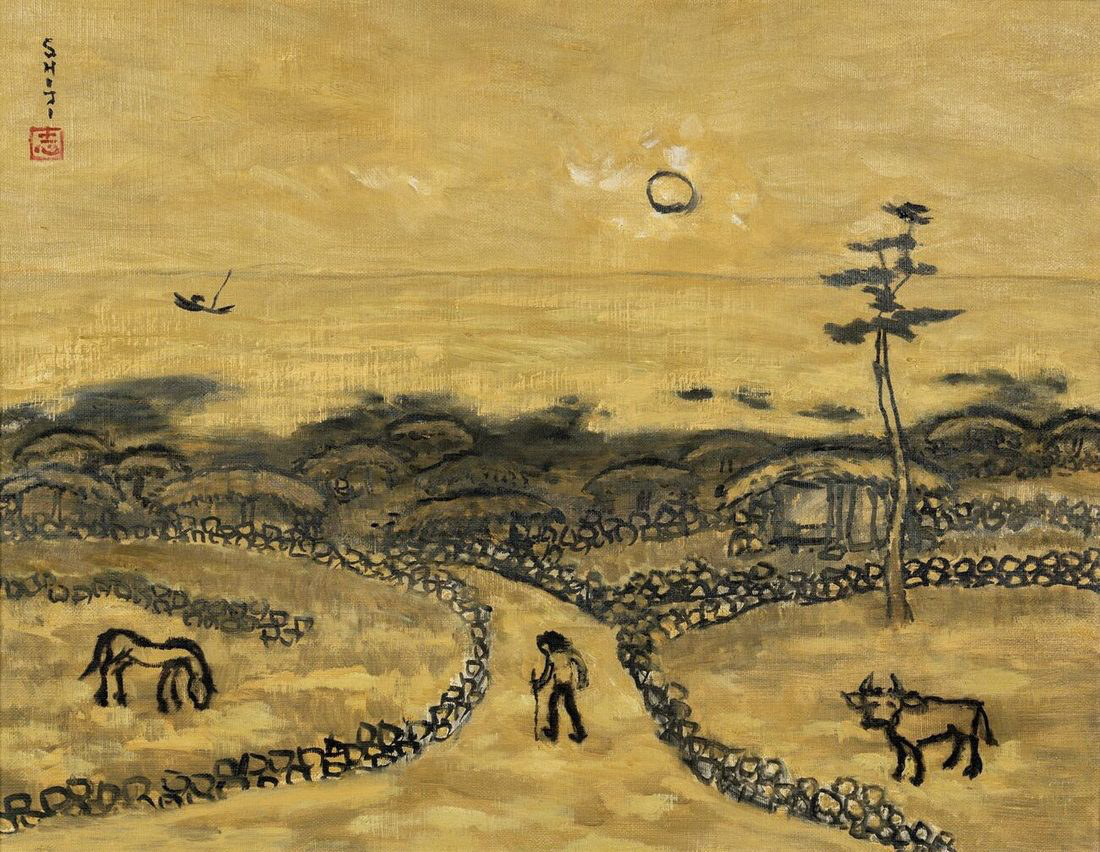
A Small Person at the Centre
In Seaside Village, a person stands in the middle of a path. A pony lowers its head on the left; a cow holds its head up on the right. Walls and houses continue behind them. Being central does not mean that the person dominates everything. The eye passes the small body and follows the paths and walls out to either side.
Composition here is more than a technique for arranging pleasing objects. It gives bodies distances from one another and distinguishes places of passage from places of staying. It also changes whom we notice first and where we look next. Reading a composition means considering how attention is distributed within the painting.
An ethical question can begin with this distribution. Does the small being merely enhance the large one? Is room left for another body? Yet a beautiful composition does not by itself establish a painter’s character or the justice of a whole society. The ethics considered here concerns the kinds of relationship the painting makes available to us.
Height Is Not Rank
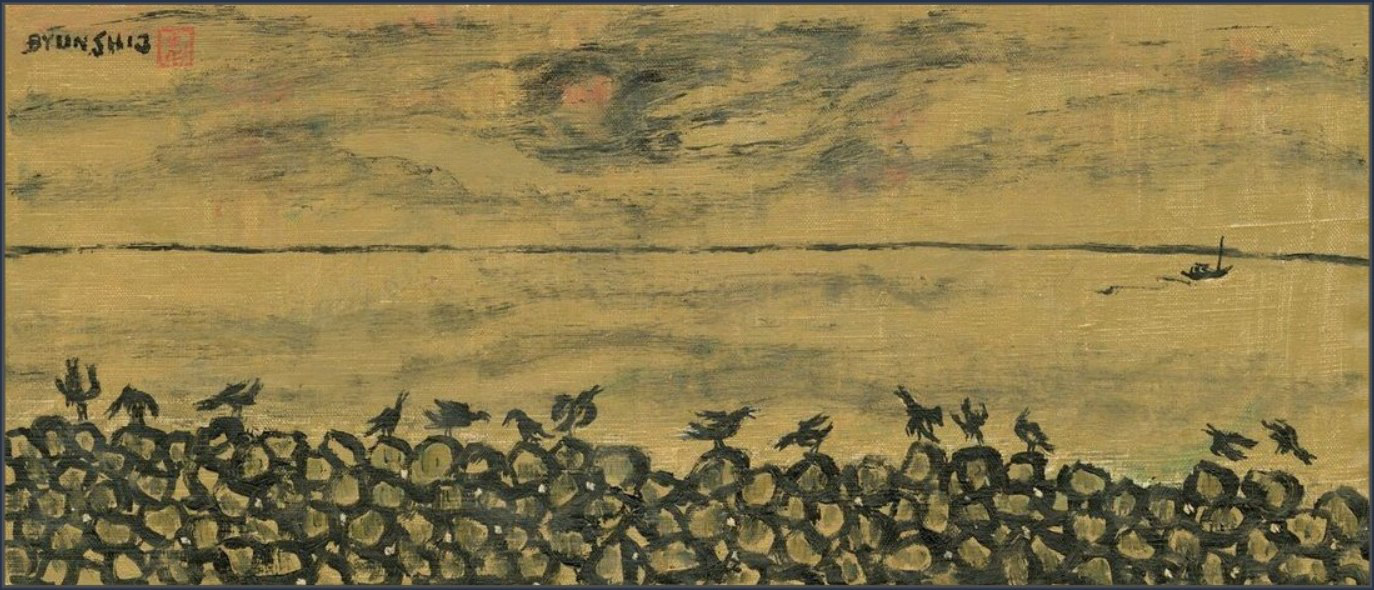
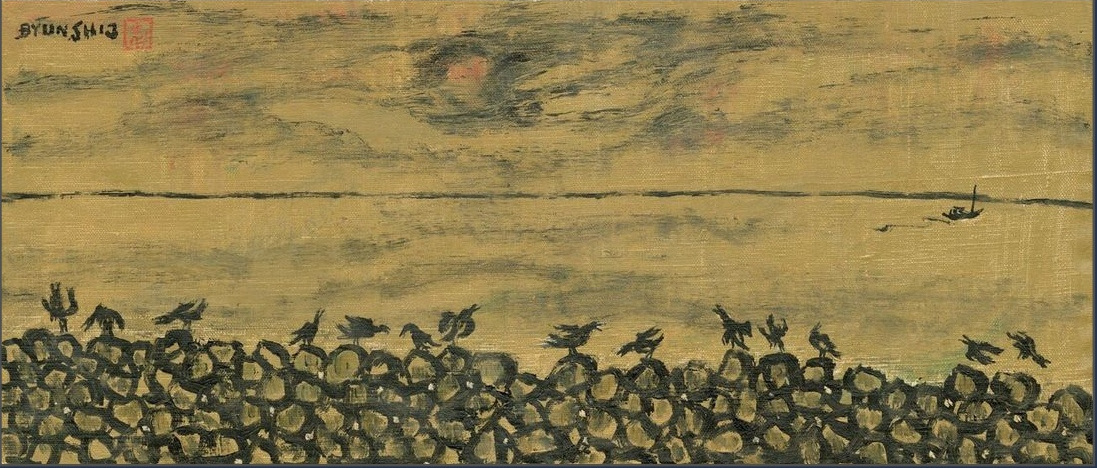
In Crows on a Stone Wall, the birds extend along a wall near the bottom of the painting. A broad expanse of sea and sky remains above. This work alone disproves the claim that crows always occupy the upper part of the canvas. A bird capable of flying high can be placed low. Bodily ability and pictorial position are not the same.
A form higher in the image may seem small because it is distant; one below may catch our attention because it is near. Height and scale create different relationships. Turning them immediately into a table of freedom and confinement, worth and worthlessness makes us miss the arrangement the painting actually presents.
Following one bird on the wall soon leads the eye to another. Between them is an unoccupied stone, then another small dark body. The birds are no less important for being placed low. A narrow band holds the pace at which we look across the broad painting.
The Different Work of Horizon and Wall
The horizon separates the sky from the distant sea. Stone walls divide the nearer land. These different kinds of line occupy the same painting in Seaside Village. That is why everything below the horizon cannot simply be called ground. A further distance lies between the water holding the small boat and the path on which the person stands.
The walls narrow the person’s route and distinguish the animals’ places. The distant horizon does not determine such details. Seen together, the lines bring the ordering of an inhabited place into relation with the expanse beyond. The person does not stand in unrestricted emptiness, but among divided plots and connected paths.
An ethics of composition also means not erasing these conditions. A broad space need not be land freely open to everyone. We first attend to the visible paths and walls, then ask what shape proximity and separation take within them. Before space is an empty area, it is a place of relationships.
Closeness and Separation
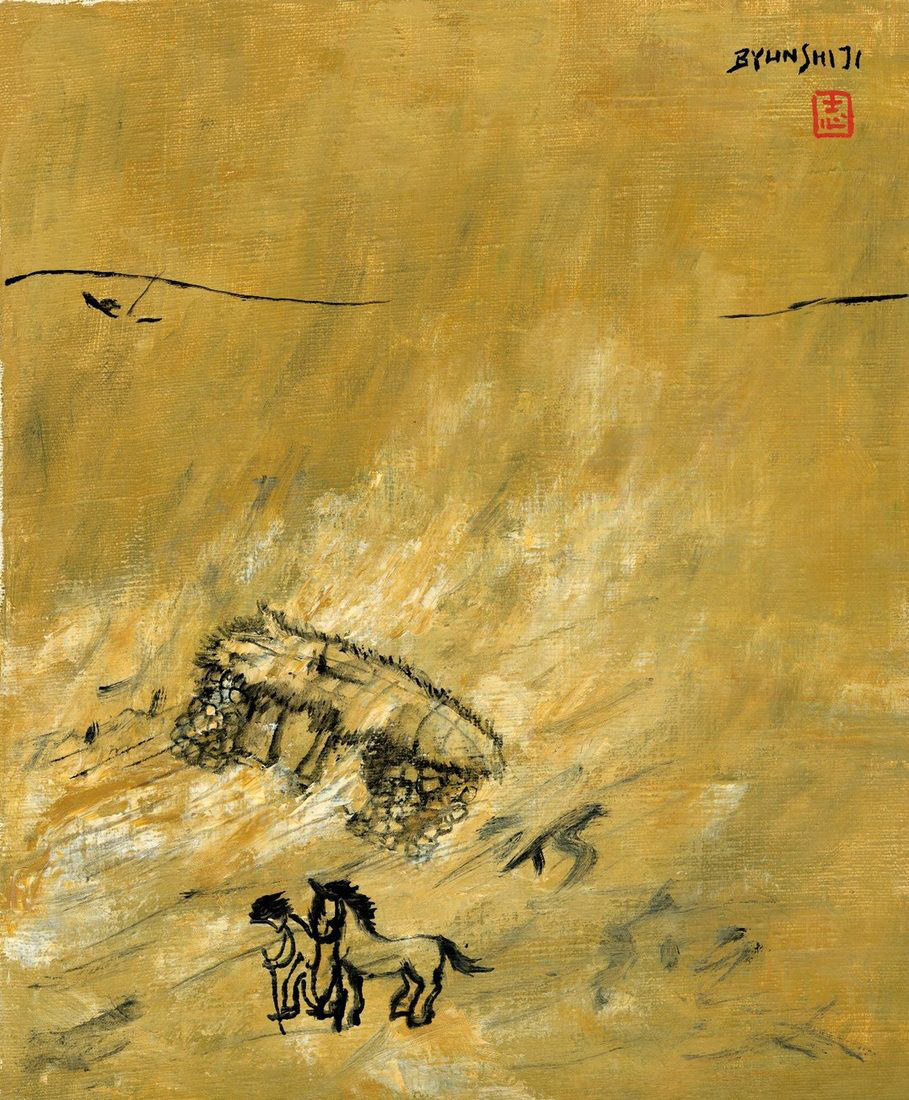
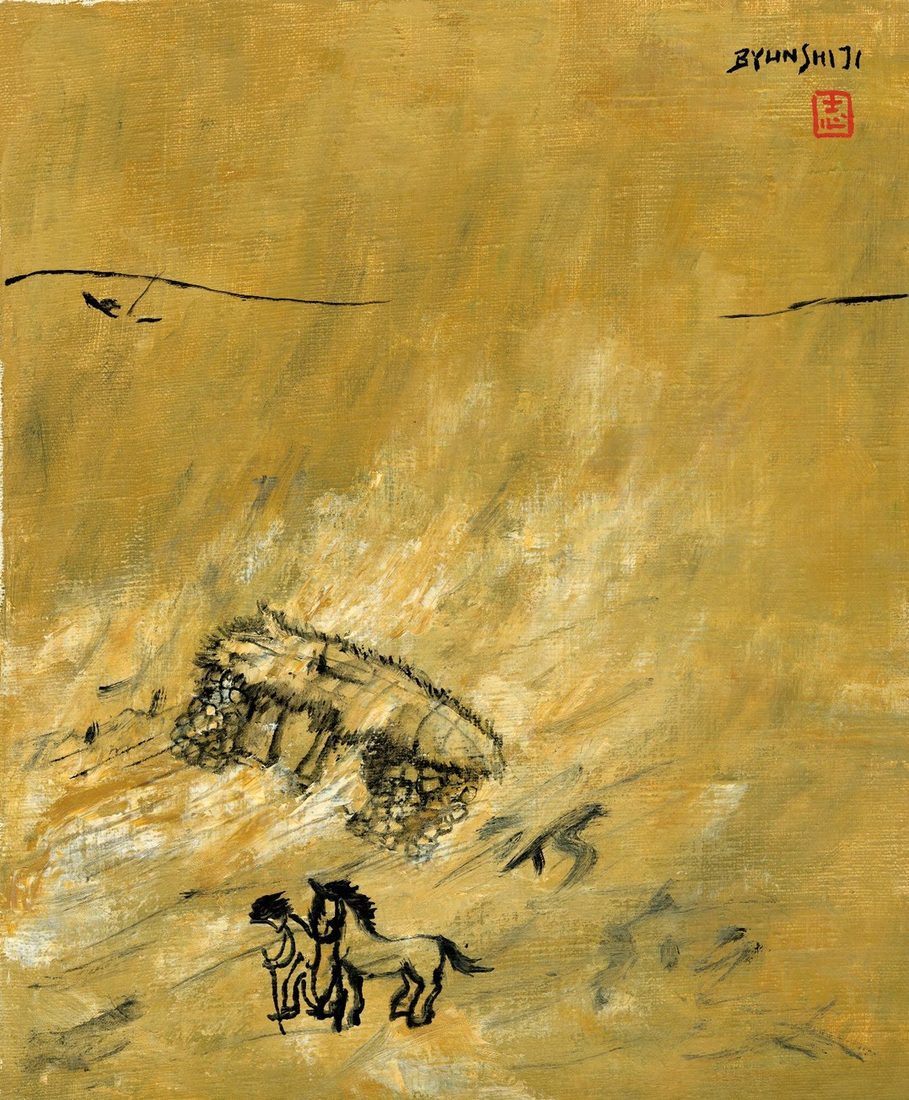
The person and pony in Stormy Seas stand very close, their neighbouring contours forming a small group. In Seaside Village, paths and walls separate the person from the animals. Companionship need not belong exclusively to either arrangement. Closeness enables contact; distance gives each body a more distinct place.
In one painting, fierce diagonals surround the small bodies. In the other, curving walls pass between them. Even with the same motifs of person and pony, surrounding lines change their relationship. Composition concerns not just the number of figures, but what is allowed to pass between them.
Something important is lost if the animals are read only as consolation for the person. Pony and cow have their own orientations. Even when the person stands centrally, their heads do not all turn towards that figure. Occupying the centre of an image is different from possessing the attention of its other beings.
Arranging the Intervals as Well as the Forms
In Notes of a Painter, Matisse did not restrict expression to passionate faces or violent movements. He described the overall arrangement—including figures’ positions, surrounding empty spaces and proportions—as expressive. This perspective distinguishes composition from decorative tidying. An interval without a depicted object can belong to what the painting says.
Something is also lost when a small body in Byun’s work is considered in isolation. How near is the pony to the house? Is the space before the person blocked or open? How much room remains to the edge? Such questions are slower than assigning a symbolic name, but they bring us closer to what distinguishes one work from another.
This comparison requires no story in which Western art only fills and Eastern art only empties. Different painters have worked with forms and intervals in different ways. Byun’s distinctiveness can be sought in how he reconfigures the question among Jeju’s low houses, stone walls and small bodies.
Where Is the Viewer?
The path in Seaside Village leads inward from the lower edge. The eye follows it towards the person and then the village behind. Yet this does not mean that the viewer knows the whole world depicted. Interiors and lives behind walls remain unseen. The painting offers a passage while leaving places beyond our knowledge.
In Empty House there is a house but no visible person. Before filling that absence with a story, we can look at the doorway, tree and distant boat. Not knowing who may have left is not a failure of looking. It reminds us that our position is neither the householder’s nor that of an observer who knows everything.
Being led into a composition does not confer a right to possess a figure’s inner life. We can look closely without knowing everything. There is a way of looking that accepts this distance. A painting’s ethical force may arise not only from what it shows, but also from what it prevents us from filling in at will.
Recurring Motifs, Changing Emphasis
House, tree, sun and boat recur in Empty House and Noon. Yet the former leaves a broad area of brightness, while short strokes set almost the whole of the latter in motion. Noon also includes a small person. A shared list of motifs cannot account for these different compositions.
The task offered to the viewer changes too. In one, we cross between separated forms; in the other, we find a small body among many strokes. The emptier painting is not necessarily the deeper one. We need to ask what kind of attention is required by spacious intervals and by narrow ones.
The ethics of repetition is not demonstrated by counting how often an arrangement is preserved. It depends on how freshly relationships are examined as familiar motifs are placed again. A person may remain small without being effaced; a tree may be large without monopolising attention. The judgement must be made anew in each painting.
A Painting That Makes Room
Byun’s compositions need not be read simply as scenes of equality in which every difference disappears. Beings stand and move differently and occupy different distances, yet are placed together. An ethics of composition begins when these differences are examined as relationships rather than fixed into ranks.
A painting does not teach us every rule for living well. It can, however, let us notice another being beside the one we saw first. The centre of attention shifts a little; a path appears where we had thought there was only empty ground. A change of arrangement changes attention. This small movement need not be dismissed.
A person occupies the path in Seaside Village. The pony on the left lowers its head; the cow on the right holds its head up. The path does not place them in a single file. It bends inward along the walls.