Research/A Hundred Years of Wind/Ⅳ Technique & Medium
Ⅳ Technique & Medium · 51 / 100
The Temperature of Colour
Warmth Is Not the Same as Reassurance
색채의 온도
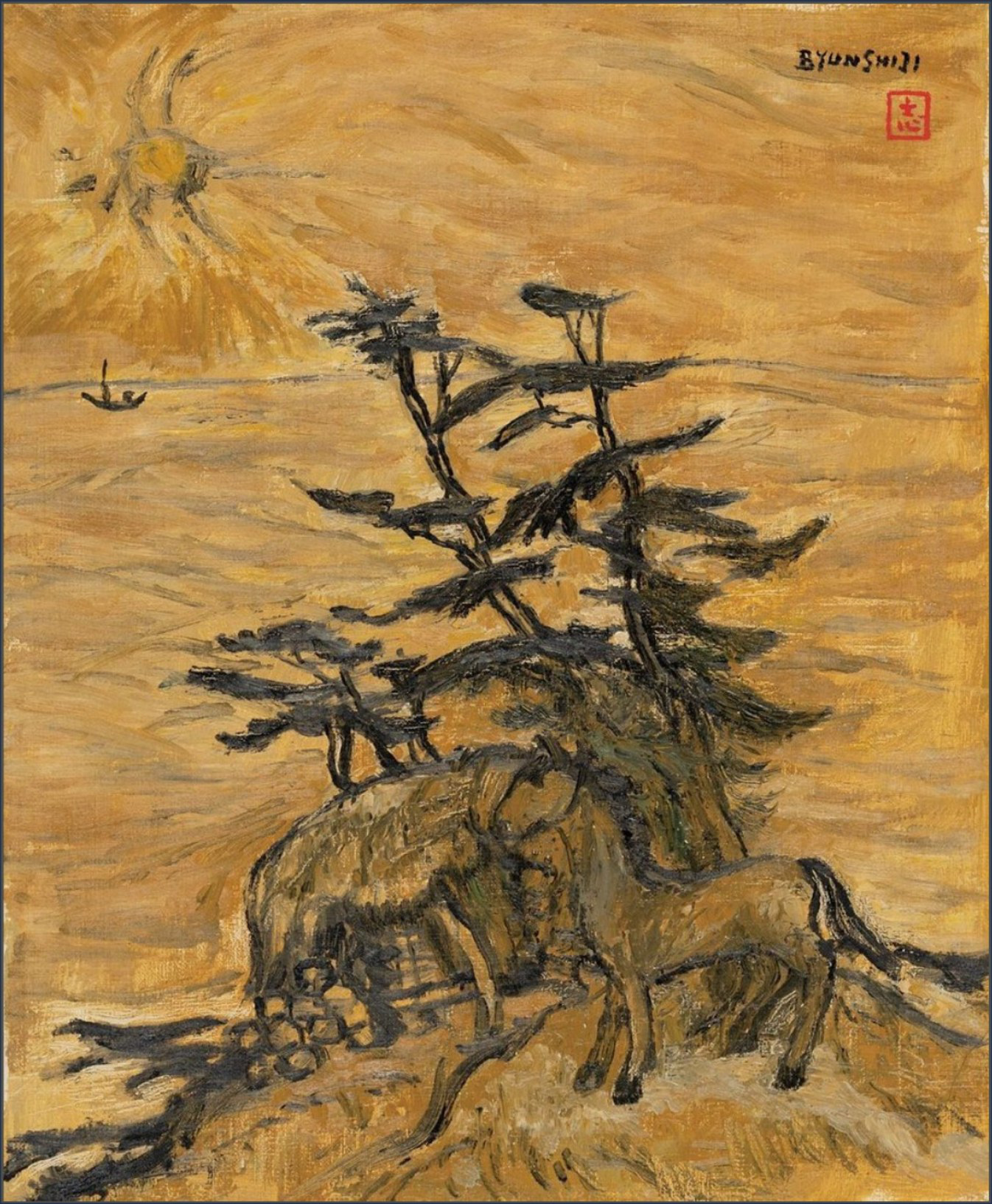
Shade Remains Where There Is Sun
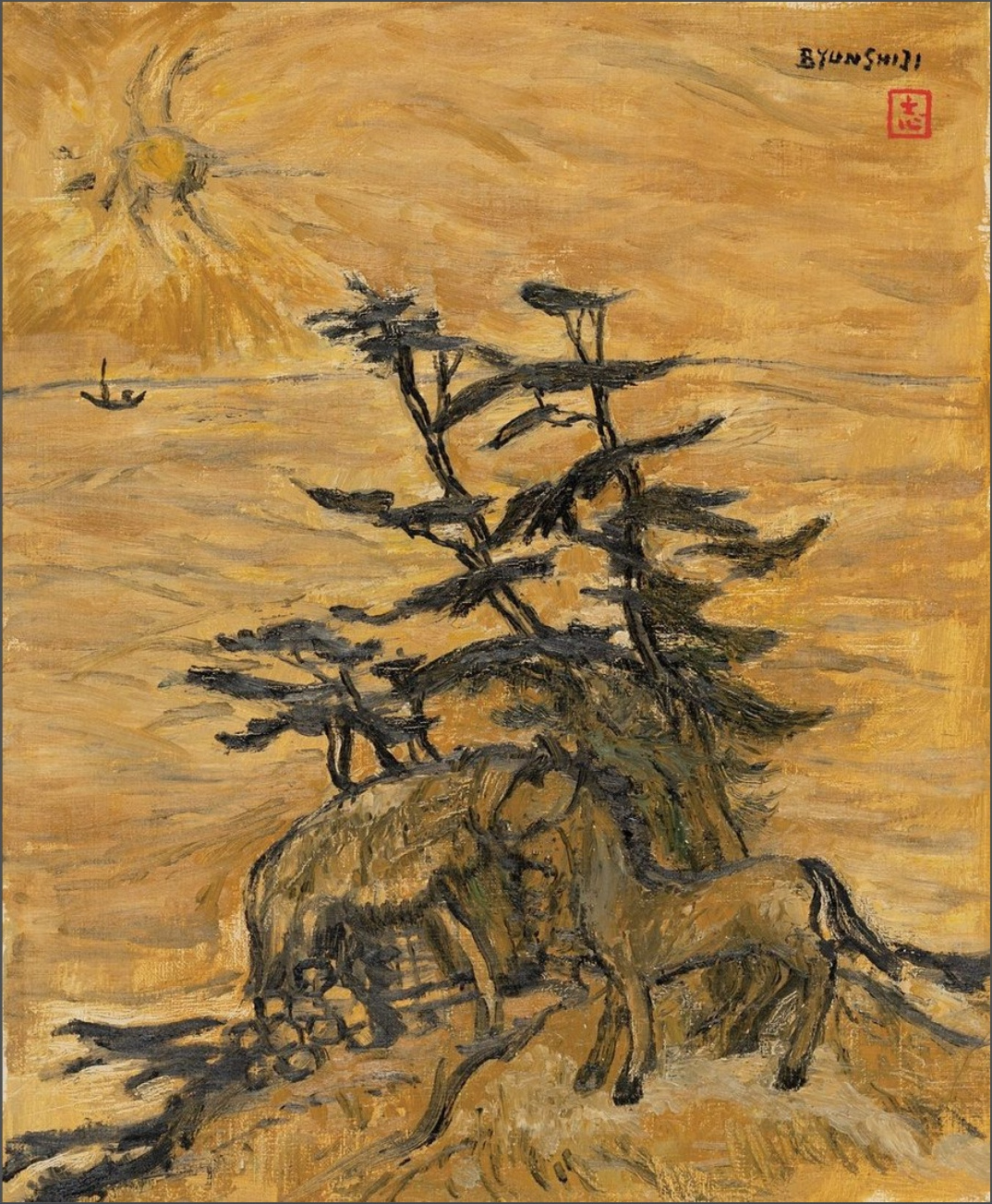
Tropical Sun first gives an impression of sunlight. A sun appears high in the painting, surrounded by spreading, luminous strokes. Below, a pony and a house stand among dark trees. The light that fills the painting and the small body within it do not enter our attention all at once. Only after that initial brightness settles do the pony’s legs become clear.
We may call this painting warm. Yet that word is not enough. Receiving sunlight is not the same as resting. Light may warm a back or make a body more weary. Because the painting does not settle which experience is present, colour sends us back to posture.
Reading Byun Shi-Ji’s colour becomes more searching with this second look. We need not translate a yellow hue immediately into consolation. Who is within it? How much room remains around the body? Where does darkness gather? Warmth emerges through these relationships, not through a colour name alone.
Temperature Without a Thermometer
Temperature here is a word for an experience of looking. It is not a measurement of the paint surface or the colour temperature of a light source. Feeling that a painting is hot is also different from feeling at ease before it. Keeping these distinctions allows us to describe colour without making the description sound like a numerical finding.
Kandinsky described warmth and coolness in relation to yellow and blue, assigning colours movements of approach and withdrawal. This was a painter’s theory of colour and the spirit. Rather than treating it as a law that requires every viewer to respond identically, we can use it as a comparative language for asking how a painting exerts its force.
In Byun’s painting, hue alone does not advance towards us. A small dark form interrupts a bright field; the eye pauses, then crosses the interval again. Colour opens out in one place while a line narrows the passage elsewhere. The felt temperature cannot be separated from this movement back and forth.
Autumn Within a Blue Painting
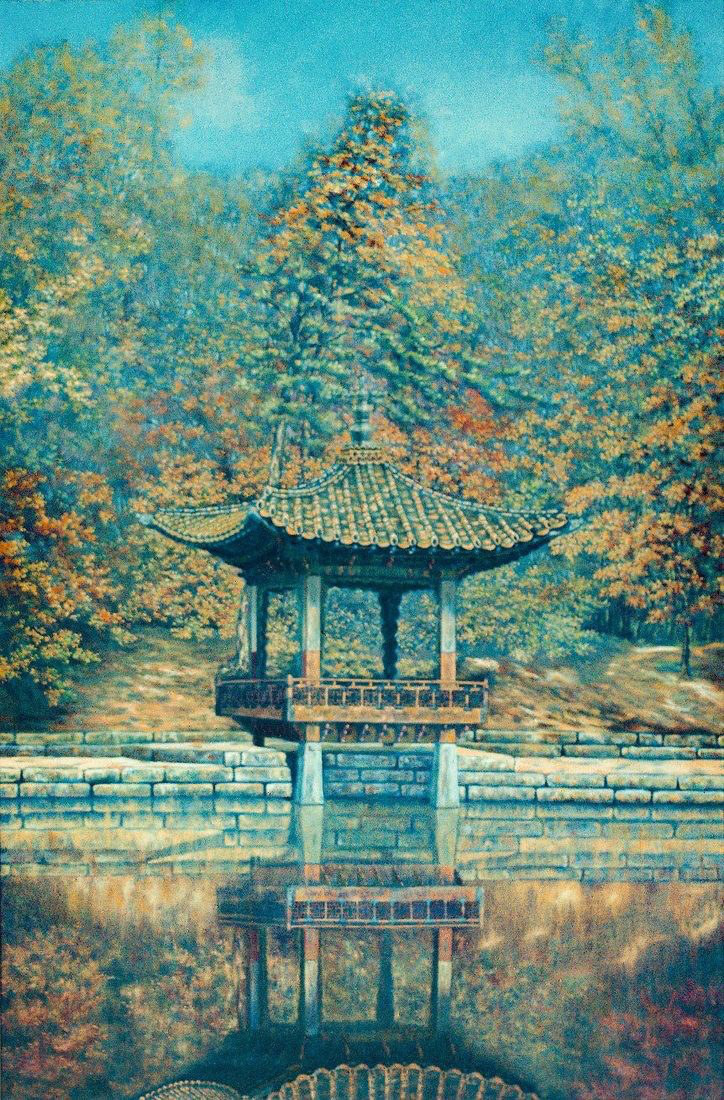
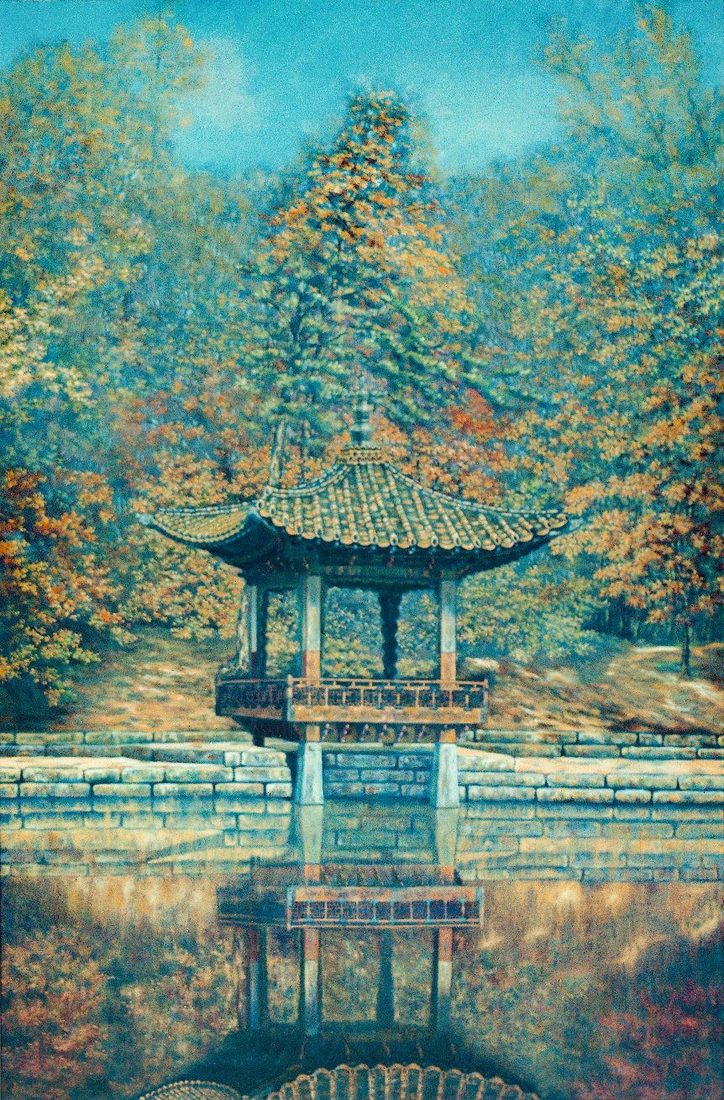
Turquoise extends through Aeryeonjeong Pavilion in Autumn. Yet yellow and reddish notes appear in the foliage, and the water receives the colours of the building and leaves. Blue does not make this a painting that simply retreats into coldness. Between the pavilion’s pillars and their reflection, different colours hold our attention in the same place.
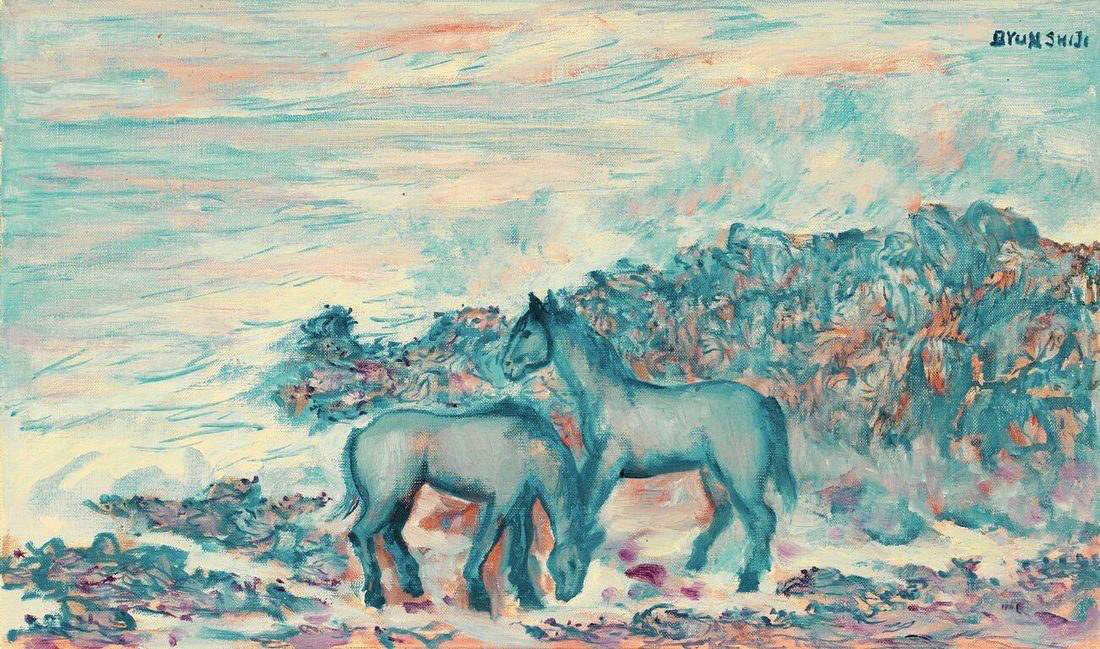
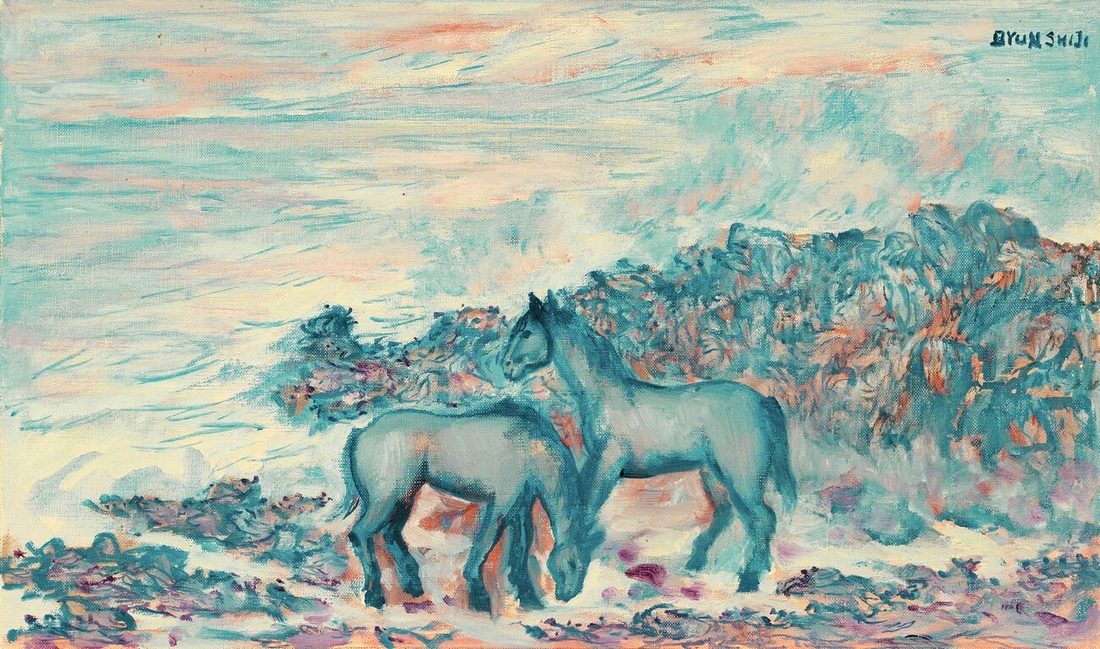
Blue and pink are also present in Jeju Ponies of 1975. The two animals, the rocks and the space near the sea share these colours. This is one reason not to claim that all blue disappeared in the year of his return to Jeju. Moving to a place and changing the language of colour did not proceed at the same pace.
His journey cannot therefore be reduced to a single line from coolness to warmth. More changed than the inventory of colours: their distribution, the degree to which forms stand out, and the way different beings inhabit a shared atmosphere. Our language of temperature must move with these changes.
The Body That Recognises a Colour
The name dried-grass colour retains a sense of something that was once green. It recalls a surface exposed to sunlight and wind. Using this name does not assign every colour in the painting a single value. It leaves room for differences in brightness, mutedness and the tendency towards red or grey.
One viewer may recall an old floor in this light; another, a sun-dried hillside or an afternoon beside the sea. The same painting does not demand the same memory. The meeting of colour and body is not determined by nationality, and may differ even between people who grew up together.
The same applies when the warmth of an ondol-heated floor enters the discussion. It belongs to a viewer’s memory, not to a fixed temperature possessed by the work. A metaphor may open a door without requiring everyone to live in that room. However useful the phrase, the painting must remain larger than it.
Looking Again at Van Gogh’s Yellow
To describe Van Gogh’s yellow only as fever narrows his colour. In a letter about The Bedroom, he explained that its colour arrangement was intended to suggest rest and sleep. The yellow furniture belonged to that arrangement. His own account offers a concrete reason not to equate strong colour invariably with agitation.
A comparison with Byun need not oppose unhealthy heat to wholesome warmth. In one painting, walls and furniture divide the colours of a room; in the other, trees, a house and a pony occupy an expanse of light. What matters is not the relative health of the painters or their souls, but how colour makes a place for a body.
There is no bed to lie on in Tropical Sun. There are a small house and a pony beneath the sun. Its warmth is therefore different from the repose of an interior. Light surrounds the body while also exposing it. We may welcome the brightness and still think about what it means to stand within it for a long time.
Colour Seen Closely, Forms That Remain Distant
Rothko’s colour fields cannot be described only as devices that overwhelm viewers through scale. The Rothko Room at the Phillips Collection was conceived as an intimate setting; the artist also made suggestions about lower lighting and a bench. The distance at which colour is encountered depends on a place to linger and on illumination, not solely on a painting’s size.
Near a Byun painting, short strokes and tonal variations emerge within the light field. A step back restores the relationship between tree and pony. This passage matters. The surface experienced close up returns to the landscape seen at a distance; once the small body stays in our attention, the broad colour feels different too.
A small painting is not invariably more intimate, nor a large one more imposing. A small work may contain a great distance; a large one may offer the feeling of sitting beside a single body. To speak of the temperature of colour, we should also consider where the viewer stands and how long they look.
Not Reading a Storm’s Colour Only as Consolation
In Stormy Seas, a person and a pony stand close together. The house above them and the surrounding diagonals unsettle the painting. A warm-toned ground does not establish their safety. Rather, the luminous field makes their small point of proximity more distinct, showing how little space it occupies.
Warmth here may come less from hue itself than from the nearby body. Yet proximity does not bring the storm to an end. Consolation and danger remain together. When Byun’s colour is not reduced to sentimental reassurance, the small companionship within it becomes a tentative relationship rather than a happiness readily given.
In his oral testimony, Byun said that even within the same yellowish range, the tone varied with what he painted. His account discourages fixing the colour to a single emotion. Related hues may do different work in a painting of strong sun and in one suggesting fierce wind. A recurring colour does not mean a recurring answer.
The Temperature That Stays with the Viewer
One viewer may feel warmth in this painting; another, time dried by the sun. The difference need not immediately be judged right or wrong. But we should be able to say what led to that response. A line beside a colour, a posture and the boat remaining in the distance provide grounds for looking.
The temperature of colour does not turn a painter’s life into a number. It names a nearness or distance arising between painting and body. Nearness may contain longing, while distance may offer room to pause. A warm colour can bring us to a halt; blue can remain close to us for a long time.
Look again at the lower part of Tropical Sun. Dark lines bring the pony’s legs down to the ground. A little brightness remains beside them. The sunlight from above has reached that place.