Research/A Hundred Years of Wind/Ⅳ Technique & Medium
Ⅳ Technique & Medium · 50 / 100
Thinking through Light
Seeing Light, Translating It, Encountering It Again
빛의 사상
The Shape of the Sun and the Light of the Picture
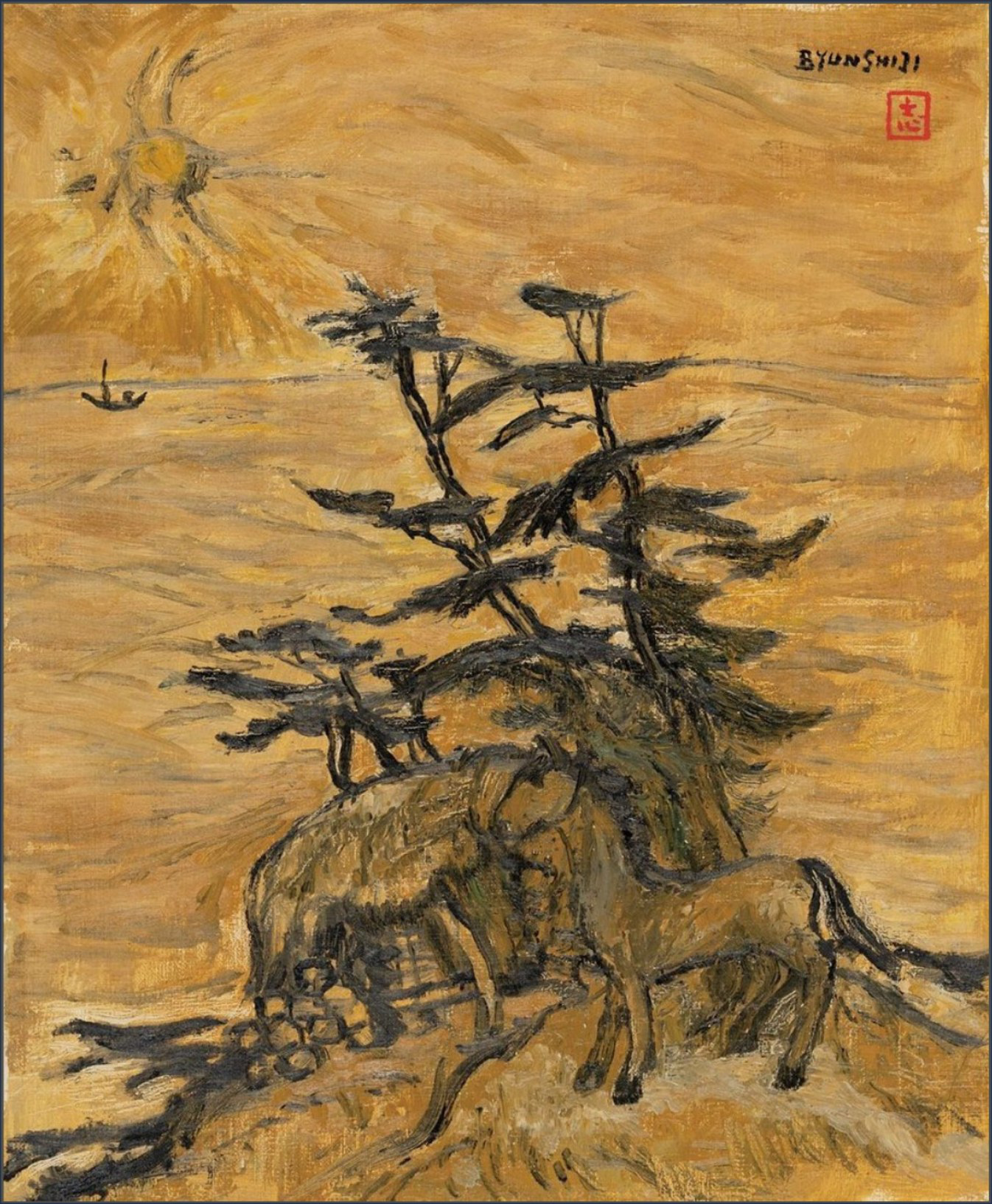
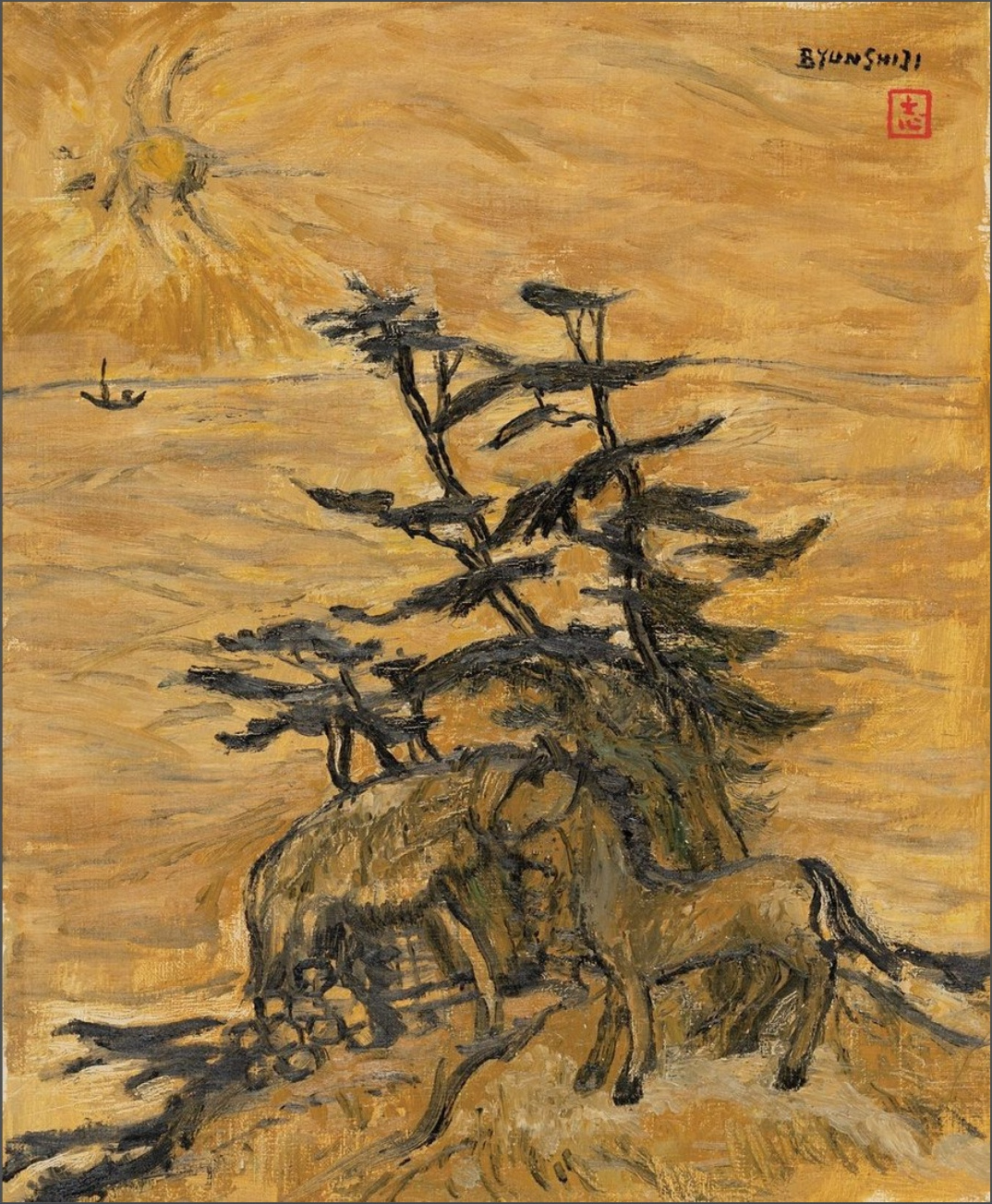
The sun in Tropical Sun (1983) sits at the upper left, with short and long marks extending around it. Below are dark trees, a house and one pony. Recognising the sun and feeling the picture’s brightness happen together, but are not identical. Light does not remain inside the small circle; it spreads through surrounding colour and between dark branches.
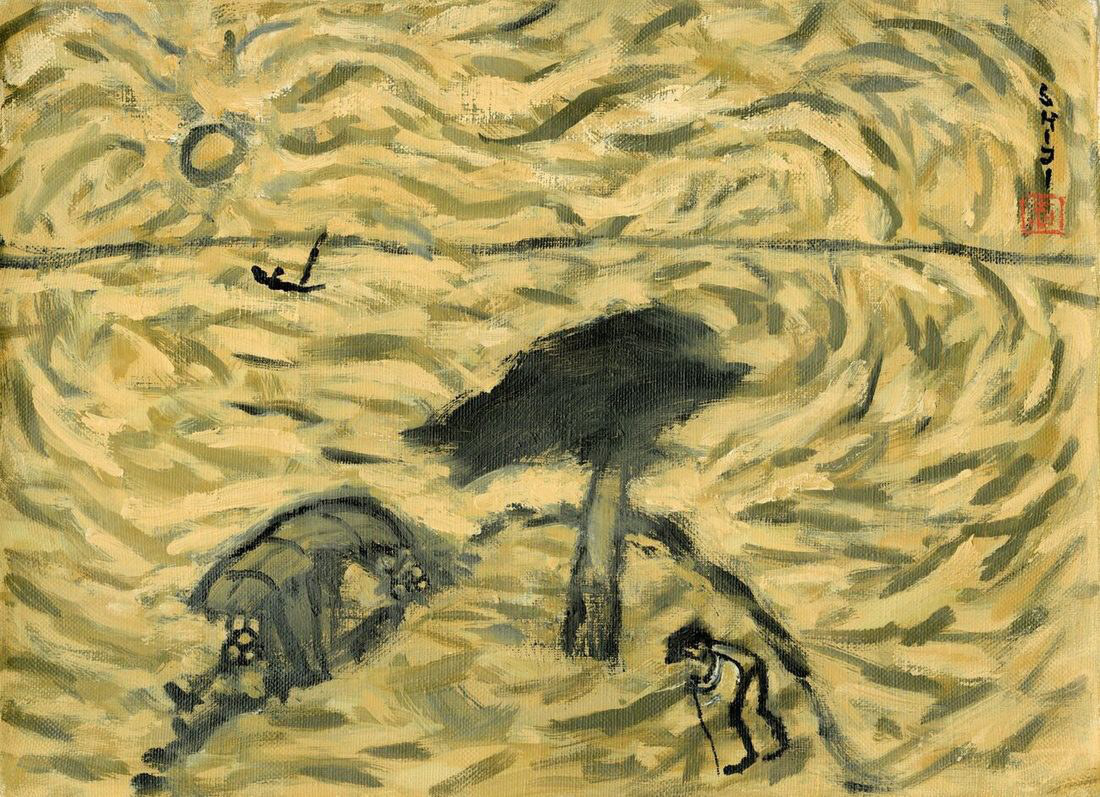
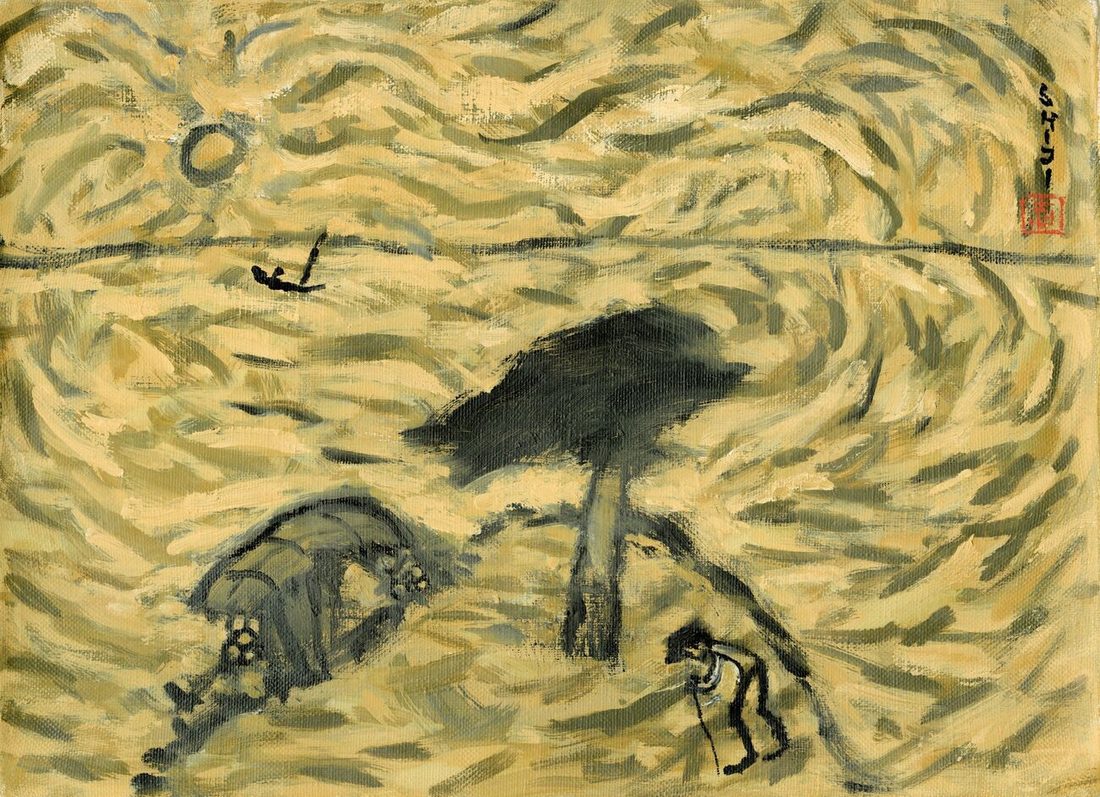
The sun in Noon (2007) appears as a dark outline. The circle itself is not the brightest place in the picture. A pale ground and short dark strokes together produce an impression of midday. If the sun’s shape is one element describing light, the sensation of light is made by the whole painting.
We can distinguish three things here: light encountered outside by the painter, brightness constructed with paint and line, and the viewer’s experience of light. One does not abolish another. Following their encounter keeps us from dividing light too quickly into the physical and the spiritual.
When Light on the Shore Becomes a Pictorial Question
In his oral history, Byun Shi-Ji described seeing white appear yellowish under strong sunlight on the shore. He then considered what colour might stand for Jeju and tried painting in a yellowish key. Observation led to an idea, and the idea to practice. Light did not become a work of art in a single instant.
He also said that the yellowish tone varied with what he was painting. This account resists fixing his light as an unchanging gold. Holding to a key over time is not the same as using precisely the same colour each time. Continuity can be the range within which change occurs, rather than its opposite.
The fact of seeing light cannot by itself explain a style. Different people see different things before the same light. The painter must translate an experience into scale, the density of marks and relations between light and dark. Fūdo provides conditions for that work; it does not automatically deliver a finished style.
Dark Forms Sustain Brightness
Imagine covering the dark branches in Tropical Sun. A broad yellowish field would remain, but the way its light divides and rests would change. The dark line is not an enemy obstructing brightness. It allows light to acquire particular places along the gaps between branches and the contours of bodies.
In Noon, the tree’s dark mass and the pale ground need one another too. The small figure is visible because it is darker than its surroundings; the pale interval beside it feels narrow and close because of the figure. Everything does not shine with the same intensity. Light moves because there are differences.
There is no need to abolish tonal contrast in order to speak of light. Even a restricted palette retains relations of light and dark. Byun Shi-Ji’s picture may be felt as one atmosphere not because differences have vanished, but because they work together without falling apart. Unity is not uniformity.
Monet’s Light Also Passed through the Studio
Something important is lost if Monet’s Rouen Cathedral series is treated only as an immediate record of passing light. The National Gallery of Art explains that after painting the cathedral in 1892–1893, he finished the canvases in his Giverny studio in 1894. Observation of changing light and reconstruction in the studio belonged together.
This does not erase their differences. It does halt the opposition in which Monet merely copies external light while Byun Shi-Ji creates an inner light. Byun, too, stressed learning through looking and translating what was seen into his own style. Their comparison begins not as a contest between outside and inside, but with ways of remaking what has been encountered.
From that starting point, look again at Byun Shi-Ji’s small sun. The yellowish key continues around house and pony, not only around the sun. The impression of light does not end with an explanation of rays at a particular moment. It becomes a condition under which small things move towards and away from one another within one picture.
From Rembrandt’s Face to the Whole Picture
The National Gallery in London describes the contrast between thick paint on the face and a thinly painted dark background in Rembrandt’s Self Portrait at the Age of 63. Brightness is constructed not only through tone but also through differing layers and textures. Attention to this making shows why an account that turns all his light into sin and redemption is insufficient.
Returning to Byun Shi-Ji, we find a different centre of gravity. In Noon, light and dark marks interact across an area far larger than the small face. Rather than gathering meaning by illuminating the figure’s interior, the work turns attention also towards house, tree and sea. This is not a claim to surpass the illuminated face, but a difference in how attention is distributed.
Nor does one picture contain only the human and the other only nature. The comparison concerns where looking begins and where it goes. An eye beginning with a face can move towards the paint’s surface; one beginning with the sea can return to a small bent body. Different paths do not establish a hierarchy of encounters.
What It Means to Shine from Within
Saying that a painting seems to shine from within can convey an experience of looking. It cannot be converted into a claim that its paint emits light by itself. Inner light here is not the name of a material component, but a metaphor for an impression produced by continuous colour and light and dark marks.
Preserving the metaphor does not require denying external light. Strong light seen on the shore passed through memory and choice into a painting, which then produces a sensation of light before the viewer. What came inward from outside travels outward again. No single direction explains this exchange.
Within this exchange, the light of fūdo becomes the light of painting. Neither the sun’s intensity nor the painter’s inward life is sufficient alone. How far should the yellowish key continue? Where should a dark stroke be placed, and which pale interval left open? These small judgements accumulate into the climate of a picture.
Shared Light, Different Positions
Pony, house and trees in Tropical Sun occupy related colours, but are not objects of equal brightness. Dark branches, pale ground, the pony’s back and the house’s shaded opening differ. Those differences give each a place. Being together does not mean erasing their particular appearances.
To read equality in the picture, it is more useful to consider attention than to claim that every being shines with the same intensity. Can we spend time with the small pony? Does the eye return to an unnamed person? The darkest form is not thereby the least worthy. Brightness does not determine an order of value.
This need not be declared the single ethic imposed by the work. It is a practice available before it: an eye that once pursued only light begins attending also to dark branches and small bodies. Gaining light becomes not the elimination of darkness, but a refusal to overlook the forms within it.
The Painting Remains after Light Has Been Explained
Reducing form, leaving space and marking a surface are not separate from light. Yet none can be replaced by that one word. Form gives a body its situation; an interval produces distance; texture changes the speed of the eye. Light is felt within the relations through which these different operations become visible together.
The reason Byun Shi-Ji’s light may feel lasting is not that we have discovered an eternal substance. After leaving the picture, brightness beside a dark branch and yellowish space around a small body remain in memory. Actual sunlight passes. Painting offers another person the relations arranged by someone who experienced it.
The sun is at the upper left. Dark trees stand below. After looking at the sun, the eye descends to the light left between the branches.