Research/A Hundred Years of Wind/Ⅱ Figure & Being
Ⅱ Figure & Being · 26 / 100
Self-Portrait Without a Self-Portrait
From Face to Landscape: Where Does the Self Appear?
자화상 없는 자화상
First, There Is a Face
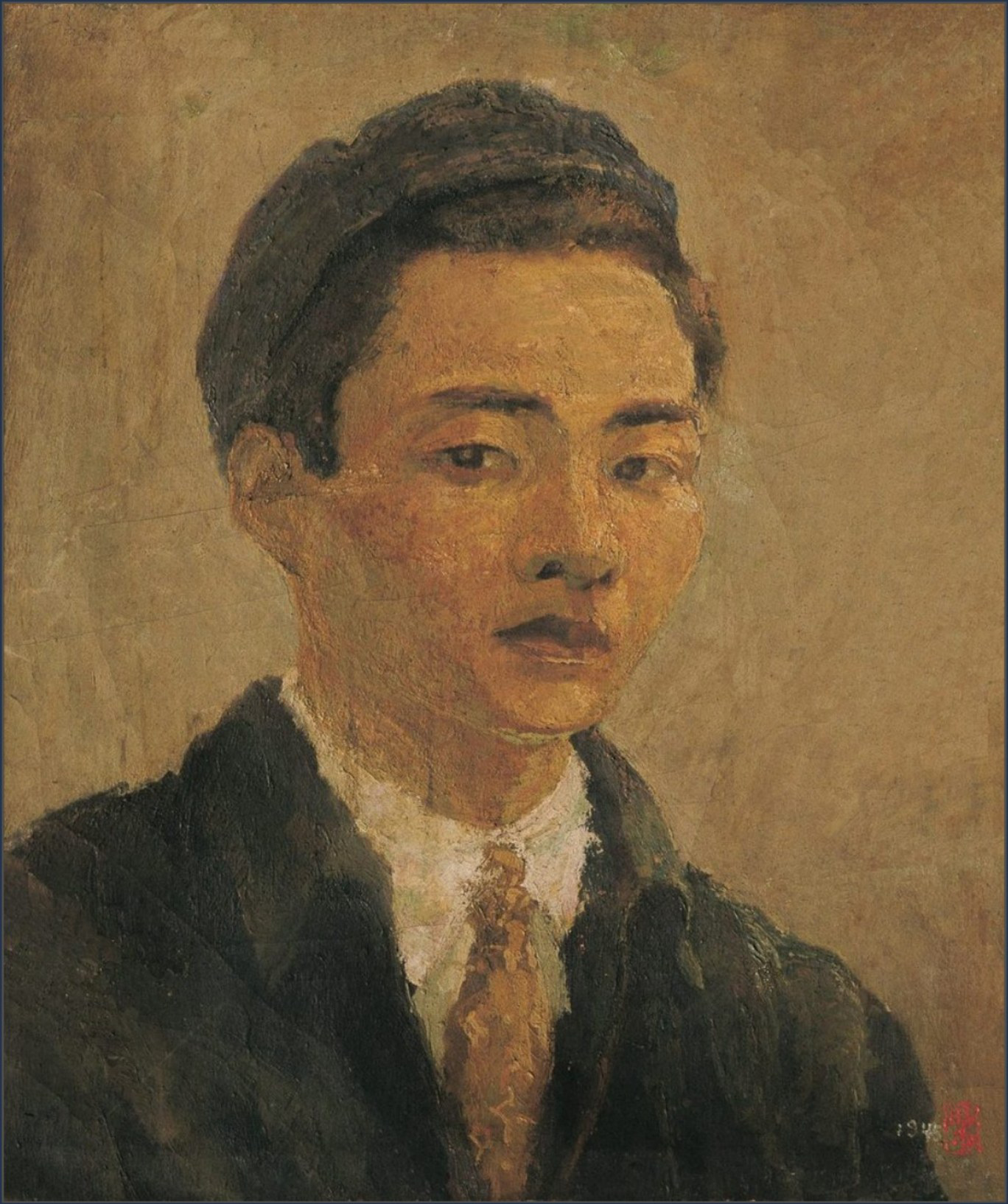
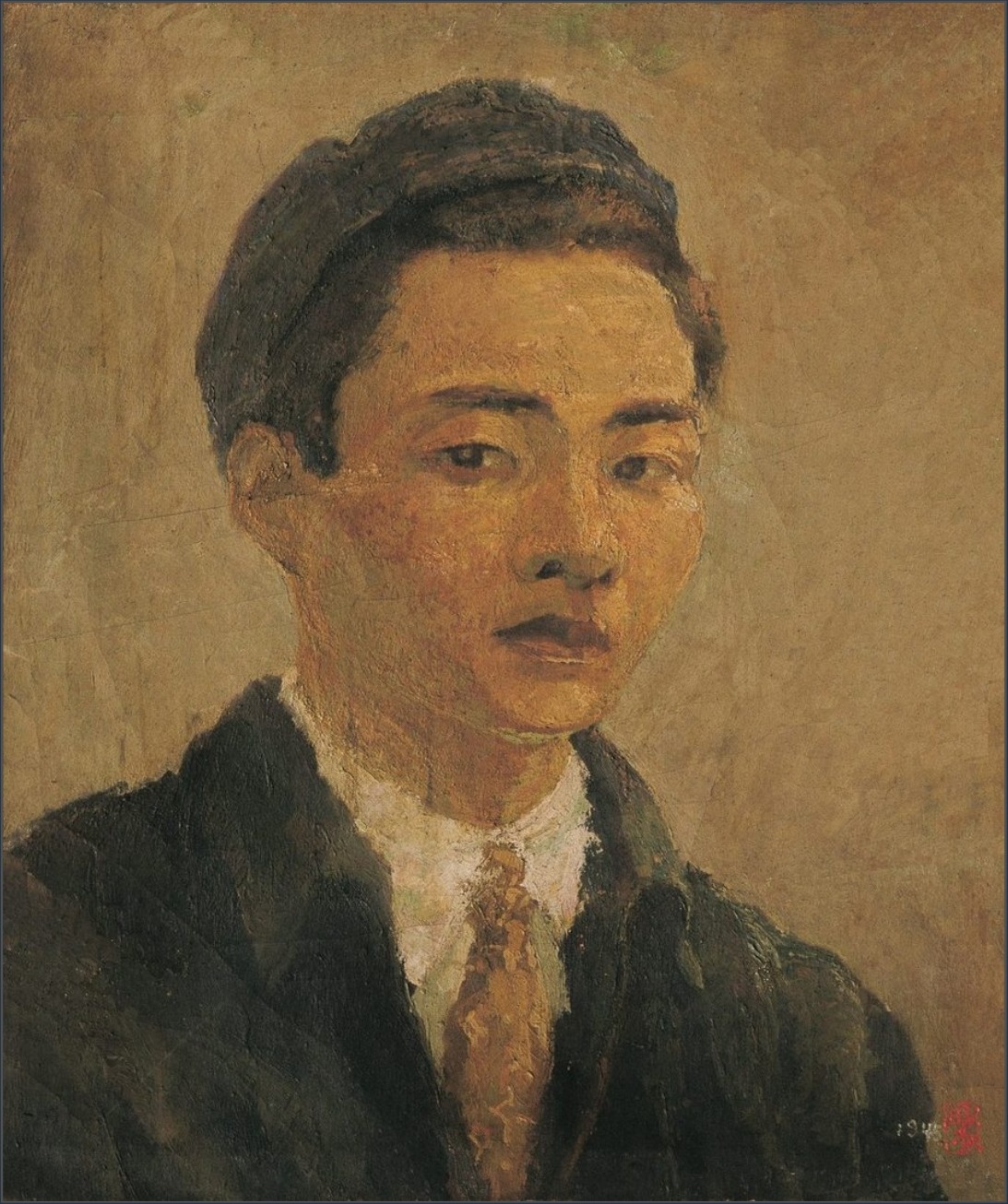
There is a young face in Self-Portrait (1944). A white collar emerges between the dark sides of a jacket; the brown of the tie is close to the ground behind the face. The head turns slightly, while the eyes face towards the viewer. Byun Shi-Ji painted his own face. This chapter’s title cannot therefore mean that he made no self-portraits. It asks how a painter who depicted his face also disclosed himself through something other than a face.
It is tempting to call those eyes ambitious or anxious. Yet the shadow around them does not establish the painter’s state of mind. What we first see is light on the forehead, the edge of the lips and a collar dividing the shoulders. The features that make a person recognisable are not separate from those organising the painting. The face is both a likeness and a relationship made in paint.
Keeping this starting point in view allows us to look more carefully at the later landscapes. Painting a face and painting a landscape need not stand for superficiality and depth respectively. They are different ways of adjusting the distance between oneself and the world. Before claiming that one arose because the other failed, we should attend to changes in that distance.
Looking at Placement Before Likeness
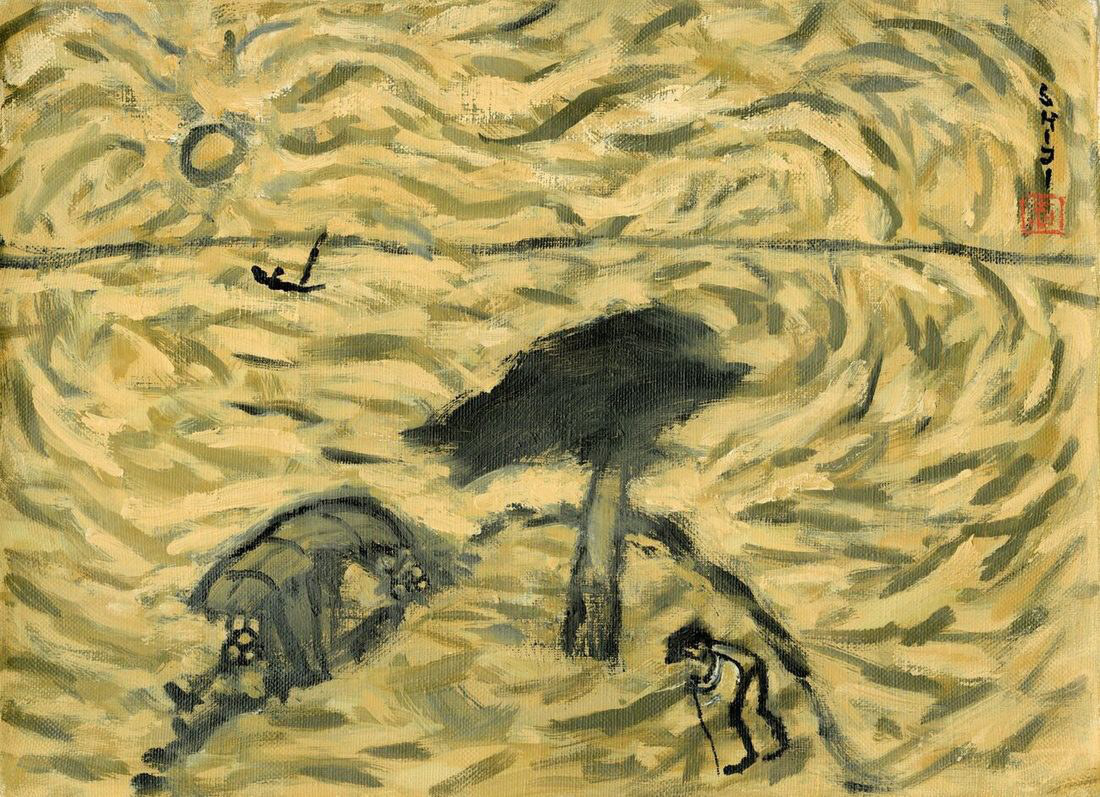
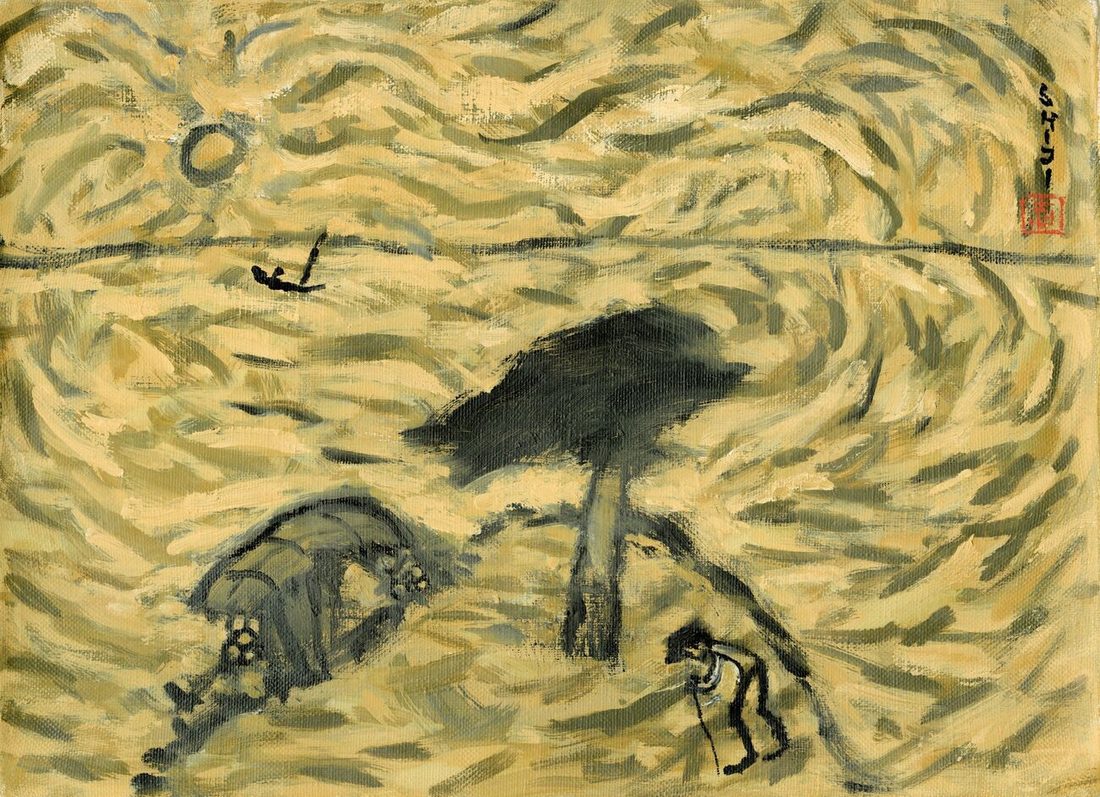
In Noon (2007), the figure’s placement reaches us before the face does. The person bends low in the lower part of the picture, beside a tree. A house, a distant boat and a round sun occupy separate positions. Unlike the large face of the 1944 painting, here the extent of the surroundings determines how we encounter the person.
A figure using a staff may bring the painter’s life to mind. But a staff alone does not establish the figure’s identity. There is a distance between finding an autobiographical resonance and declaring that this person is the painter. The former may sustain attention; the latter may close other possibilities too soon.
Nor does a smaller body mean the disappearance of a self. A small body depends more visibly on its surroundings. Ground supports it, a tree establishes distance, and the sea delays the end of our gaze. If self-description is not confined to enlarging one’s face, arranging these relations can also become a form of self-expression.
A Landscape Is Not a Codebook of the Mind
Explanation becomes easy if crow means anxiety, horse means consolation and wind means fate. Such a codebook, however, erases differences between paintings. The same horse establishes different relationships alone and beside a person. A crow in flight and one on the ground also distribute weight differently. Meaning takes shape again through placement, rather than residing permanently in a name.
An autobiographical reading does not require us to distribute the painter’s feelings among every object. It asks which distances were chosen, what was enlarged and where the surface was left rough. Inward life need not be an answer hidden behind things. It may be a depth suggested by the manner in which things meet.
Nature must not disappear in the process. If the sea is only a metaphor for a mind, its extent and waves become less worth attending to. If the horse is only an alter ego, the animal’s body is erased. A sustained reading preserves both human experience and the separate existence of things. Contact does not make them identical.
Even a Mirror Does Not Deliver a Finished Painting
The National Gallery’s examination of Rembrandt’s Self Portrait at the Age of 63 records alterations to the hands during its making. A self-portrait centred on the face is not simply a copy. Even before a mirror, a painter chooses and revises. Its honesty may lie less in avoiding revision than in repeatedly asking how to present oneself.
There is no need, then, to elevate Byun’s landscape above the facial portrait as a more complete self-image. A face comes with surrounding darkness, clothing and hands; an expansive landscape also excludes much. Neither form contains the whole of a person. Within that limitation, each brings different aspects nearer.
Comparison is not a means of choosing a winner. It attends to the difference between a close encounter with a face and an approach to a person across open ground. One can intensify the meeting; the other can lengthen the route towards it. Rather than compete, they enlarge the distances at which we encounter another person.
The Distance of a Third Person
We might call the figure in a landscape a third-person self-portrait. This is a critical metaphor, not a grammatical person written into the painting. A form touching one’s experience is placed separately before oneself: someone resembling me, yet not ending with me. Familiarity and strangeness can arise in the interval.
Distance does not necessarily diminish feeling. From farther away, the body’s smallness may become visible in a way that a close face concealed. Nor does distance guarantee restraint. A small person made into an excessively tragic symbol can invite sentimentality even from afar. Restraint concerns the handling of relationships, not size alone.
In Noon, the person is below the tree without merging with it. The rough marks around the body do not wholly engulf it. These distinctions let us locate a person and then return to what surrounds that person. Moving between self and world becomes a way of reading the picture. Within that movement, the meaning of self-portrait expands.
Not Turning Three Periods into One Destiny
The face of 1944 cannot simply be called an unfinished self awaiting the Jeju paintings. Through its own light, clothing and scale, it already establishes a relationship. Knowing the later work gives us no reason to see only deficiency in the earlier painting. That would conceal the choices the young painter had already made.
The movement from figures to palace landscapes and then to Jeju’s sea need not be read solely as a ladder of development. What was learnt close to a face may operate in a landscape, while a landscape’s intervals can redirect attention to a person. A new place does not erase all earlier experience. Experience changes its use when it meets another problem.
Landscape as self-portrait is therefore not a sole correct answer reached at the end of a life. It is a question that can connect otherwise different works. Where might personal experience dwell here: in a face, a bodily angle or the distance between things? As the answer changes, the painter’s world becomes less narrowly defined.
An Unnamed Person Is Not Just Anyone
Without a given name, a viewer brings personal memories to the figure. But the arrival of those memories does not entitle us to turn the painted person wholly into ourselves. The body already has a particular scale and direction. We need to consider where what we feel meets, and differs from, what the painting presents.
Universality need not be an empty vessel obtained by removing individuality. It may arise when we sense a fatigue like our own in a stranger without claiming to know that stranger’s life. Even when facial detail is reduced, relational detail remains. It offers a way of approaching someone whose identity we do not know.
An open self-portrait, on this account, is not a painting into which anything can be inserted. It is open while also questioning us. Why did I take that person for myself? Did the face I wanted to see make me overlook the small body actually present? The viewer, too, has a gaze to revise.
A Face Remaining Between Two Paintings
Between Self-Portrait (1944) and Noon (2007), the difference is greater than the presence or absence of a face. In one, shoulders and collar form a close setting for the head; in the other, house, tree and sea extend the body’s surroundings. The difference need not be called a loss. The means of placing oneself in the world have changed.
When dried-grass colour is not equated directly with the painter’s mind, it can hold more: light, layers of paint, the distance between things and time spent looking at a person. Rather than erase the outside world in order to explain an interior, we trace inward life where it meets that world. That encounter is what this chapter calls a self-portrait.
A white collar lies beneath the young face. In another painting, the line of a tree descends beside a small body. Between the two pictures, the eye looks for a person once more.