Research/A Hundred Years of Wind/Ⅱ Figure & Being
Ⅱ Figure & Being · 25 / 100
Listless Posture and Resistance
Before Reading a Lowered Body as Defeat
무기력한 자세와 저항
When “Listless” Comes First
A figure with lowered head and bent back may first be called listless. Yet the word binds a visible posture to an invisible will. We can see the body’s height without seeing the measure of its resolve. This chapter’s title does not diagnose the figure; it asks us to reconsider that first judgement.
Byun Shi-Ji’s small figure is sometimes placed low before an immense landscape. That relationship can suggest vulnerability. But smallness in the image does not make the person’s life small. No automatic proportion links the area occupied on canvas to human value.
We need not defend the posture by immediately reversing it into the strongest resistance. Many conditions lie between listlessness and heroism: temporary fatigue, remaining, cautious movement, and time spent leaning on something else. Preserving these differences gives the figure the complexity of a living person.
One Meaning of the Storm, in the Artist’s Account
In his December 2004 oral history, Byun Shi-Ji connects the storm with resistance to treatment he recalls receiving from investigative agencies. This is the artist’s account linking a natural force with his experience. Rather than fixing the painting’s sole meaning, it can provide one route back to the image.
Importantly, the passage does not declare a single exclusive meaning for the storm. It provides grounds for historical interpretation without turning every wind or bent figure into a code for the same event. Links to particular paintings still require attention to dates, images and other evidence.
With that distinction, nature and history need not displace one another. A form depicting bodily exposure to wind can also hold other experiences of being subjected to pressure. Reading this overlap is different from proving particular historical events. Picture and testimony illuminate one another without becoming interchangeable.
The Difficult Question Bartleby Leaves
In Melville’s Bartleby, the Scrivener, the copyist repeatedly expresses a preference not to perform what is requested. His employer, the narrator, repeatedly revises his judgement. Discomfort, sympathy and a wish to avoid responsibility become entangled. The story concerns not only a refusing person but the responses surrounding that refusal.
Beside Byun Shi-Ji’s lowered bodies, the story lets us question a gaze that values an existence less because it sees less action. We cannot assume that the painted figure speaks Bartleby’s words. Fiction provides speech and events; painting provides posture and arrangement. Comparison matters when it does not leap over that difference.
Nor need Bartleby’s ending be explained as the inevitable extinction of a rootless life. That would obscure failures of relationship and difficulties of care within the story. Before the painting, too, reading the lowered person only as a will enduring alone may hide the companionship and support they need.
Bending and Support Belong Together
A body may seek balance by inclining rather than remaining rigidly upright. But not everything that bends is therefore stronger or guaranteed never to fall. A painted posture need not become a law of mechanics or a promise of survival. What matters is what accompanies the body.
The comparison with stone walls requires the same care. The Food and Agriculture Organization describes Jeju’s field walls as agricultural structures reducing wind exposure and soil loss. Their function concerns a construction of many stones, not a miraculous gap. This may prompt attention to supportive relations in a painting without making people identical to stones.
Attending to staff, ground, house and nearby animal makes endurance something other than a capacity enclosed within one person. Leaning because strength is insufficient and moving through a relationship may be different descriptions of the same scene. A gaze seeking only deficiency begins to ask what enables the body.
Non-Forcing Is Not Indifference
Chapters 43 and 78 of the Daodejing reconsider strength through softness and water. Read alongside its thinking on non-action, they invite a question: does declining to exert force necessarily mean lacking capacity? But non-action cannot simply be equated with doing nothing or accommodating every situation.
Bringing this question to Byun Shi-Ji does not declare that he illustrated Laozi’s philosophy. It temporarily sets aside a standard that sees a lowered body only as deficient. We must then return to the painting: which body receives which forces, and where does it find a place?
Bartleby’s refusal and non-action are not two names for the same conclusion. The story contains relations of request and refusal; the philosophy questions contrived exertion. Different questions may meet before a painting without one becoming a translation of the other.
Trees in the Cold, Relationships That Remain
Kim Jeong-hui made Sehando (1844) in thanks to Yi Sang-jeok for sending books during his exile on Jeju. Its inscription connects trees in the cold with an unchanged relationship. Here, the trees’ meaning is supported not merely by resemblance but by the surviving text and circumstances of the work.
A comparison with Byun Shi-Ji’s trees cannot end in a symmetry of straight and bent, scholar and common people. A shared island and similar motifs do not by themselves prove direct lineage. We should first examine the relations made by open space, dry marks and what stands beside the tree.
Endurance then moves somewhat beyond a story of isolated resolve: a relationship unbroken in cold weather, another form beside a small body. A being that seems to stand alone is not unrelated to its surroundings. Open areas in the painting leave room to attend to those connections.
A Person Need Not Stand to Remain
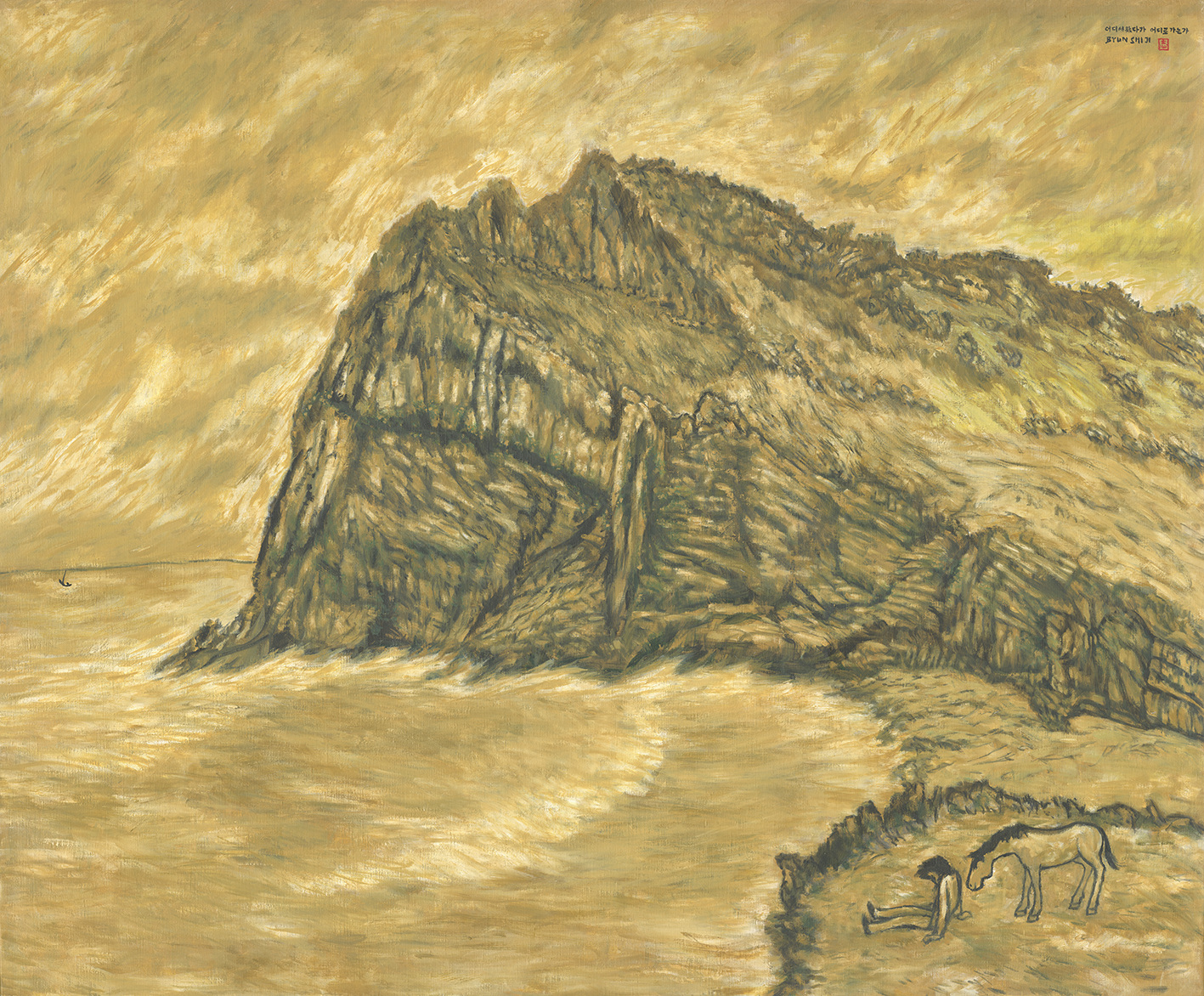
The person in Where Do We Come From, and Where Are We Going? (1992) sits close to the ground with legs extended. We see an inclined torso, a lowered head and a nearby horse. This scene alone makes it difficult to maintain sweeping claims that Byun Shi-Ji’s figures never sit or sink low.
More important is the name given to that body. Rest, exhaustion or another condition cannot be settled from the image alone. Yet not standing does not reduce dignity. If only those who do not fall are valued, the language of looking excludes precisely the person whose strength has diminished.
The painting has not cast this person outside its frame. Small against the great mountain, the figure occupies the lower-right space together with the horse. Size of form and importance to the scene do not coincide. Even after traversing the mountain, the eye returns to the small body.
Not the Scale of Resistance, but the Place Retained
There are grounds for reading resistance in Byun Shi-Ji, where the painter’s recollection meets pictorial form. But making resistance the answer to every posture repeats what the word listless did at the beginning. Different bodies are enclosed within one name.
What this chapter seeks to recover is not only a resisting hero. It is also the place retained for someone sitting silently. Without proving what that person is overcoming, we can attend to what is beside them and to the distance ahead. Such a gaze does not convert a life’s value into a record of unceasing endurance.
The person sits low. The horse stands nearby. A small stretch of earth remains between them.