Research/A Hundred Years of Wind/Ⅱ Figure & Being
Ⅱ Figure & Being · 24 / 100
A Drunken Night
Between Intoxication and Creation: Returning to the Work
술 취한 밤
Can a Glass Explain a Painting?
Rough lines and unsettled colour invite us to imagine an impassioned moment of making. Was the painter drinking? Did feeling move ahead of the hand? Yet instability in the image does not directly disclose the maker’s bodily condition. A stroke that looks rough may be the result of repeated choices.
A Drunken Night here names neither a particular painting by Byun Shi-Ji nor the verified record of a single night. It is an essay title asking about intoxication and creation. The story of one bout of drinking producing a distinctive style is vivid, but cannot by itself explain a sustained transformation in painting.
The question is not how many paintings drink produced. It is what can be retained when a familiar order of perception is unsettled, and how the work of looking again, discarding and choosing continues. To speak of intoxication, we must also consider the work beyond it.
Reading Apollo and Dionysus Again
In The Birth of Tragedy, Nietzsche brings together Apollonian dream and image with Dionysian intoxication and the unsettling of individual boundaries. The two impulses do not simply designate sobriety and drunkenness. They distinguish artistic powers whose conjunction he uses to account for tragedy.
This distinction can become a question for reading Byun Shi-Ji: how do the forces that keep forms recognisable coexist with those that unsettle them? But assigning reason to the Japanese period and intoxication to Jeju gathers too many paintings into one answer. Multiple forms and sensations coexist within a single period.
Philosophical names are not a plot substituted for the painter’s life. Nor does this comparison establish that he consciously enacted Nietzsche’s scheme. To be useful, it must disclose pictorial details that the scheme misses rather than fit the paintings inside it.
Unsettled Surfaces, Retained Outlines
In Where Do We Come From, and Where Are We Going? (1992), slanting brushwork extends across sky, mountain and waterside. Light and dark strokes overlap, making the surface seem to flow in one direction. Yet the mountain’s great contour and the places of person and horse at the lower right remain distinct. Difference persists within the disturbance.
Freedom here is not identical with abolishing every boundary. If mountain and sky merged completely, the small body’s relation to them would also change. Retained contours and loosened surfaces act upon one another. The distinction between what remains recognisable and what becomes unsettled makes the picture.
This is not an analysis assigning an intoxicated hand and a sober hand to two parts of the painting. Speed and judgement can coexist within a single stroke. What remains visible is not the maker’s hidden state but a tension between paint and form. We can begin there.
Finding Colour, Making Colour
In his April 2005 oral history, Byun Shi-Ji recalls white things appearing yellow in sunlight at the shore. Starting there relates a change of colour first to looking. When a familiar thing becomes unfamiliar in another light, even an established name for its colour can briefly become uncertain.
Seeing a colour is also different from constructing a picture with it. The illuminated thing changes, while paint must remain on canvas. Questions follow: how light should the colour be, how should it differ from a black line, and how much variation should be retained within a common ground?
Dried-grass colour is one language for reading the result. It evokes weathered time and an enduring surface. It cannot, however, serve as a recipe for the artist’s paint or evidence of a particular occasion of drinking. When critical metaphor is distinguished from facts of making, the metaphor works more precisely.
The Time of Scissors and Discarded Canvas
In his January 2005 oral history, he recalls cutting canvas for experiments and wiping out or discarding what failed. The account makes us think of the worktable behind the finished picture: time closer to an unframed piece of cloth, its scale and form still undecided, than to an established work.
This account does not deny the importance of a sudden perception. It shows that work remains beyond it: judging that something does not work as a painting, trying another scale, and deciding what to retain or discard. Creation does not end in one moment of release.
Discarded pictures need not be called only evidence of failure. They may indicate a period of exploration invisible in surviving works. But neither do they establish painful trial and error as a necessary route to good painting. We can read the recorded work without making it the destiny of every artist.
Not Making Crisis the Price of Creation
An artist’s difficult night can become a convenient story for explaining a later work. To say the painting was born because of suffering puts the finished object before the person who endured it. A work remaining after pain is different from pain being necessary for that work.
Intoxication requires the same distinction. A loosening of perception may serve as a metaphor for pictorial freedom. The metaphor does not establish a causal link between actual drinking and creation. The depth of a painting cannot be measured by the quantity of drink or the magnitude of a wound. Its forms and relationships still require reading.
Instead of filling an unverified inward crisis with asserted facts, we can attend to surviving records and pictures. This may be less dramatic. It brings us closer to the process of change without consuming a person’s life as a myth of artistic origins.
What Remains After Excitement
Used broadly, intoxication may name absorption in a scene to the point of forgetting oneself. But absorption and judgement are not necessarily enemies. A rapidly made mark can still be placed in relation to another; after pausing, the maker can look again at the speed just recorded.
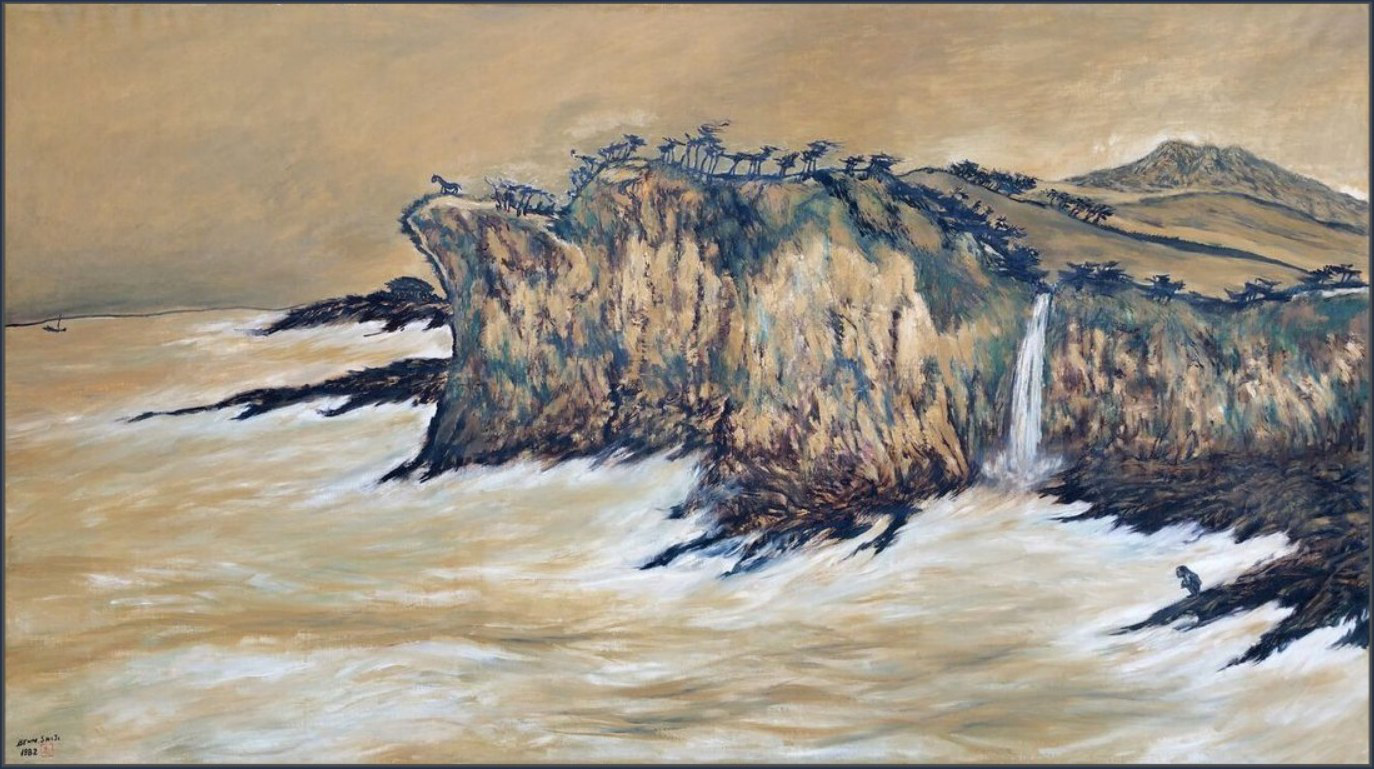
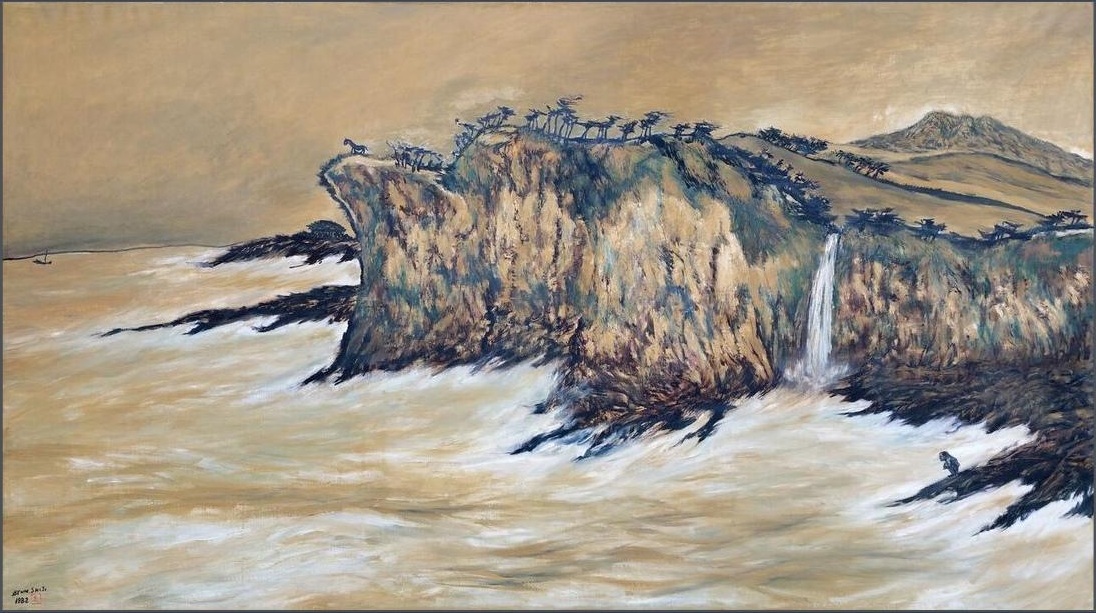
In Typhoon (1983), the spreading light of the waves meets the dark marks forming the cliff. Following the sea’s movement, the eye encounters the waterfall’s thin vertical and briefly changes direction. A small directional difference lies within the larger surge. The force of the painting comes from that difference, not roughness alone.
For a nocturnal sensation to remain as painting, it must meet an eye that does not share the initial excitement. The viewer has not lived through the painter’s night. If the picture can nevertheless hold that viewer, experience has acquired a form that reaches another person rather than remaining enclosed in private secrecy.
The Painting Before Us Again
A drunken night need not culminate in a miracle of inspiration. It may be followed by looking again: removing today what seemed worth keeping yesterday, or attending to a small form previously overlooked. Creation also includes that slower time of reconsideration.
What matters between intoxication and creation is therefore not only a force dissolving boundaries, but also a force choosing relationships. A painting grows between what is released and what is retained. Remembering the hand attending to that interval keeps the painter’s night from hardening into a legend.
Between the broad movements of water, a waterfall descends in a thin line from the cliff.