Research/A Hundred Years of Wind/Ⅱ Figure & Being
Ⅱ Figure & Being · 23 / 100
The Walking Figure
The Philosophy of Walking: Distance Known by the Body
산책하는 사람
Look First at the Step
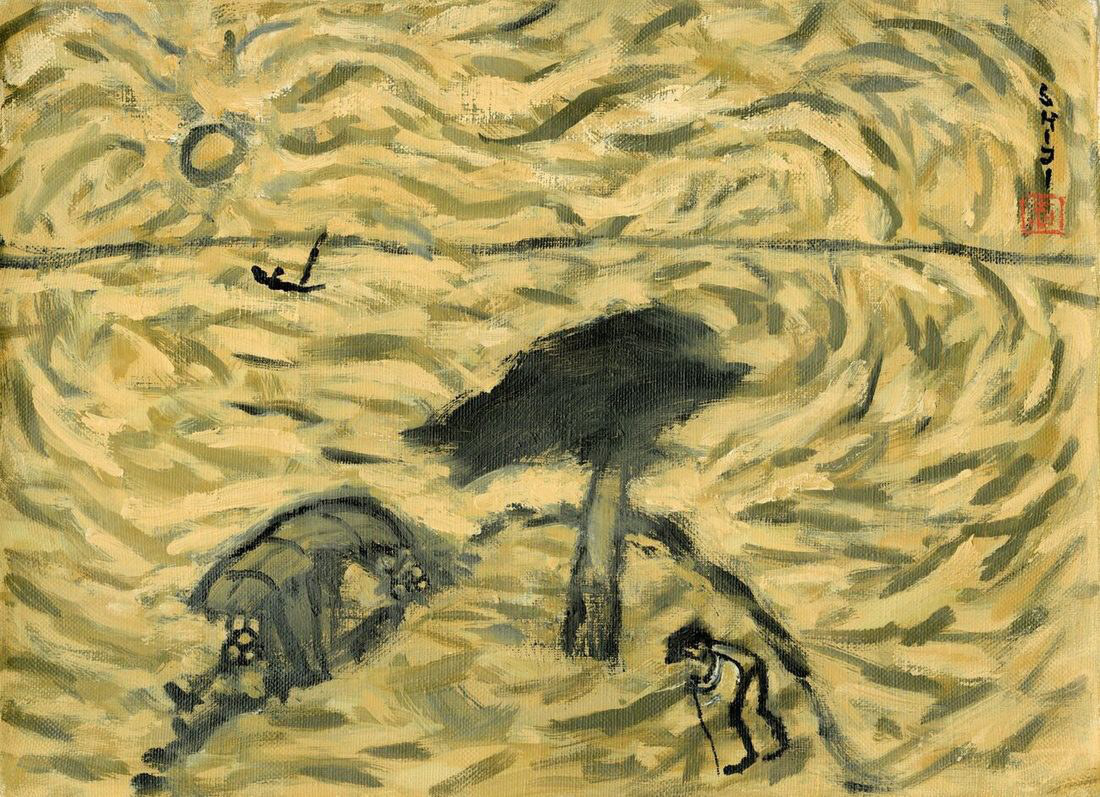
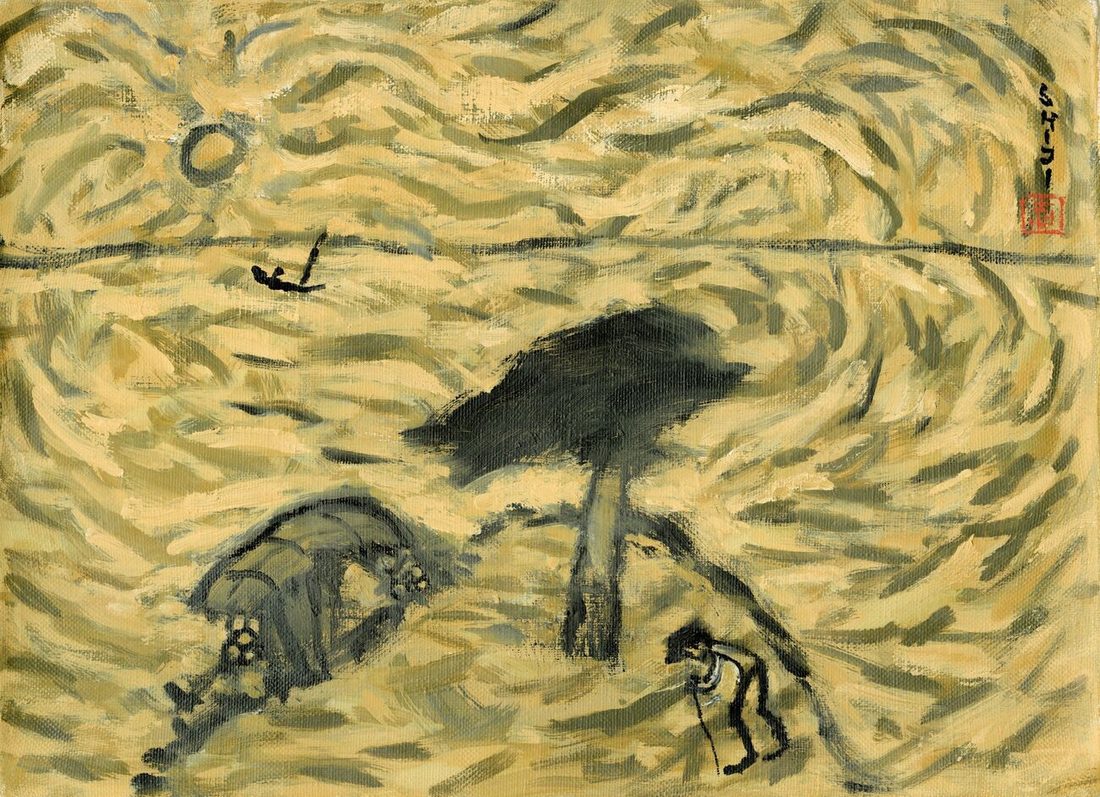
At the lower right of Noon (2007), a person leans on a staff. The back is bent, and the nearby tree carries a broad, dark crown inclined to one side. Short curves move around them. Before asking where the person is going, this picture lets us ask with what kind of body they go.
Walking, in this chapter, does not rename that scene as leisurely recreation. It asks how a walk after work differs from one absorbed in thought or interrupted by rest. Walking does not give everyone the same experience. What is held and the ground underfoot matter alongside speed.
No actual footsteps sound in the painting. Movement is sensed through the separation of legs, the body’s inclination, and the arrangement of figure and path. The step does not unfold inside the canvas, but the eye links what lies before and behind the body. A still form allows us to construct a step.
Walking into Thought
In an 1847 letter to Jette, Kierkegaard connected walking with his thinking. Roger Poole’s review, which reproduces the letter in part, also discusses walks taken in imagination in Kierkegaard’s correspondence. Walking here is not merely a rest from philosophy. It is one way for thought to continue in another form.
But one person’s letter cannot be treated as a prescription for every body. Walking is not available to everyone, and not every distress is dissolved by it. In bringing Byun Shi-Ji’s figures into this comparison, the point is not to make walking proof of a healthy mind. It is to recognise the differing conditions of thinking bodies.
We do not know what the painted person is thinking. They may be attending to the landscape or calculating an everyday task. The absence of depicted thought does not mean the absence of thinking. Preserving what we do not know returns the figure from a symbol of natural sensation to a person.
The City Stroller and the Coastal Body
Benjamin’s urban flâneur is not simply an observer standing outside crowds and commodities. Shops and the street’s spectacles also draw the stroller in. Freedom to look overlaps with the experience of having one’s attention captured. Reading the urban walk as pure leisure loses this tension.
Different visual conditions appear in Byun Shi-Ji’s coastal scene. In The Road Home, broad darkness and white waves fill the space behind the person instead of shop displays. The comparison does not divide calculating city dwellers from sensing islanders. It asks how the scale, density and direction of what approaches eye and body differ.
This difference prevents isolation from being casually renamed freedom. A sparsely inhabited road need not be easy. A distance may feel longer because no one is nearby. Behind the first impression of a quiet landscape, the conditions of a body that must pass through it reappear.
Distance First Measured by the Body
Merleau-Ponty’s phenomenology does not treat the body merely as an object commanded by the mind. The body already relates to the world through possible movements and reachable distances. Before becoming coordinates, space is experienced as somewhere a hand can reach and a foot can be placed.
From this perspective, a slope seen beside a laden body is not merely a shape of measurable height. Through the inclined back and shortened reach of a step, it approaches as a distance to ascend or cross. Landscape has a scale beyond measurement alone. Its meeting with the body’s possible movements gives it another weight.
This does not mean that nature unilaterally determines the body. A person stops, turns and seeks support. Small choices alter the relationship with space. While fūdo leaves traces on the body, the body also makes a way within it.
Reading the Staff Beyond Deficiency
In discussions of Byun Shi-Ji’s figures, the staff is often called a sign of injury or age. Yet a staff does not indicate only what a body cannot do. It creates another point of contact between body and ground. In a posture supported by a staff, the hand’s exertion also participates in the distance beneath the feet.
There is no need to make the body without a staff a perfect standard and describe others by deficiency. The body to consider is not an imagined one deprived of its aid, but the body standing with that aid now. Support is not merely the opposite of independence. It is also a relationship through which movement becomes possible.
Nor must the staff be called a third leg or assigned a fixed walking rhythm. How it is placed and how much weight it takes must be examined in each work. Before gathering it into one symbol, we look at the particular meeting of hand, shaft and ground.
The Same Path Is Not the Same View
Painting a place repeatedly does not mean seeing the same thing each time. A slight movement changes the interval between house and sea; lowering the gaze enlarges the nearby ground. Collecting distant views and attending to differences within one place are different practices. Neither alone guarantees depth.
Byun Shi-Ji’s recurring motifs can be read through such differences. Even when person and horse reappear, scale, spacing and line weight need not remain the same. Meeting a homeward journey in another picture is more than confirming a meaning already known. Familiar forms can lead us to differences previously overlooked.
The painted step and the viewer’s movement come closer here. The figure remains in one posture, while we encounter different distances as we move between works. Repetition need not be merely marking time. It can make a place look different upon return.
A Resting Body Also Belongs to the Road
In the lower right of Where Do We Come From, and Where Are We Going? (1992), a person sits low with legs extended. The head is lowered, and a horse stands nearby. We cannot establish death or defeat from this posture. But neither can we say that every figure always stands or walks.
This scene restores the pause to a philosophy of walking. A road does not belong only to those able to move without interruption. Places to sit and lean are also part of it. To declare that will has ended because movement has stopped is to judge speed before attending to the body.
The horse beside the resting person prolongs our attention to the pause. Another living being is near, and the large mountain stands behind. The body’s lowered position does not erase the person. Instead, the small place it occupies makes us reconsider the scale of the surroundings.
A World Within Reach of a Step
To call all of Byun Shi-Ji’s walking an ordeal would erase the lightness of a stroll and the necessity of rest. To call it all peaceful strolling would erase heavy loads and difficult ground. Between those accounts, the paintings allow different bodily paces to become visible.
Slowness is not a morally superior speed. What is needed here is a gaze that does not hurry to assign meaning. Before declaring what the person has overcome, it notices what supports them. Before asking how far they will go, it looks for the place of the next step.
The road extends into the distance. On the ground nearby, there is room for a foot.