Research/A Hundred Years of Wind/Ⅱ Figure & Being
Ⅱ Figure & Being · 22 / 100
The Road Home
The Place One Must Inhabit Again
귀로(歸路)
Who Is Going Home?
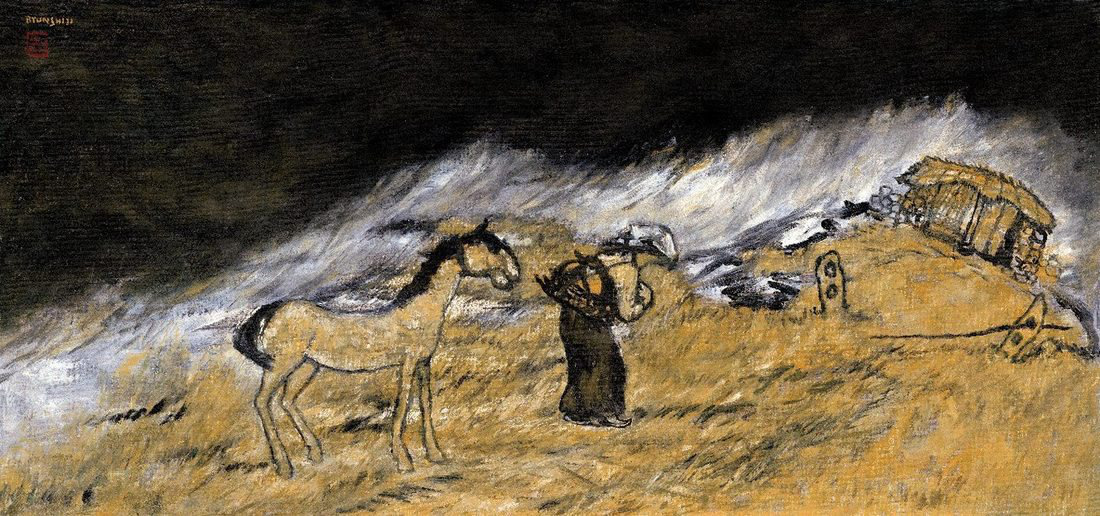
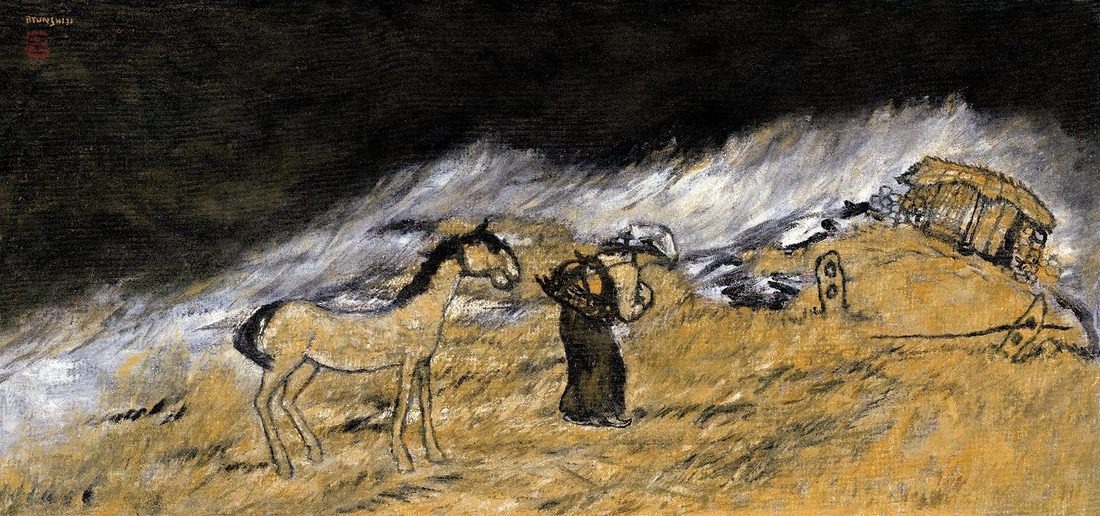
In The Road Home (1991), a horse and a person stand beside one another. The figure bends beneath a rounded load on the back, while a low house occupies the upper right. Behind them, bright waves run diagonally beneath a heavy dark sky. The house is visible, but ground still separates it from the person.
To identify this figure immediately as the ageing painter would blur the particularity of the load and the life it suggests. The public catalogue commentary describes a woman carrying a water jar. At the least, this homeward journey cannot be reduced to an old man’s monologue. It can accommodate the bodies of different people returning home.
A road home does not belong only to the great event of returning from another country. It also belongs to the journey after a day’s work, carrying a load. A body still bearing weight and a small house it can approach bring the title close to ordinary life.
Seeing the House Is Not Arriving
The house is not a sign that resolves everything at the edge of the picture. Its low roof is not detached from the turbulent setting. The forces surrounding the person do not stop at the doorstep. Having somewhere to return and rest is different from possessing shelter against every difficulty.
The interval between person and house therefore matters. The eye moves from the laden body to the house and back again. It returns from distant rest to the weight that must still be carried. Homecoming is not only the name of a destination; it is also what a body does in reaching it.
An indistinct end to the road does not establish a lack of purpose. The house may be a destination, and the load may suggest a task. What is not omitted is the process of reaching it. The small person remains before the house in our attention.
After Reaching Ithaca
In Book XIII of the Odyssey, Odysseus reaches his homeland without immediately recognising it. Through the mist cast by the goddess, Ithaca appears unfamiliar. The difficulty of homecoming is not confined to the distant sea. The returned place must still be recognised.
Nor do all journeys end with the reunion in Book XXIII. Odysseus tells Penelope of the prophecy requiring him to carry an oar to people unfamiliar with the sea. To divide Western homecoming as complete from Korean homecoming as unfinished misses this narrative itself. Work remains after the house has been reached.
Byun Shi-Ji and Odysseus cannot be superimposed: one is a historical painter, the other an epic figure. Yet reading them together reveals an interval between arrival and homecoming. The returning person does not simply recover a place. Changed by what has happened, they must begin living there again.
Two Returns in One Life
Byun Shi-Ji returned from Japan to Korea in 1957 and moved from Seoul to Jeju in 1975. Can the two movements be called the same kind of return? Between returning to a country and inhabiting one’s native island again lies time lived elsewhere.
Those two dates cannot explain every change of mind. Nor can the first day of arrival be made identical with the completion of a new style. Looking at another place through an acquired method may bring moments when the method no longer fits. To seek the time of return in painting means attending to changes of form, not only an accomplished manner.
From this perspective, homecoming is not a retreat into the past. What was learned in Osaka and Tokyo, what was painted in Seoul, and what was encountered in Jeju can remain together in one hand. When no period is dismissed as failed preparation, the time held by the returning work becomes more complex.
More Than One Way to Read a Back
A figure turned away directs attention from the face towards what that person sees. Friedrich’s Wanderer Above the Sea of Fog likewise leads the viewer into a landscape through a figure seen from behind. The device belongs to no single culture. What matters is the scale and height at which that back is placed.
Comparing Friedrich’s figure on elevated rock with Byun Shi-Ji’s laden body shifts the position from which we look. But there is no need to end the comparison with conquest for one and humility for the other. It is more precise to examine how each picture arranges obscured vision and uncertain distance.
In Byun Shi-Ji’s homeward scene, the eye lowers itself along the figure’s posture. The weight of the load and the nearby ground come first. Even a gaze reaching into the distance returns to a place where feet must be put. The landscape is something to see and somewhere that person must pass through today.
The Horse Beside the Journey
The horse in The Road Home is not a pedestal raising the person above the ground. The two bodies occupy separate places on nearby earth. The figure folds beneath the load; the horse’s long neck makes another curve beside it. Without becoming identical, the two forms share the picture’s movement.
Companionship does not remove this difference. We cannot establish who leads whom, or whether they move at the same pace. Yet this is not a homeward route containing only one body. Another living body beside the person brings return closer to relationship than to possession or achievement.
To call the horse salvation would resolve the scene too quickly. Ground still remains before the house, and the person’s burden has not vanished. Being together does not solve the difficulty. It does, however, prevent the road from being read solely as one person’s inward experience.
Remembered Home, Inhabited Home
Home in memory is easily held at the moment of departure. In the place returned to, however, other people’s time has continued. Those who remained had lives of their own; houses and roads may have changed. To explain the place only through the returnee’s longing makes its inhabitants disappear.
The laden person in The Road Home turns our attention away from that risk. Home is not a landscape that merely waits for the returnee. Within it, someone must carry water, tend a house and go out again. Such particular lives make homecoming larger than an image of nostalgia.
To read fūdo as a condition of living is to notice this reciprocity. A place changes people, and within it they make paths, houses and relationships. The returning painter cannot stand outside that exchange. The home he paints again is not an answer already known, but a place to be seen anew through inhabiting it.
The Road Does Not End at the Door
At home, the load may be put down. But the painting does not give us that scene in advance. It holds together the weight still on the back and the house not yet reached. While the title names return, the image retains the bodily time that return requires.
For this reason, Byun Shi-Ji’s road home is neither a promise of complete repose nor a declaration of eternal failure. It is a road on which arrival is possible and life must begin again. To say that return is impossible passes over this body, just as saying everything is restored by arrival does.
The low roof is visible. The load is still on the person’s back.