Research/A Hundred Years of Wind/Ⅱ Figure & Being
Ⅱ Figure & Being · 21 / 100
The Time of Waiting
Time Within a Still Painting
기다림의 시간
Between Boat and Shore
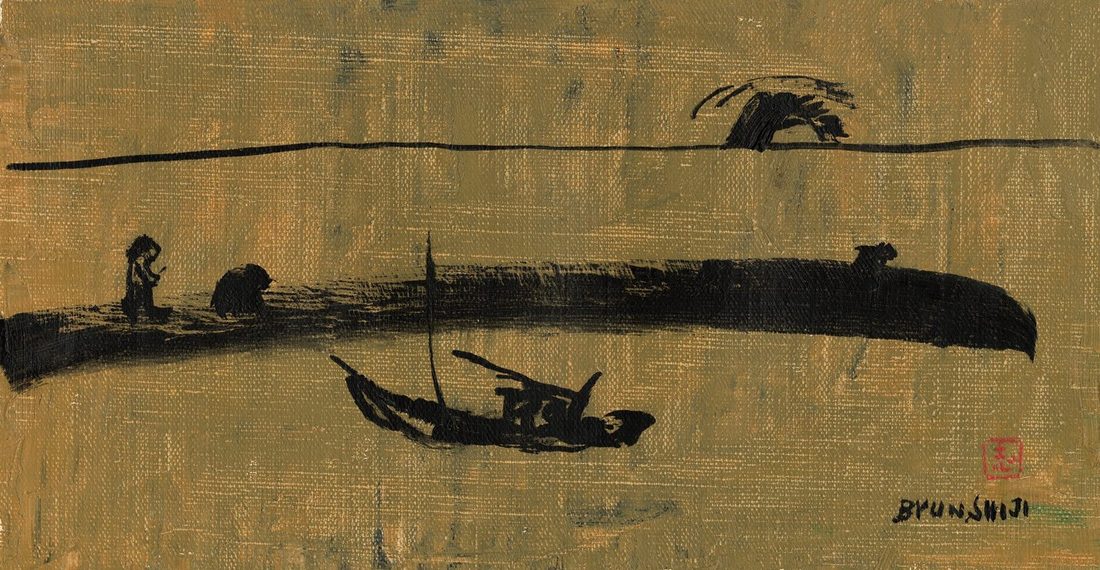
In The Jetty (1979), a broad black strip of land crosses the picture. A boat lies before it, and a small figure occupies the shore on the left. Above them are a long horizon and a tree bending to one side. Boat and person seem close, yet they do not touch. The narrow stretch of water between them holds the eye.
The picture does not tell us whether the boat has just arrived or will soon depart. Nor does it identify anyone the figure may be waiting for. Yet the absence of movement does not eliminate waiting. Leaving a distance that seems possible to cross, the painting withholds the next moment.
Waiting approaches here not as a facial expression but as a form of relationship: boat and shore, person and water, what is near and what has not yet been reached. Seen separately, these are ordinary things. Placed together, they make the eye wait briefly for something to happen between them.
An Unnamed Object of Waiting
An object of waiting absent from the picture need not be absent from the figure’s life. Someone may be outside the frame; the figure may be absorbed in something unrelated to the boat. What is not depicted is not necessarily nonexistent. Preserving that distinction also preserves the painting’s silence.
In Samuel Beckett’s Waiting for Godot, speech, gestures, visits and changes take place during the wait. Godot’s deferred arrival does not empty the stage of time. Small actions fill the interval, making it difficult to bear while also keeping the characters in one another’s company.
What emerges from placing the two artists together is not an opposition between Western emptiness and Eastern fullness. While something has yet to arrive, what is already nearby becomes perceptible. Beckett unfolds time through speech and recurring actions; Byun Shi-Ji leaves it open through separated forms and intervals.
How Long Can a Moment Last?
In Laocoon, Lessing distinguishes forms placed beside one another in space from actions succeeding one another in time. He does not, however, exclude time from painting: the condition of a body can suggest preceding or subsequent action. A still form can be a way of presenting time rather than negating it.
In Byun Shi-Ji’s jetty, clues to an event are sparse. The eye cannot proceed directly to a conclusion such as arrival or departure. It looks into the boat’s dark interior, then returns to the thick shore. It follows the horizon and comes down again to the small figure. The same picture is traversed differently several times.
Three kinds of time need distinguishing: the time suggested by the picture, the time spent making it, and the time we spend looking now. None directly proves the others. Where they meet, however, even a briefly drawn line can acquire the power to sustain attention.
The Returning Gaze Is Not the First
In Time and Free Will, Bergson distinguishes time counted as separate units from the duration of experiences that interpenetrate. In hearing a melody, an earlier note is not simply abolished and replaced by the next. It remains, altering how the following note is felt.
Something comparable can be considered before a painting. The first impression of the boat does not disappear while we examine the horizon. On returning to it, the surrounding openness may feel wider. What has changed is not the boat’s position but a gaze in which previous impressions have accumulated.
There is no need to take this as evidence that the artist painted Bergson’s theory. Philosophy is not an answer substituted for the picture, but a means of examining how we look. The time of waiting does not lie finished inside the canvas. It gradually takes shape in the encounter.
Lines That Make a Pause
The horizon in The Jetty is long and thin. The shore below is thick, while fine vertical and diagonal lines rise from the boat. Although all are black, their weights and directions differ. The long line carries the eye sideways; the crossings of smaller lines catch that movement.
A sense of waiting can arise between these two actions. The eye moves towards the distance, then pauses nearby. It moves again without immediately reaching an end. We need not decree that the vertical means humanity and the horizontal eternity. First, we can observe what the lines ask the eye to do.
The bending tree participates in this process. Within a world stretched horizontally, its form is pulled to one side. The picture is still, but its directions do not settle into complete agreement. A small discrepancy within the pause preserves the possibility of another moment.
A Waiting Body Has a Life
A jetty is not a place reserved for abstract waiting. It is a passage of departures and returns. A pause there may be a brief rest for one person and a period in which work cannot begin for another. The weight of waiting changes with the life in which the same posture occurs.
Time without visible activity cannot always be called the fullest time. Some choose to wait; others have no choice. The painting’s beauty should not erase that difference. The smaller the body appears, the more carefully we must avoid speaking in its place about the conditions it bears.
Fūdo here extends beyond an atmosphere of wind and sea. It includes when a person can move and when they must stop, and distances that cannot be crossed despite their closeness. Looking at the picture’s intervals also means leaving room for different lives within them.
Between Enduring and Waiting
Enduring and waiting do not separate neatly. Waiting may require endurance; enduring may involve waiting for something. Two times overlap in a lowered head: the time of bearing the present and the movement of attention towards what has not yet come.
The painting does not say which predominates. The figure is small, and the face is insufficiently visible. Rather than easily reading an expression, we attend to the person’s placement: the distance to the boat, the width of the shore, the space above. When the mind cannot be declared, relationships become more distinct.
The viewer’s memories may enter these relationships. Yet my memory should not become the painted figure’s biography. A picture recalling my own waiting is different from its person having undergone the same experience. Resemblance can remain without being forced into identity.
Leaving the Next Moment Open
Byun Shi-Ji’s painting does not resolve waiting. It does not move the boat up to the person or summon the awaited object from outside the frame. Instead, it leaves a distance across which a relationship remains possible: not contact, but not complete disconnection either.
Remaining before it, we gain less an event than a different pace of looking. First there is the boat. Then there is the interval between boat and shore. Finally, we cannot pass over that interval as something we had already noticed. The question shifts from what is coming to what we are still looking at.
The boat does not touch the shore. The light on the water between them stays a little longer.