Research/A Hundred Years of Wind/Ⅰ Nature & Fūdo
Ⅰ Nature & Fūdo · 15 / 100
Fūdo and Painterly Style
Making One’s Painting Within Given Conditions
풍토와 화풍
Between Wind and Line
In speaking of Jeju’s wind, we may begin to regard the black line as its inevitable result. Yet much work lies between actual wind and a mark on canvas. Which scene will be attended to? How much retained in memory? Where will paint be placed, and where will the stroke stop? The relation of fūdo to painterly style begins with recovering this intervening work.
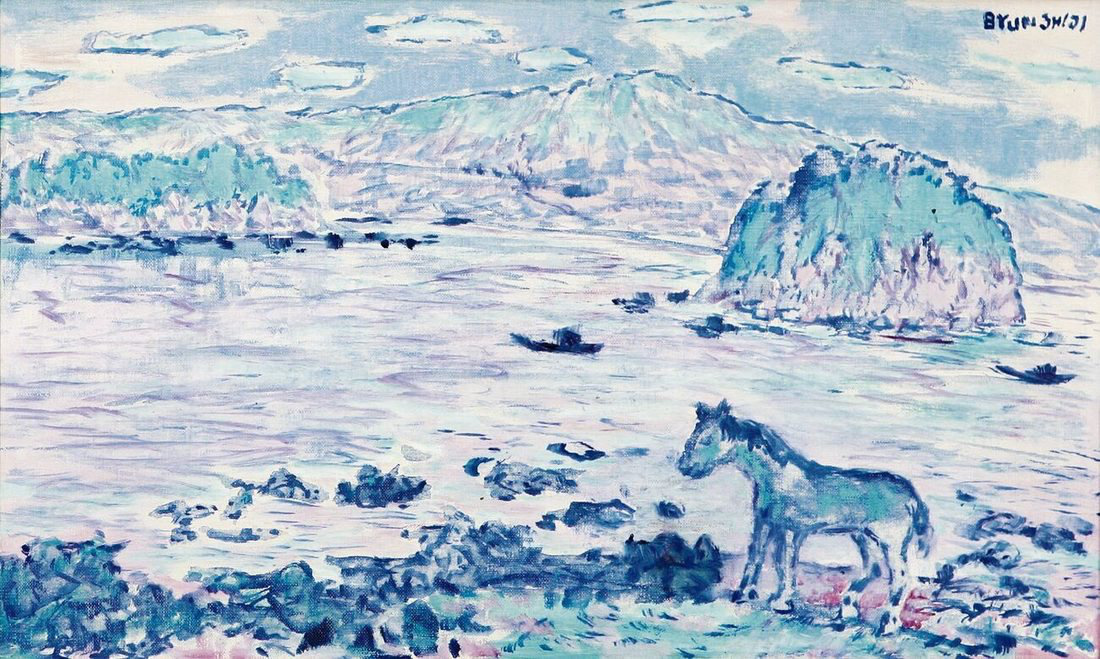
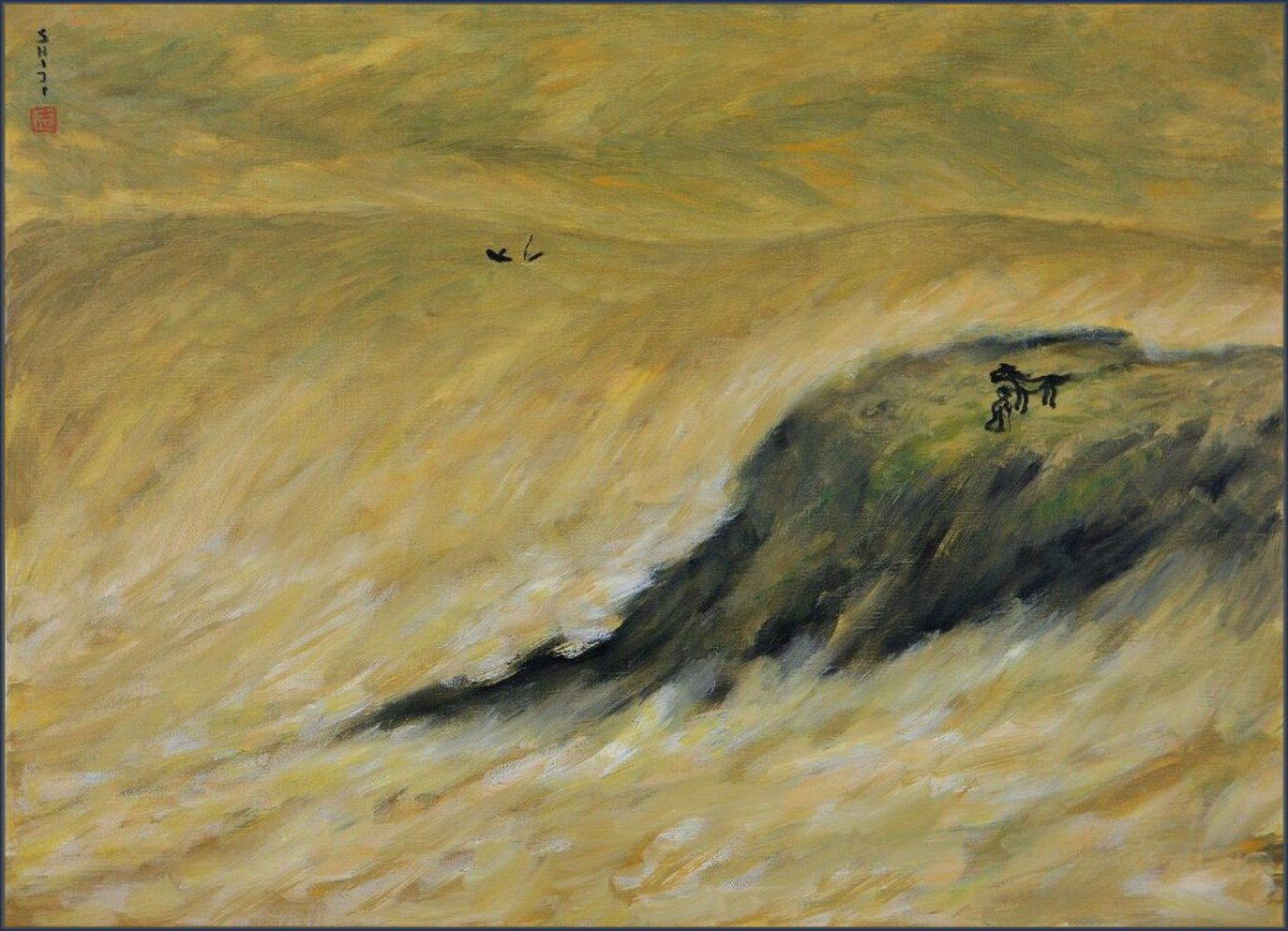
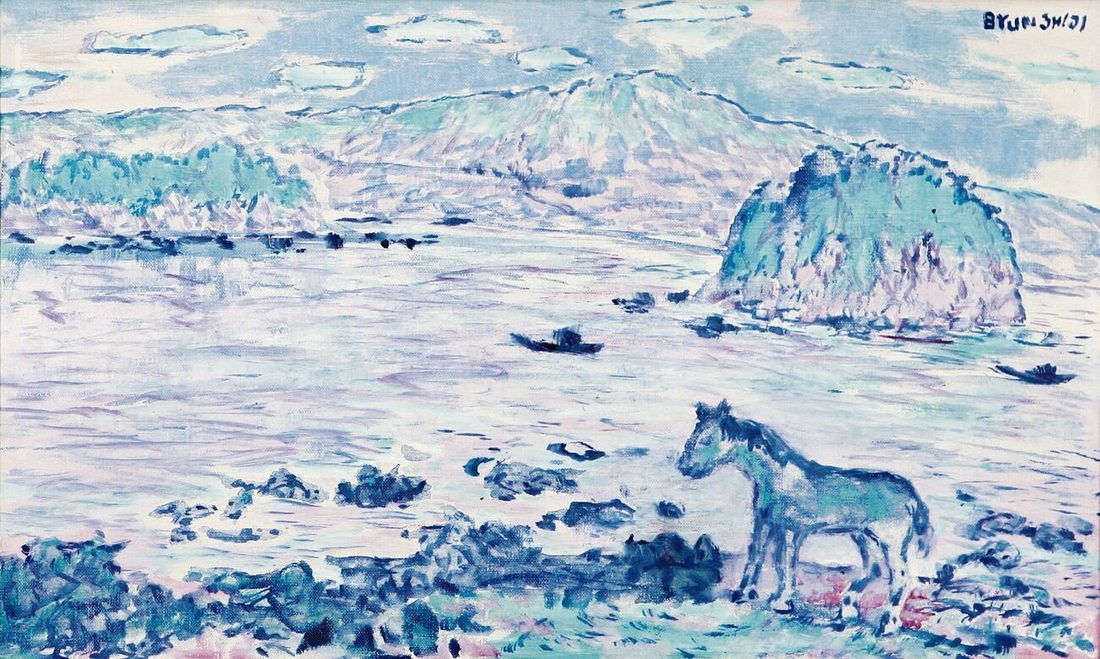
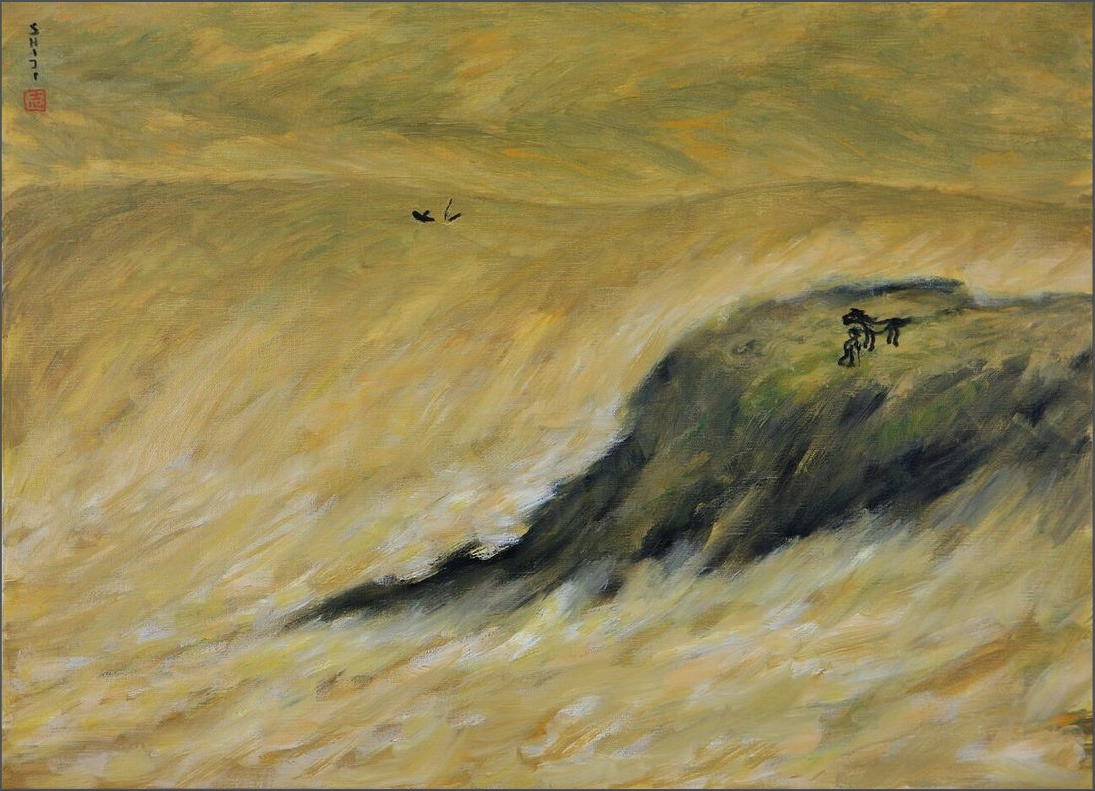
The blue sea of Jeju (1976) and the yellowish diagonals of A Wavering Horizon (2005) present different pictorial versions of Jeju by the same artist. Two works cannot explain the whole development of a style. They nevertheless make it visible that the name Jeju does not automatically specify one colour or one form. The same place can become different problems of painting.
It does not follow that an independent mind, unconcerned with fūdo, decides everything instead. What can be seen, the rhythms of living, acquired skills and available materials participate in choice. Conditions and freedom are not two powers that first exist separately and then contend. Pictorial freedom is closer to deciding which relations to alter while responding to what is given.
Watsuji: Weather Is Not Ours Alone
One route into Watsuji Tetsurō’s account of fūdo is to consider relations among people as well as those between people and weather. Jin Baek emphasises this interpersonal dimension in his study of fūdo and sustainability. Ways of responding to cold or heat do not end with an individual observing an environment alone. Shared spaces and other people’s actions enter into the experience.
This perspective lets us look again at the small house and stone wall. A dwelling is not an individual box completely detached from nature, nor is a wall solely a line excluding weather. They divide and connect places in which life becomes possible. The more we read fūdo through bodily experience, the more we can attend to the daily practices and other people’s work that provide a place for bodies.
This relational approach need not become a scheme in which climate determines national character. People encountering the same weather have different circumstances and responses. Watsuji is an interlocutor for this reading, not a figure established here as a direct influence on Byun. The value of comparison lies less in making the painter an instance of a philosophy than in revealing relations previously overlooked in the painting.
Heidegger: Relations Gathered by Things
The bridge in Heidegger’s Building Dwelling Thinking is not explained merely as an object to which symbolism is later attached. He describes it as a thing gathering earth and sky, divinities and mortals. The question to borrow is not which four elements of a painting match four philosophical categories. It is what relations a thing allows to gather in one place.
Bringing that question to a painted house lets us examine the distances a small building establishes within an extensive field: between house and shore, house and person, low roof and high sky. Its meaning is not already complete inside the shape of the roof. It changes with the ways surrounding things allow the house to be seen, and from where.
This reading of dwelling differs from the judgement that only long residence produces profound art. Dwelling and movement need not be ranked. Those who remain enter relations with elsewhere, and those who move experience the conditions of places where they briefly stay. Byun’s return can likewise be read less as recovering a pure homeland by discarding time elsewhere than as placing learning from several places into new relations.
Deleuze and Guattari: A Place Made Through Recurrence
Reading Deleuze and Guattari’s territory solely as a sequence of changing addresses loses the question of expression. In his study of the refrain, Guillaume Collett centres the conjunction of expression and territory, treating territory as formed and transformed relationally. Following this discussion, a painter’s recurrence can be examined as more than the reappearance of a motif: it can establish recognisable relations and open them again.
A horse or boat isolated from a Byun painting does not explain his style. Scale, spacing, surrounding colour and density of line act together. When familiar elements return in related arrangements, we recognise a painter’s world. Yet a small alteration in those relations can generate another sensation within that recognisable world.
This can be read metaphorically as making a pictorial territory. The point is not ownership of Jeju, but the renewed organisation of where the gaze pauses and across which interval it moves. That organisation can change while the place-name remains the same. Through recurrence, the picture finds a place while gaining the possibility of altering the place it previously established.
For this reason, departure will not simply be labelled deterritorialisation and return a completed reterritorialisation. A consequential change can arise within pictorial relations without movement on a map. Conversely, travelling far does not necessarily make a form new. Philosophical terms should work as tools for asking what actually changed, rather than as labels attached to an itinerary.
Different Materials, Different Relations
SFMOMA records oil, straw, emulsion and a gelatin silver print on linen as the materials of Anselm Kiefer’s Margarethe (1981). Straw enters here as actual material, not solely as the painted appearance of grass. This allows a concrete comparison between placing material within a picture and using paint to evoke a surface.
Andy Goldsworthy’s work cannot all be described as natural objects briefly existing before disappearing. Storm King Wall (1997–98) was conceived as a permanent installation. According to Storm King Art Center, Goldsworthy designed and supervised it, while five skilled wallers built it. Engaging with place includes not only natural change but knowledge of materials and the work of several people.
In Byun’s Where Do We Come From, and Where Are We Going?, brush marks composing a cliff let us perceive the surface of another material. An actual rock and a painted rock do not become identical. Painting does its work as we sense weight across that difference. Comparing this picture with one painting by Kiefer and one installation by Goldsworthy reveals different ways of introducing material and making place available to experience.
These differences should not be fixed into three labels: accusation for Kiefer, union for Goldsworthy, translation for Byun. What one work does cannot be applied unchanged to an artist’s whole practice. The comparison nevertheless prevents Byun’s distinctiveness from being explained by the uniqueness of his location alone. A language for reading artists alongside one another requires attention to materials used and relations retained.
Choice Is Not Outside Conditions
The relation between fūdo and style is not a sequence in which nature gives once and the artist makes once. What is seen while painting may alter the next encounter with a landscape. After a line has been found, an incline previously overlooked may become noticeable. While the world conditions painting, painting can also condition a renewed way of seeing the world.
This reciprocal movement can be proposed critically as fūdo modernism. It means more than translating regional subject matter through modern techniques. Acquired forms are tested again in a lived place; the resulting paintings, in turn, alter how that place can be seen. The term is offered not as the name of an established school, but as a hypothesis for studying Byun’s form and fūdo together.
The hypothesis needs testing in each work. Rather than stop at saying that wind resembles line, we must ask which mark produces what distance or relation. We must also distinguish abandoning what was learnt elsewhere from using it differently. Distinctiveness can arise less from a purity severed from outside relations than from the way what has been received is arranged anew.
The question of whether climate determines art finally requires more than affirmation or denial. Which conditions became which forms, through what experiences? What did the painter choose in that process, and what remains in the picture? Continuing to ask these questions lets fūdo become not a word explaining everything, but a way of approaching one work more closely.
A black line lies on the dried-grass-coloured ground. Where the line stops, the ground continues. The eye passes its small ending towards a place not yet painted.