Research/A Hundred Years of Wind/Ⅱ Figure & Being
Ⅱ Figure & Being · 16 / 100
Nostalgia for the ‘Primitive’
Looking Anew Without Returning to the Past
원시에의 향수
What Remains in a Spare Painting
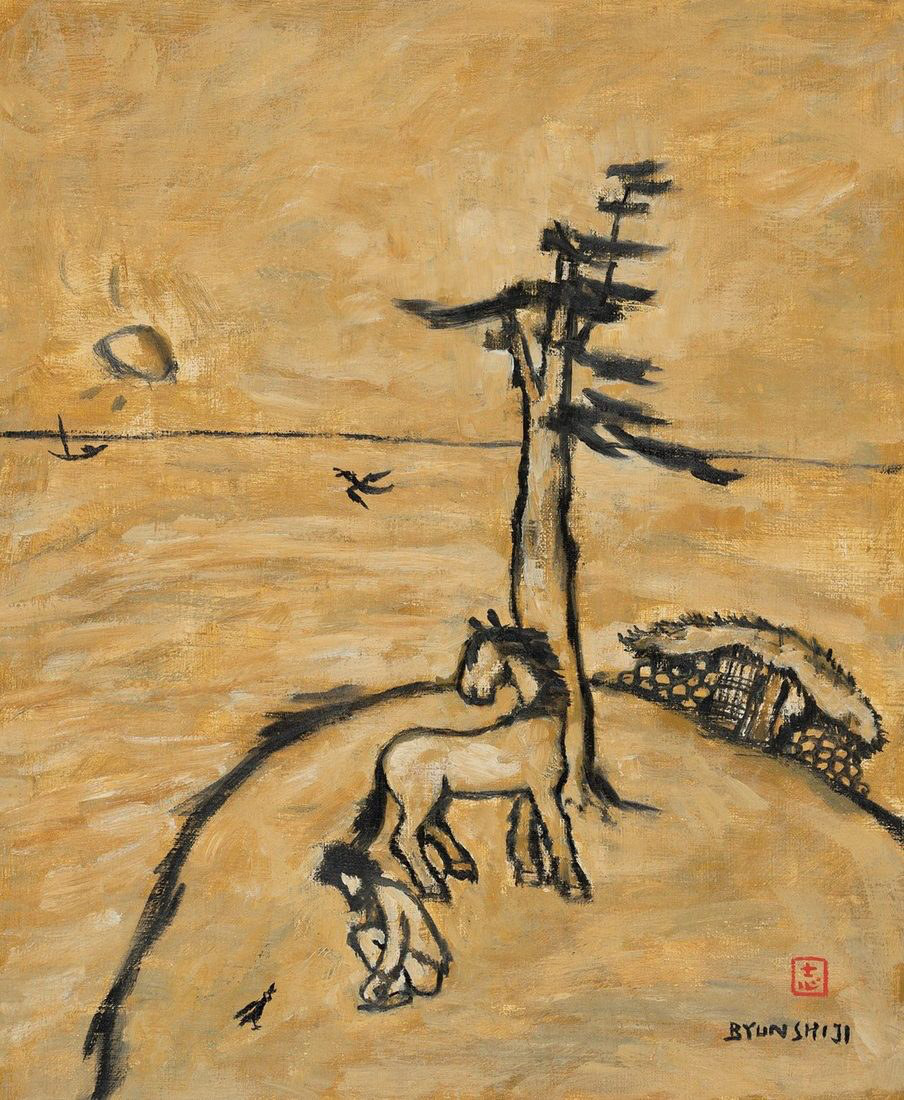
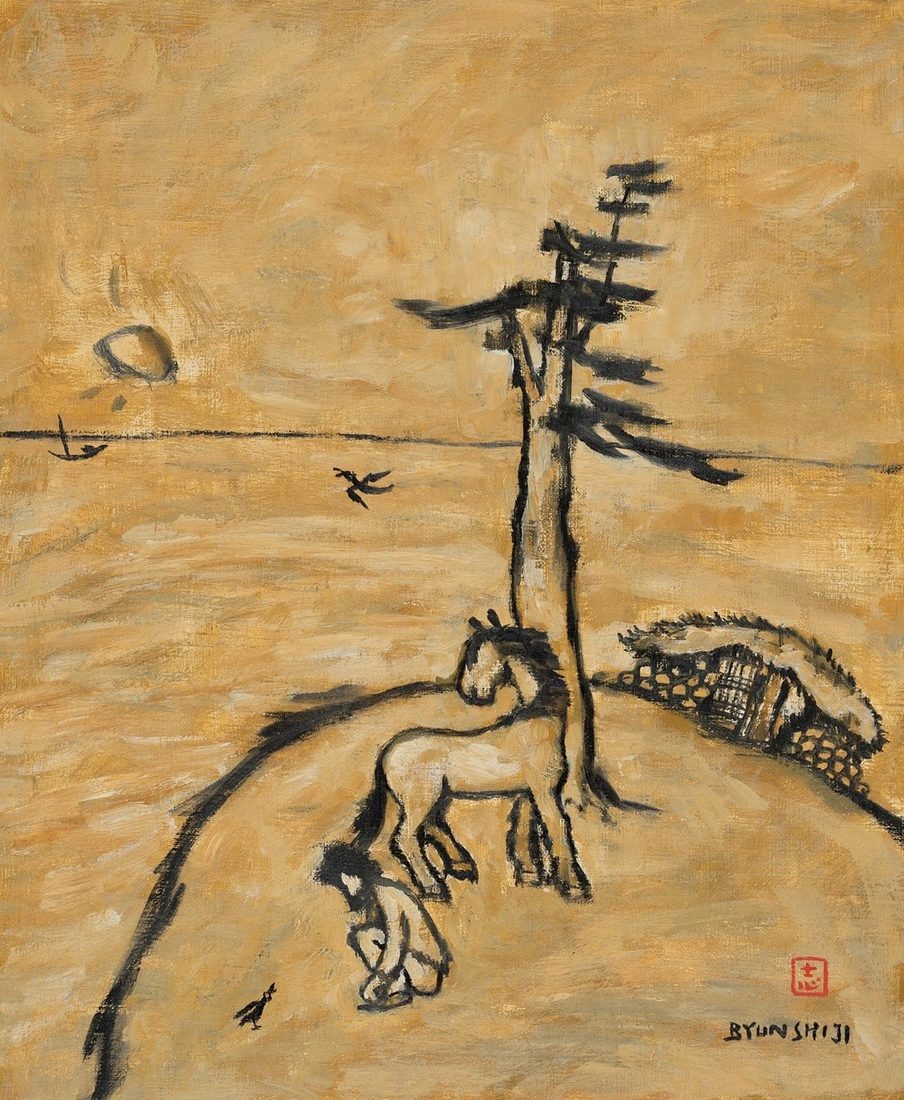
Dialogue (1986) contains a small person and horse, a tree and a house. Against the broad ground, these seem few. Look more closely, however, and the house retains the pattern of stacked stones and lines dividing its entrance. The body folds in on itself, while branches extend in different directions. Behind the first impression of simplicity lie small distinctions that make different things recognisable.
To call this Jeju before civilisation risks overlooking the human work that remains in the image. A house is not a rock that has risen by itself, nor has a distant boat grown out of the sea. Those small forms can hold the activities of making, repairing and travelling. A reduction of pictorial detail does not mean that the life represented lacked history or skill.
Before asking about nostalgia for the primitive, then, we should ask what has been reduced and what retained. Ornament is sparse, but the placement of things is not arbitrary. Horse and person do not merge into one; the house occupies a separate place nearby. Simplicity need not abolish distinctions. It can use a few of them to sustain our attention to relationships.
The Word “Primitive” and an Unfamiliar View
The word primitive can carry different desires: to revisit an old form, to move beyond familiar techniques, or to approach sensation before explanation. Yet once it begins to classify other people’s lives as less developed, the eye that sought renewal confines those lives within an inherited frame. A desire for freshness does not by itself make the language of that desire innocent.
Here the term does not name a historical stage of Jeju. It poses a question: can a thing we believe we know become unfamiliar again? Painting a pine need not mean repeating the same branches; painting a house need not mean placing the same roof. Change begins when we notice that an acquired formula has started to do the looking for us.
A renewed eye is not an eye without memory. We need some awareness of what we have seen before in order to notice what appears differently now. Honesty does not require the erasure of learning. It may require a familiar hand to pause and make room for the difference before it. Purity, used in this sense, is closer to attention than to ignorance.
Old Images Are Not Images Without Skill
The National Museum of Altamira complicates the idea of cave painting as an impulse preceding technique. Its account describes engraving, charcoal outlines, areas of colour and the addition of details. An image’s antiquity does not establish an absence of skill. We should begin with the evidence of particular decisions about materials and surfaces.
This comparison does not establish a direct lineage between Byun and cave painting. It helps us avoid equating economy with inexperience. What is required to make an animal’s body recognisable through a few lines? Which curves must remain, and which details can be omitted without losing direction and weight? The comparison becomes useful at the level of these questions.
The horse in Dialogue has a broadly open interior, yet the lines of back, belly and legs let us recognise a body. The dark strokes of the tree do not perform the same task as the horse’s finer contour. Choices regulate these differences within one painting. To describe the result simply as an abandonment of skill would erase the judgement involved in leaving less.
A Distant Place and a Place of Return
The contrast between discovery and homecoming is likewise insufficient to separate Gauguin and Byun. The Metropolitan Museum explains that Gauguin drew on a photograph of a Borobudur relief for the composition of Ia Orana Maria. A painting made in Tahiti incorporated an image brought from elsewhere. Arrival in a place does not strip away everything an artist has previously learned to see.
The same question remains for the person returning home. Home names a closeness, but it does not guarantee complete knowledge. A remembered house may differ from the one now encountered. Rather than erase that difference by speaking of paradise recovered, we can ask how familiarity and estrangement meet within a painting. Return opens a problem of attention rather than bringing it automatically to an end.
Fūdo is not, on this reading, a storehouse of untouched origins. It is a setting through which lives, memories and acquired knowledge pass. To connect Byun’s painting deeply with Jeju is not to turn Jeju into an unchanging past. The painting’s distinctiveness is better sought in the formal differences produced by looking again than in proof that a place has remained pure.
Precision Within a Rough Line
Rough lines are not all rough in the same way. A spreading stroke and a fine, interrupted mark move the eye differently. A long branch and a branch that stops short also alter the pace of looking. The more spare the form, the more responsibility each direction carries. Roughness can be a way in which judgement becomes visible rather than a sign of its absence.
Nor need a gentle line be called compromise and a broken line truth. A gradual curve can convey weight, while an agitated stroke can become a familiar decoration. What matters is not praising a kind of line but asking whether it is needed for this body in this space. No fixed shape of mark holds an exclusive claim to truth.
An attentive reading of Byun’s simplicity follows this necessity. Seen alone, a black stroke may appear forceful; seen beside the light ground, it reveals spacing and balance. Form includes not only the places where a hand has passed strongly but also those where it has stopped. Such pauses allow a small person to remain distinguishable within an extensive landscape.
A Point of Beginning Again
What may be retained from nostalgia for the primitive is less a belief that the past was purer than a demand to set a settled eye in motion again. It asks us not merely to repeat what we have learned to call beautiful. But rejection is only a beginning. We must follow through to what becomes newly visible in the reduced image.
Simplicity then becomes a relationship achieved in painting rather than the inherent nature of a region. A few colours and lines bring person and horse, house and sea into a shared view. The lives within it do not recede to a time before civilisation. They ask more distinctly where a body finds its place here and now, and how far it stands from another being.
Looking anew has no final completion. Discarding an acquired habit does not finish the task, since a form once discovered can itself become habitual. Looking for longer means recovering small differences within that familiarity. To say less without seeing less: this is the question the word primitive can leave open here, rather than the name of an innocence we can simply recover.
The tree’s black stroke stops. Between its tip and the roof of the house, the colour of dried grass remains.