Research/A Hundred Years of Wind/Ⅱ Figure & Being
Ⅱ Figure & Being · 17 / 100
The Crouching Man
Lowering the Body, Finding a Place
웅크린 사내
First the Knees and the Back
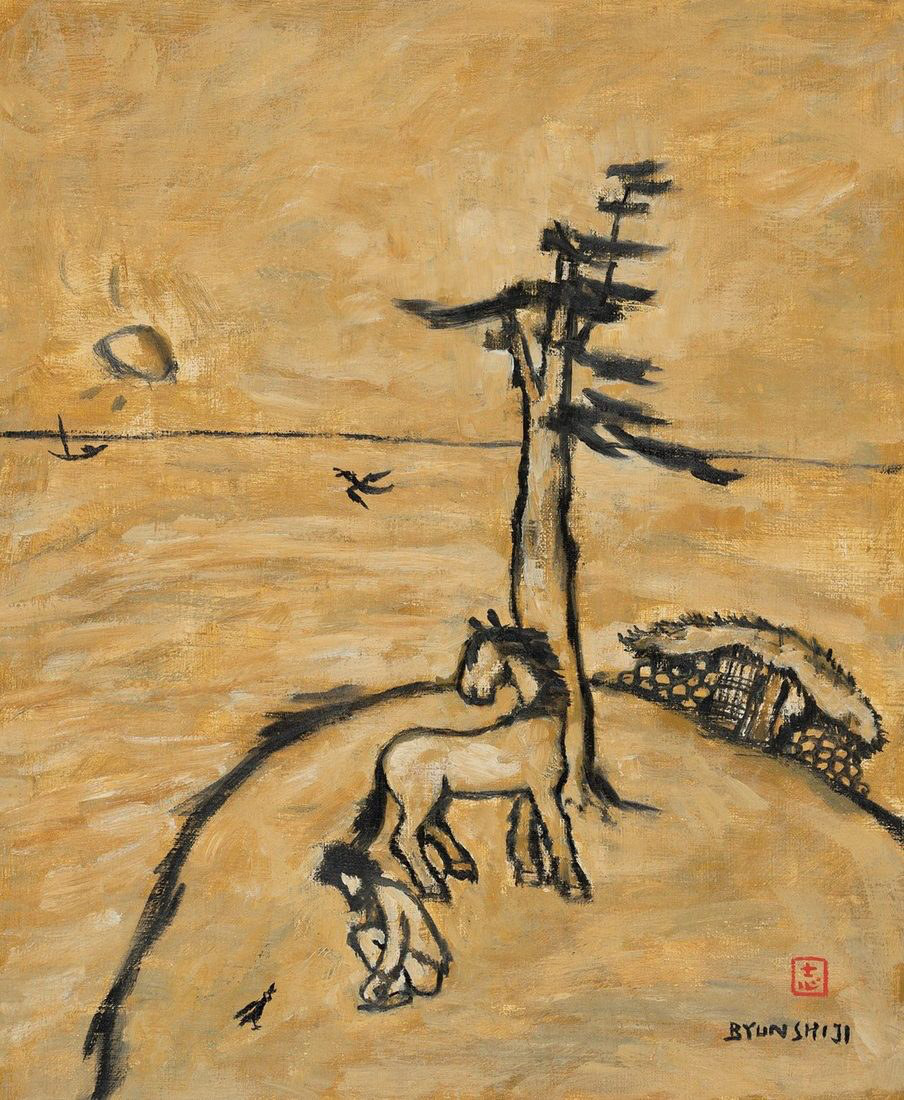
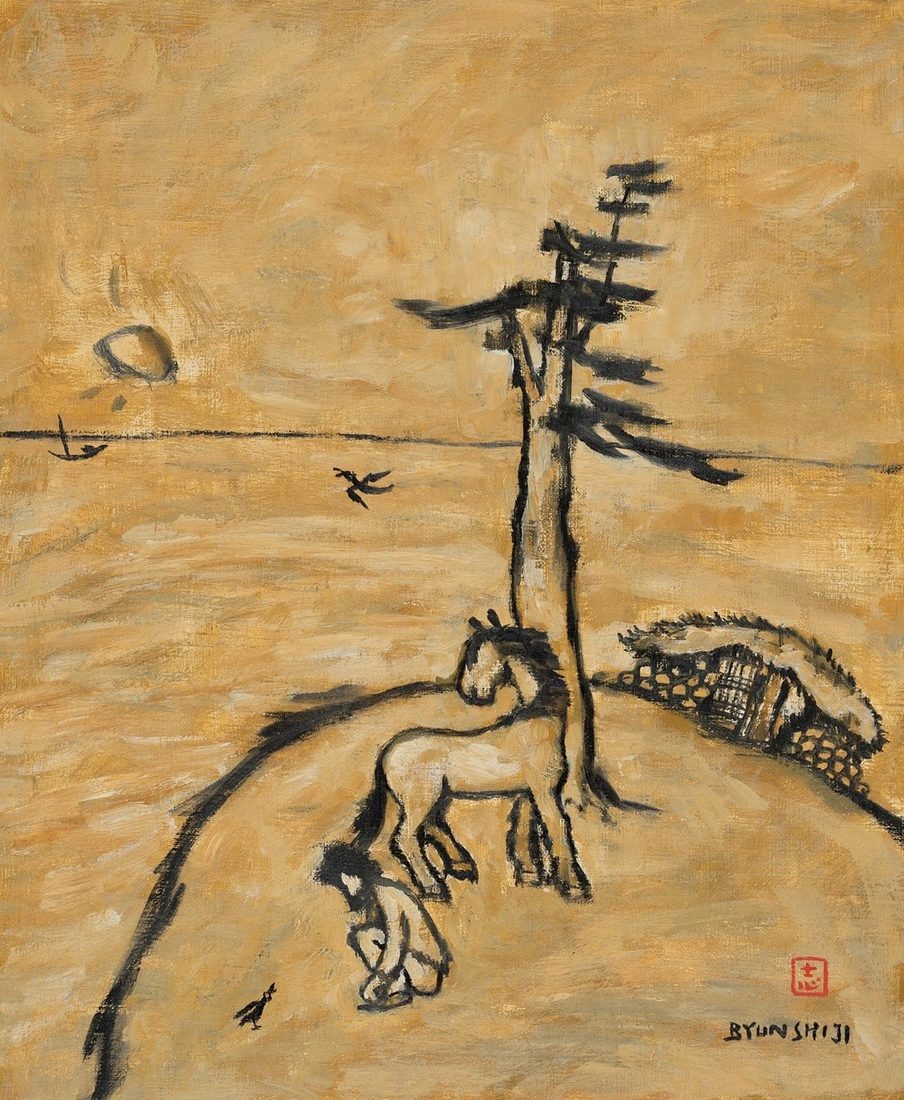
The person in Dialogue (1986) sits small in the lower part of the painting. The head is lowered; arms and legs gather close. A contour running down from the back rounds the body’s outer edge. A horse stands behind. Moving our attention from the person to the horse’s legs makes the difference between a lowered body and a standing one distinct.
Crouching appears here to reduce the body’s extent. Its presence does not necessarily diminish in the same proportion. Open ground remains around it, making the contour noticeable. The person is not the largest form, but may become a place where an eye travelling in several directions pauses. Smallness and prominence are not simply opposites within this arrangement.
Before translating the posture into defeat or courage, we can attend to where the body folds. Hands near knees, a lowered face and the curve of a back are distinct elements. When the single word crouching does not conceal these differences, the figure returns from a familiar emblem to a particular body. Interpretation begins with this differentiation rather than replacing it.
What Supports a Body?
An attentive look at a seated body also reaches beneath it: where a foot meets the ground, the height of a knee, the earth remaining close at hand. An open pictorial ground does not necessarily suspend the person in a void. Short marks, overlaps and distances can suggest a place for the body. Posture is a relation to a setting, not solely a bodily shape.
In Dialogue, the upright length of the tree and the horse’s legs accentuate the person’s low position. Yet the forms do not all lean the same way. Branches extend in different directions, and the house occupies its own place along the slope. No single body explains all the forces of the world. Its posture acquires meaning as surrounding forms modify one another.
Bodily wisdom, used here, need not mean that a body foresees every danger. It can name modest responses: seeking a place, adjusting a balance. No painting guarantees that a posture will always be safe. It can, however, open a way of seeing the person without dividing them into either a being that only thinks or an object that merely receives forces.
A Thinking Body Is a Living Body
Comparison becomes too easy if Rodin’s Thinker is treated as an emblem of reason alone. The Musée Rodin explains that the figure originated as the Poet for The Gates of Hell, associated with Dante, combining a tormented body with free thought. The tension between thinking and bodily experience was already present within the sculpture.
Rather than say that Rodin thinks while Byun lives, we can examine differences in how bodies become visible. Sculptural volume and musculature make a body available from several directions. Byun’s small figure is read through the relation of a few contours to an extensive ground. Scale, medium and viewing distance offer a more precise comparison than allocating mind to one artist and body to the other.
A large body need not mean a powerful person; a small one need not mean a helpless person. Taut muscles can suggest exhaustion, and a fine contour sustained attention. When we do not assign a theory of humanity to a shape in advance, the particular tensions made by each work remain available. The comparison can then clarify rather than flatten either figure.
A Figure Resembling the Self Without Closing Around It
An unnamed figure may invite a reading through the painter’s own body. Sensing a resemblance, however, differs from establishing an identity. A bent posture does not disclose a particular memory or feeling. Even a self-portrait reading needs to preserve the scene in which the figure has been placed, rather than allowing biography to replace everything visible within it.
One might call this a fūdo-based third-person self-portrait. The phrase is a critical proposal, not a name given by the artist. It suggests placing a body close to one’s own life within the painting as another person, then looking at it through its relations with other beings. Instead of a declaration that I have painted myself, a distance opens in which the viewer’s experience may also enter.
Read this way, horse and tree are more than props explaining the painter’s mind. They draw an eye returning to the person outwards again. Nearby beings remain different; a shared ground does not absorb them into one person’s interior. Fūdo becomes less an enlargement of the self than a setting in which the self encounters its own scale beside other things.
The Next Movement Within a Still Posture
A seated person may still have a next movement: opening a hand, lifting the head or lowering the body further. The painting does not show what follows, but a folded posture lets us consider such possibilities. Leaving them open prevents crouching from hardening into an image of permanent resignation. Stillness can contain an interval without supplying the event that ends it.
The same applies to waiting. If neither its object nor its duration is specified, we need not invent them. A posture suggesting duration differs from the story of someone waiting a lifetime for another person. Keeping the distinction enlarges the time the painting permits. A brief rest and a prolonged stay can both remain possible without either becoming a fixed account.
The title Dialogue adds another direction to this small stillness. We cannot know what words, if any, pass between the beings, nor reduce the arrangement to a face-to-face conversation. Yet an eye moving between bodies at different heights sees one and then the other. In place of spoken words, the return of attention can make a relation perceptible.
Dignity Is Not a Test of Posture
If dignity depends solely on a crouching person not having fallen, a reclining body or one leaning on another is pushed beyond the account. Dignity need not become the achievement of a posture. Our first question is less how successfully the figure endures than what space this small body is given and alongside which beings it has been placed.
Looking at someone who has lowered their body also makes us reconsider our own height of looking. We bring attention closer to a small form previously passed over. There is reason to remain without turning it into a powerful emblem. Where a face tells us little, back and hands, and the small contacts with the ground, may stay with us longer.
Reading Byun’s figure need not end with reversing weakness into strength and praising it. It also means acknowledging a body before attaching either name. The broad ground can overwhelm and disclose it; the nearby horse can accentuate its smallness while making a distance of togetherness. Feeling develops gradually within these overlapping relations, not from the successful completion of a test.
A hand rests near a knee. Light ground continues between the horse’s legs and the person’s back.