Research/A Hundred Years of Wind/Ⅱ Figure & Being
Ⅱ Figure & Being · 18 / 100
The Aesthetics of the Beggar
Seeing the Person Without Praising Poverty
걸인(乞人)의 미학
Before Giving the Figure a Name
The title beggar first directs attention towards a person’s social circumstances. Yet reading the name requires care. The official archive lists The Beggar (1979) as a distinct work. The existence of that title does not establish that every unnamed person elsewhere is also a beggar. One work’s name cannot determine the lives of all the painter’s figures.
A long garment, a small body or a cane-like form may bring poverty to mind. But the line of a garment does not disclose an inventory of possessions, an occupation or a life history. A person depicted with few details is not the same as a person who possesses nothing. Keeping that distinction is not seeing less; it is refusing a premature judgement.
The aesthetics of the beggar should therefore ask how painting lets us attend to a socially named person, rather than declare poverty beautiful in itself. A name may draw us closer, but it may also conceal the face and posture it does not encompass. Before assuming that we know the person, we return to the body the painting has left visible.
The Extent Around a Small Person
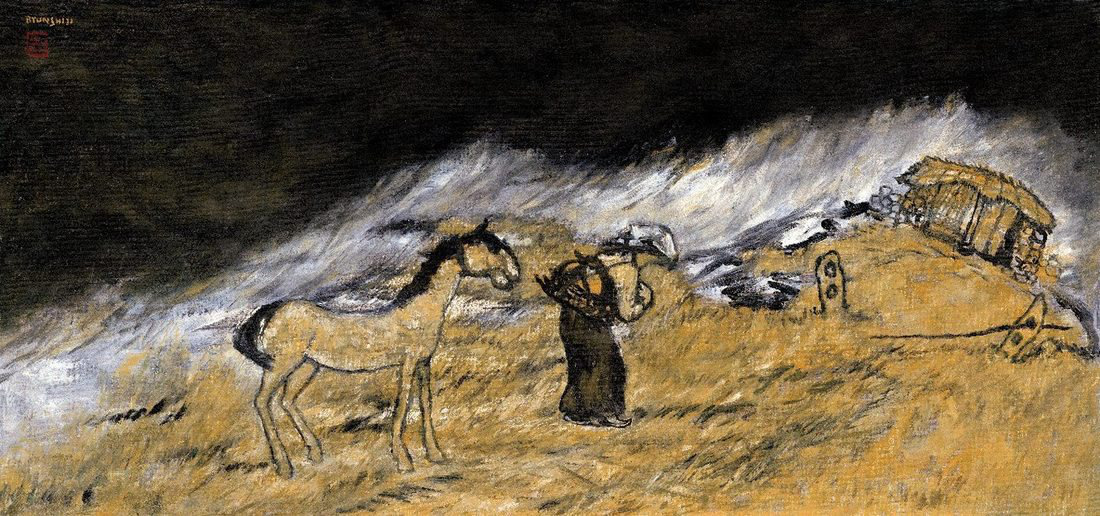
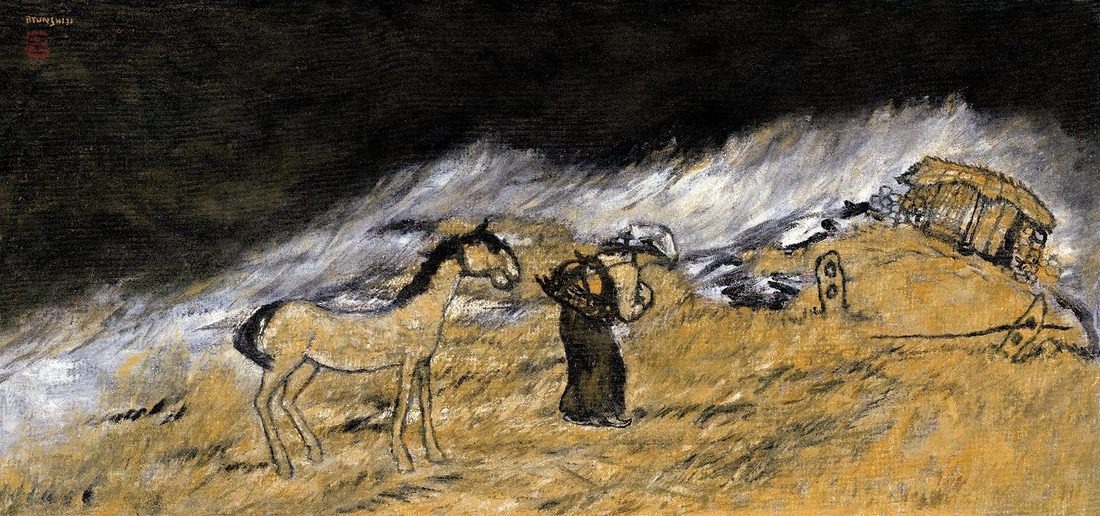
In The Road Home (1991), a figure in a long dark garment stands with a horse to the left. The upper part of the painting is dark; below it, white strokes run diagonally. The ground occupied by person and horse is lighter. Without identifying this person with the subject of The Beggar, we can examine how the dark body meets the light earth.
The body’s small scale helps us gauge the surrounding landscape. Yet to treat the person solely as a measure of space would overlook the garment’s darkness and the body’s incline. The eye surveys the expanse and then returns to the dark form. Being depicted small need not mean being assigned little importance. The figure’s presence emerges within that difference.
A reading of poverty requires a similar movement back and forth. Erasing circumstances in favour of a universal human being can obscure a particular life. Explaining everything through poverty can make further attention to posture and placement seem unnecessary. Social questions and visual observation need to remain together without cancelling one another. Neither gives us permission to stop looking.
Not Having and Leaving Open
A painter leaving part of a canvas open and a person lacking necessities are different situations. One may be a formal decision; the other may reduce the choices available in life. If few depicted objects are taken to mean that a figure has become free from possessions, pictorial omission is made to explain material deprivation. The analogy has then exceeded what it can show.
To say that someone with nothing has nothing to lose makes the figure too weightless. Bodily warmth, a place to spend the day and relations with other people cannot be counted as possessions. A person in poverty also has things they wish to preserve. The absence of a detailed inventory in the image does not remove the weight of that life.
The beauty of open space must therefore be distinguished from praise of deprivation. If a broad ground makes us attend longer to a person, its force is not to tell them to make do with less. It interrupts a gaze accustomed to counting possessions first. The question of what someone owns cannot exhaust what there is to attend to in their presence.
Ground Beneath the Feet and Beyond
In the External Things chapter of the Zhuangzi, a question is posed: if only the patch beneath our feet were left and the surrounding earth dug away, could we still use it? Immediate use is not a sufficient measure. This does not justify calling a poor person useless. It asks us to widen our attention to what supports what, changing the measure of our judgement.
The absence of a visible tool does not establish that a person does no work. A still scene may contain a moment of rest. The body exists even when production and achievement are not on display. Painting’s ability to attend to that body opens a way of looking that does not entrust human value entirely to evidence of activity.
Even the phrase simply being needs care. It does not remove the needs of a body that must eat, rest and receive care. Praise of existence stripped of its requirements turns a life into an abstract emblem again. To see a body in its own right should also mean not becoming indifferent to what that body requires.
The compassion possible before Byun’s small figures need not be a feeling directed downwards from above. It may postpone the conviction that another life is fully known and move attention towards the painting’s lower register. Rather than conclude with the word pitiable, we stay longer with the body’s weight and its distance from other beings. Such attention offers no instant possession of their story.
A Self-Portrait Reading Without Inventing a Life
Even when a self-portrait reading is brought to the figure, it does not become a record of the painter’s finances. A small body or sparse line cannot establish that the artist voluntarily abandoned all status and property. Formal restraint and decisions about living call for different kinds of evidence. Neither should be made to stand as proof of the other.
Self-portrait can be understood more modestly: a form close to one’s own life is placed within a landscape as one person. We attend not only to resemblance but also to the ground the figure occupies and the direction it faces. Self-expression then shifts from enlarging one’s own story towards making a place for a person with greater precision.
The dark garment in The Road Home remains distinct from the light ground. The separation is too marked to describe the figure only as a being dissolved into the world. The person occupies a landscape shared with the horse without the difference between them disappearing. Even without knowing what either possesses, this arrangement gives us something precise to read.
Dignity Is Not Poverty’s Reward
The aesthetics of the beggar should not preserve a hierarchy in which the poorer person is purer. Wealth does not guarantee depth, and neither does poverty. When dignity is not awarded as compensation for deprivation, the figure is released from the duty to demonstrate virtue. A person whose life is difficult need not also provide us with a lesson.
The depth made by the painting’s few elements becomes clearer once these distinctions are kept. A small number of lines makes a person recognisable, while the extensive ground returns the eye to that small form. Openness matters not because it resembles an empty pocket, but because it alters the relation of looking. Restraint can then avoid decorating another person’s suffering.
We cannot offer practical help to a painted person. We can choose the words through which we look: whether to reduce the figure to someone with nothing, or leave room for a life we do not know. This choice may alter our stance before the painting more than it determines one final meaning for the image.
The dark hem of the long garment meets the light ground. A little way off are the horse’s feet.