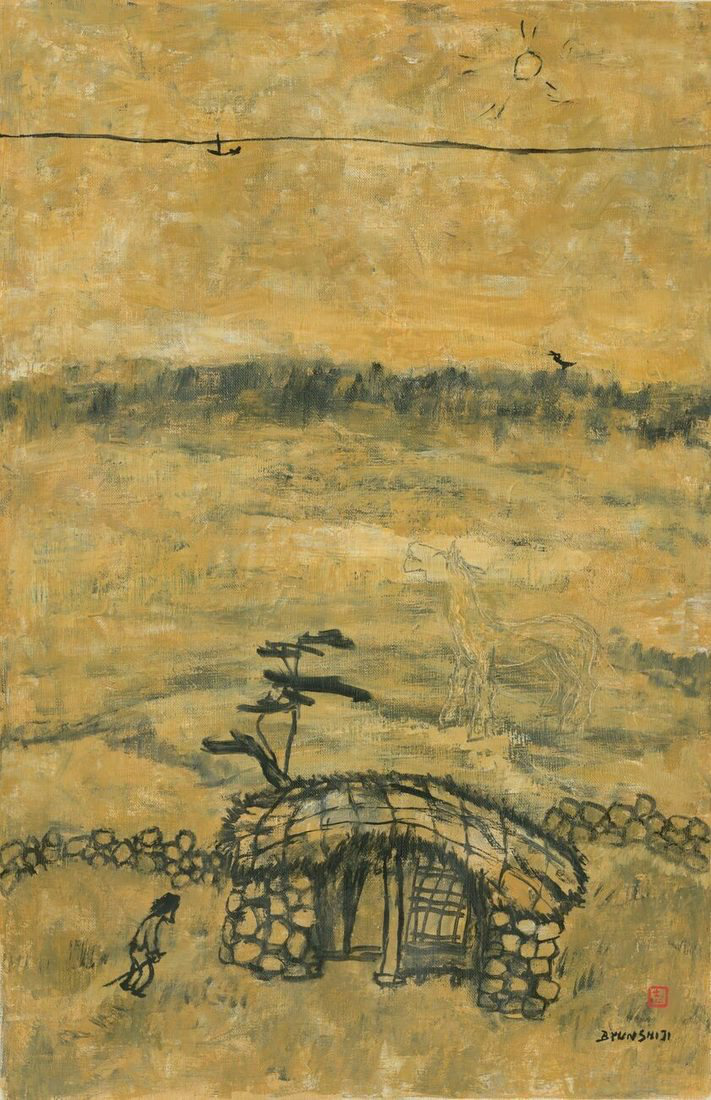
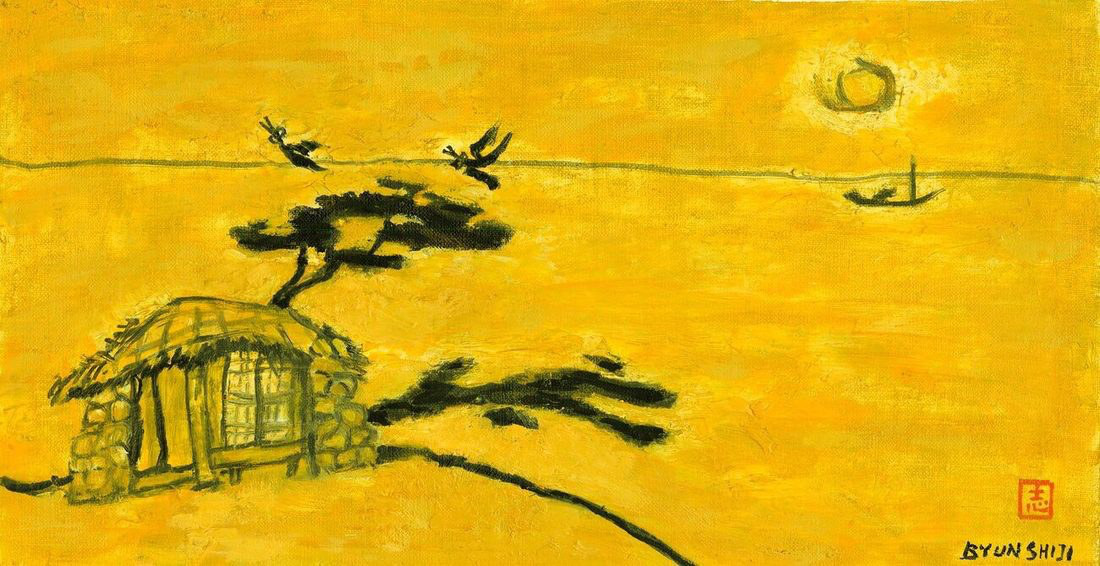
Research/A Hundred Years of Wind/Ⅱ Figure & Being
Ⅱ Figure & Being · 19 / 100
The Man Inside the Thatched House
Dwelling Begins at the Threshold
초가집 안의 사내
Before Looking Inside
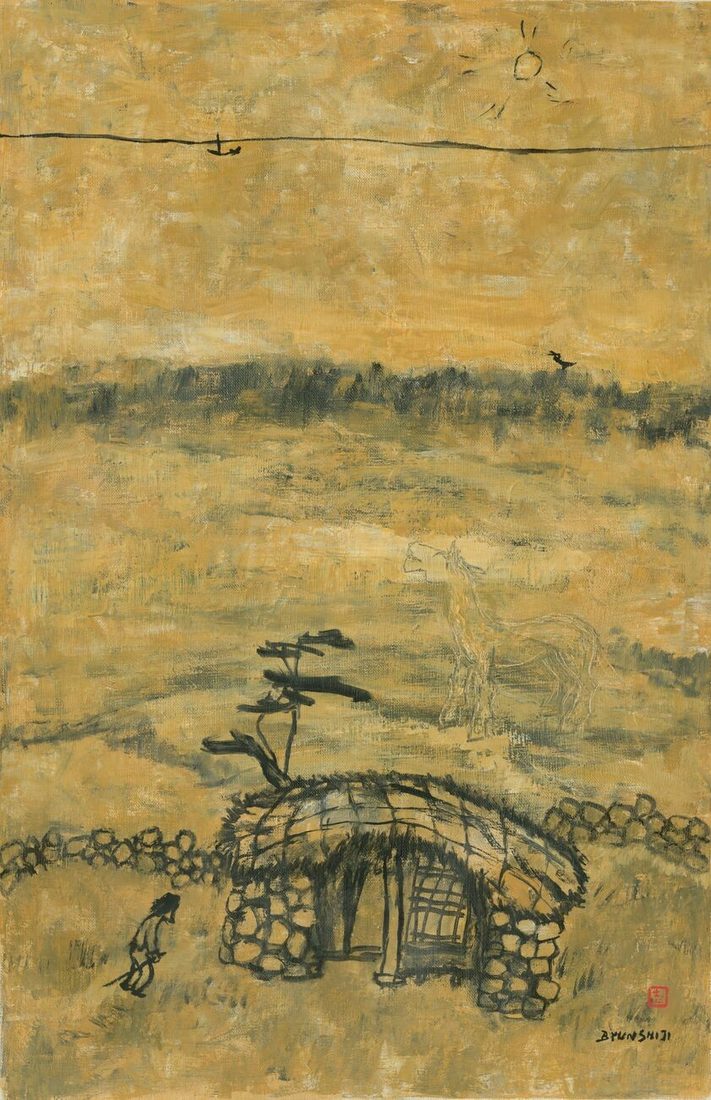
The house in Recollection (1988) occupies a substantial place low in the painting. Beneath the curved roof are a wall of stacked stones and a doorway. A small person is outside to the left. The eye moves from that person to the door, then upwards into the space above the roof. Painting a house with a person does not necessarily place the person inside it.
The man inside the thatched house can therefore be read as a question directing the eye inwards. What place is available there? Can the person outside enter? Where does a line towards the doorway begin? If no interior is visible, what we can examine is less the life of a room than the small boundary connecting outside and inside.
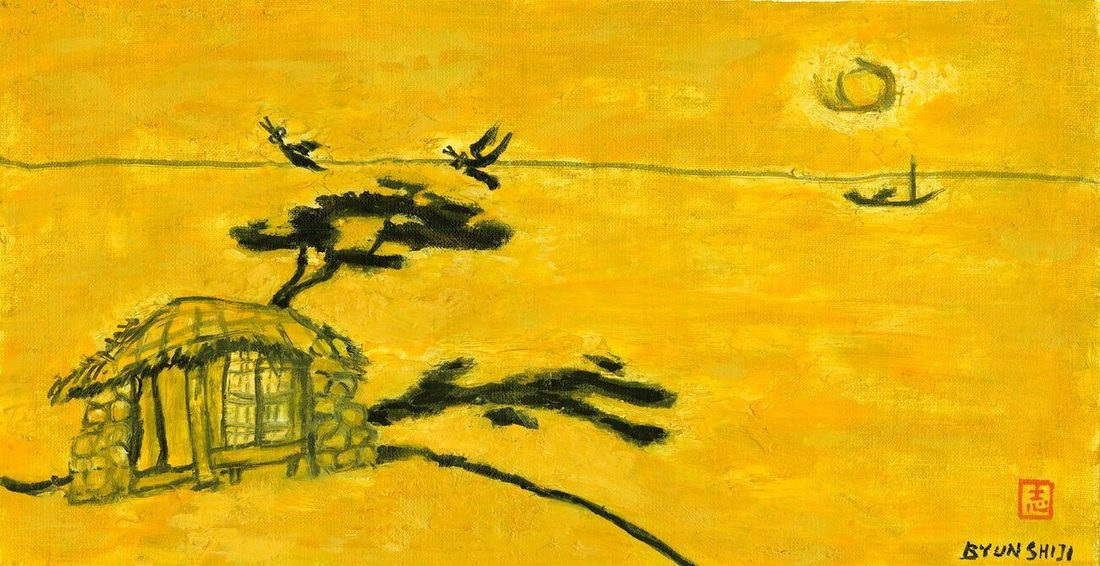
In The Empty House (1987), the house is on the left, with tree and broad ground extending around it. No human figure is clearly discernible outside. Yet the dark entrance does not reveal everything within. Even when a title names emptiness, the image does not thereby tell us who left or when. The visible boundary remains different from a complete account of absence.
The Scale Made by Roof and Door
The roof makes an outer contour; the door introduces the possibility of entering. The two do not perform the same task. An eye following the roof’s curve stops at the doorway’s vertical. One small division can make the extensive ground feel less like a flat surface and more like a space with somewhere to enter and somewhere to remain.
In Recollection, stone walls extend to either side of the house, with a tree and the pale form of a horse above. Related colours connect several distances, but differences of line and tone prevent everything from occupying one depth. The near house’s details and the open ground distinguish one another. Dwelling is suggested through this arrangement, not solely through the shape of a building.
Calling a painted house small also requires a point of comparison. It may be small against the sky, while the doorway and roof have another scale in relation to a person. Being smaller than a mountain does not make a house negligible. Seen at the scale of use, the nearness of daily life and the extent of nature play different parts within one painting.
A Thing Gathers Relations
In the bridge passage of Building Dwelling Thinking, Heidegger questions treating a bridge first as a mere object to which symbolism is subsequently added. The thing gathers relations and makes a locale possible. This account cannot simply be transferred to Byun’s houses, but it can prompt us to examine a house with its surrounding relations rather than as an isolated sign.
The place leading towards a door, a person near a wall, an enclosing boundary and a tree beyond it alter what the building means. A house is not a token of refuge that can be placed anywhere unchanged. Even the same roof reads differently according to whether the approach is blocked or open. An inquiry into dwelling begins with these particular arrangements.
There is no need to allocate these relations to four compartments labelled earth, sky, divinity and humanity. The presence of a crow does not establish a divine being. Philosophy becomes more useful as a question about what needs to be seen together than as a chart supplying correct answers. Looking at a house leads towards its door and the body that might approach it.
Shelter Without Romanticising Exposure
A house can be understood as a place that permits contact with the outside while regulating it. A place for light to enter and a place to escape rain answer different needs. Opening a door is not the same as having no protection. Speaking of life close to nature should not suggest that the body requires less rest or care.
The intimacy suggested by a low painted roof must be distinguished from the safety of an actual house. Form alone cannot guarantee survival in a storm. We can nevertheless examine how the small area beneath a roof feels differently scaled from the expanse outside. Reading a sense of shelter differs from turning the difficulties of living into virtues.
Dwelling includes more than remaining; it also involves a way out. Thinking of entering to rest and opening a door again prevents inside and outside from becoming fixed enemies. A house’s meaning is not determined solely by how much wind it admits. We also need to ask who can rest there and how contact with other places becomes possible again.
Time Within a Dark Doorway
The doorway in The Empty House is dark, while the neighbouring wall and roof carry many marks. The eye passes from a more described surface to a less described opening. The unseen interior may seem to hold a time different from the outside. Yet that need not immediately become the time of bereavement or abandonment. Darkness opens a story without completing it.
A house without a visible person readily admits a viewer’s memories: a room long left empty, an evening of returning late. Such memories belong to the experience of reading, but do not prove that the painter depicted those events. Distinguishing the place left by the image from the time we bring to it allows them to meet without one covering the other.
Returning to Recollection, we notice the small person outside again. We need not establish ownership in order to read the distance between figure and entrance. The house becomes less a container for a concluded story than a place where movement could continue. Memory, in this reading, brings the present eye back towards the doorway rather than sealing the past away.
More Than One Person’s House
If a house is read only as the painter’s interior, there is less room for other lives. The work of building walls, tending a roof and moving along paths need not be converted entirely into one person’s mind. Even when those workers are not depicted, the thing called a house can invite thought about such relations. An interior is not necessarily a room without relationships.
Nor need true dwelling begin only after a return to one’s birthplace. A person who moves also makes a life; relations and memories can form in a temporary place. Deepening the meaning of home need not render previous lives meaningless. The weight of a house returned to can include time lived elsewhere, rather than depend upon the denial of that time.
Read in this way, Byun’s house offers a possibility of placing a body again rather than proof of homecoming completed. A low roof, divisions of stone and a dark entrance make that possibility. A small inside remains without the whole outside being erased. Without knowing everything about whose place it is, we can pause before the door.
The doorway is dark beneath the roof. In front of it, a patch of ground remains light.