Research/A Hundred Years of Wind/Ⅰ Nature & Fūdo
Ⅰ Nature & Fūdo · 14 / 100
The Memory of a Volcanic Island
The Time of Rock and the Time of a Brush Mark
화산섬의 기억
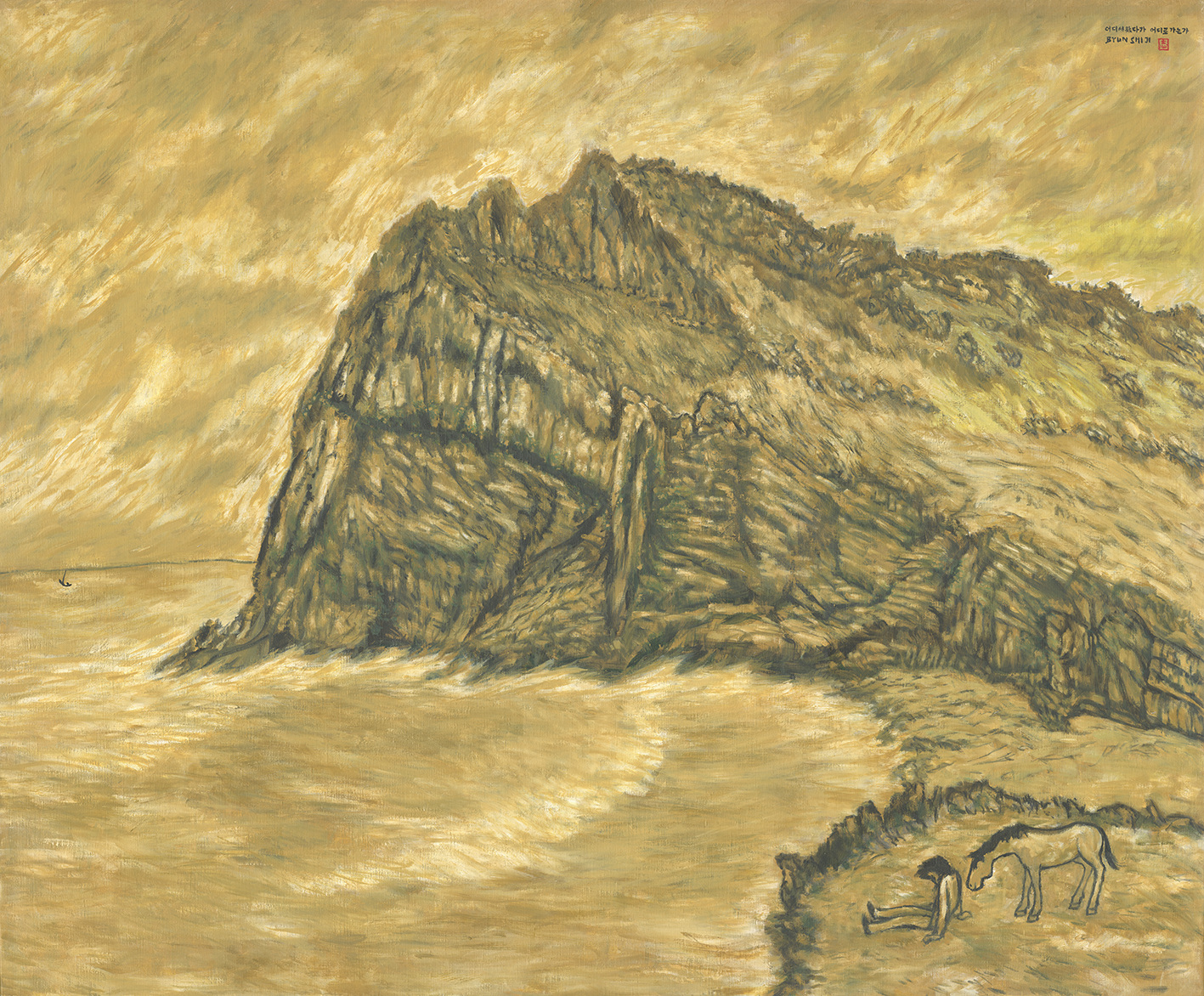
A Small Body Before the Cliff
In Where Do We Come From, and Where Are We Going? (1992), a massive cliff occupies the centre. Dark marks overlap beneath its rising contour and descend towards the water. At the lower right are a person close to the ground and a horse with its head lowered. Looking from the body back to the cliff, we may experience their unequal scales as different kinds of time within one picture.
There is no need, however, to assign the small person immediately to a brief life and the large cliff to eternity. Rock also changes, and human time consists of more than a momentary feeling. The contrast does not establish which scale is more valuable. It brings together two orders of magnitude that a single glance cannot measure in the same way.
The title adds a question to this encounter: where do we come from, and where are we going? It does not supply the answer. Without establishing the person’s posture as evidence of death, we can attend to a temporary place for the body and the extensive world around it. Finitude can lead us to dwell on their difference rather than announce an ending in advance.
A Volcanic Island Is Not Made of One Kind of Stone
Calling Jeju a volcanic island does not make every landform the outcome of an identical process. UNESCO’s World Heritage account distinguishes the Geomunoreum lava-tube system, the Seongsan Ilchulbong tuff cone and Hallasan’s volcanic landscape. Even within one island, traces of flowing and solidifying cannot be treated as identical to structures made of accumulated eruptive material. Distinct processes matter more than the single word volcanic.
The distinction matters before a painting as well. A cliff’s markings may recall strata, but brush marks alone cannot establish its exact location or rock type. A painting is not a geological survey. Its maker can select and transform structures. Knowledge of landforms should sharpen our questions about that selection, rather than fill the image with geological information it does not provide.
The phrase memory of a volcanic island opens in two directions: investigating traces of the past in rock, and considering how someone who has experienced the land recalls it in a present painting. One requires geological evidence; the other calls for pictures and records. Keeping them distinct allows the encounter between them to gain a precision beyond an unexamined metaphor.
Similar Surfaces, Different Processes
The cliff in this work combines descending strokes with others laid across them obliquely. Some passages gather densely; others expose the lighter ground. These differences suggest folds and clefts in the rock. Yet pictorial roughness is not materially identical to rocky roughness. One consists of painted marks; the other belongs to a natural surface the artist may have encountered.
Rather than conclude that geology produced dry brushwork, we can ask what relation the painter established between unlike materials. Hardness can be suggested without transferring every point of a rock’s texture. A long stroke can encounter shorter ones; a light edge can remain beside a dark field. Resemblance may be made through selected differences rather than through copying.
Room for contingency can coexist with judgement that adjusts a picture. Rough marks need not be declared in advance to have flowed without planning. The surviving traces show results, not every stage of production. Explaining them only through nature’s spontaneity would overlook the artist’s work of contending with material, selecting and stopping.
Time Does Not Only Accumulate
Thinking of a rock’s past in terms of layers can bring long duration closer. But we should not imagine every trace of time accumulating neatly into a complete record. A remaining surface may also bear the place of something lost. Age means not only having preserved many things unchanged, but also having passed through a time in which something disappeared or altered.
The same care is needed when a painter’s life is compared with strata. What was learnt earlier may do different work in a later picture; a form unused for some time may return. The past is not material simply buried at assigned depths. It is experience used again in relation to a present decision. A career cannot be explained solely by reading an order of accumulation.
There is no need to abandon the metaphor of layers altogether. It reminds us that a stroke does not arise wholly alone. Earlier habits, present sensation and the resistance of material can bear upon it together. We should simply avoid claiming that these contributions can be separated into dated deposits. A picture containing time is not the same as a picture constituting a chronology.
Smallness Is Not Worthlessness
Following the cliff’s mass and then lowering our gaze to the right, we see the person and horse again. Small beside the extensive picture, they have not been erased. Their modest place instead renews our sense of the cliff’s scale. Large nature and small humanity need not form an opposition in which one cancels the other; they can make one another’s scale perceptible.
Recalling geological duration does not make a human day insignificant. The meaning of a place for the body, or of a being standing nearby, cannot be measured only by length of time. Painting can place unequal durations before one gaze without measuring their value by one scale. A small form need not end as decoration for an immense background.
The body in this picture is close to the ground. The horse is nearby. Their relation can turn our thoughts towards birth, return and a temporary stay. These thoughts, however, remain our reading beginning from the work. When we do not convert them into an answer conclusively fixed by the artist, the painting’s question remains open to the next viewer.
Caring for Time That Has Been Left
The fact that a painting is material brings this reading into the present. Cracking or discolouration should not be confused with the aged time intended in a picture. Rough marks made in painting and subsequent damage pose different questions. Conservation is less a stopping of artistic time than a practice of distinguishing the work from later changes while passing it to another person.
Checking a title, date and reproduction in an archive belongs to that care as well. A misattached description can change the starting point of the next interpretation. Looking closely at a surface and checking differences in the record are not opposing activities. Both try to distinguish what the painting has left from the stories we add to it.
The memory of a volcanic island is therefore not a completed meaning waiting to be extracted from stone. It is an attentive encounter, through present eyes, with traces remaining at different rates. The grain of a cliff, marks on water and a small body close to the ground evoke unequal times. The painting gains its breadth by holding those differences within a shared colour range.
The eye descends from a dark cleft in the cliff. A light stroke remains on the water. Beyond it, a horse stands beside the small body.