Research/A Hundred Years of Wind/Ⅰ Nature & Fūdo
Ⅰ Nature & Fūdo · 13 / 100
Landscape in the Rain
Surfaces and Distances That Suggest Wetness
빗속의 풍경
First, Is Rain Depicted?
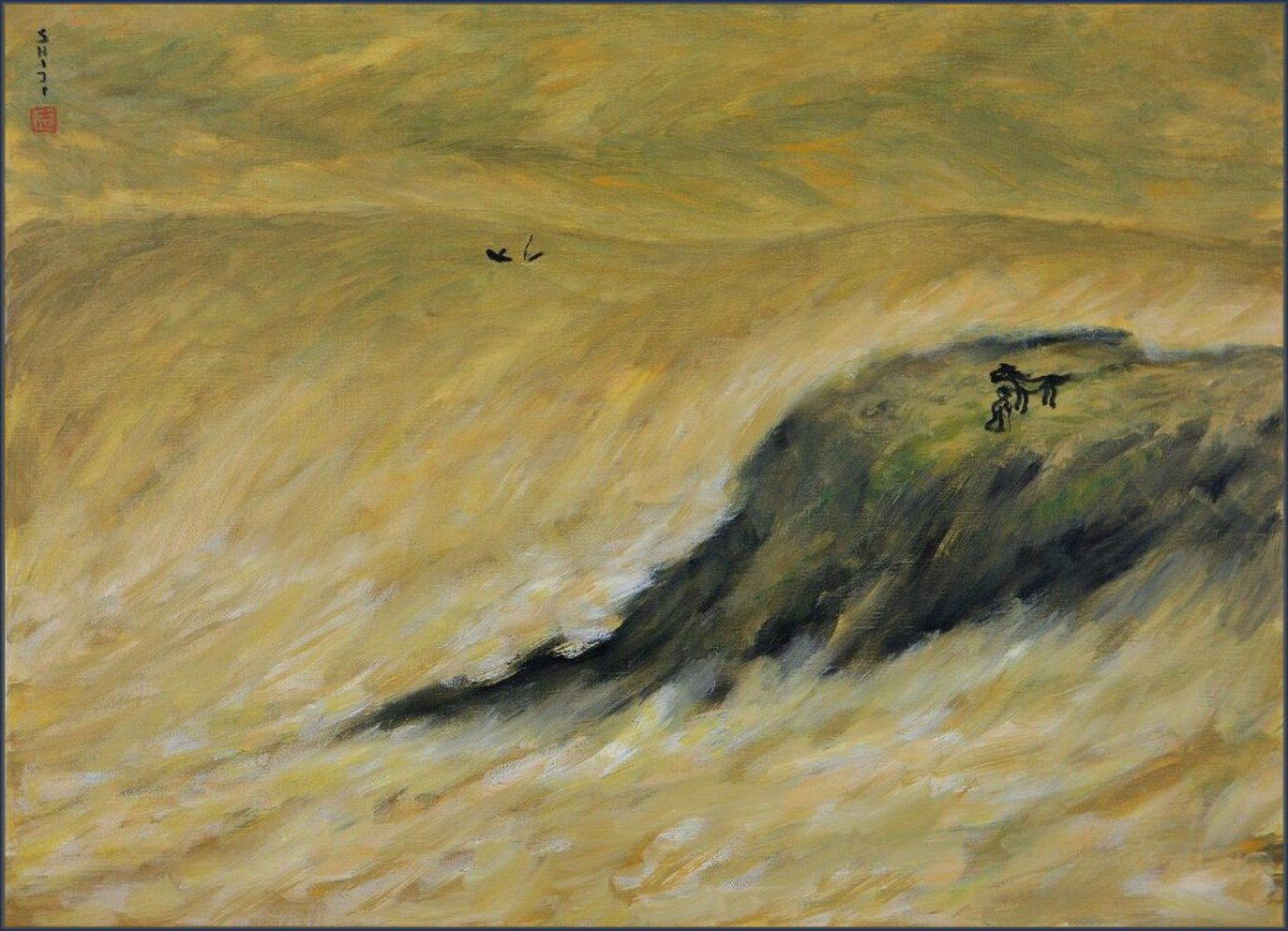
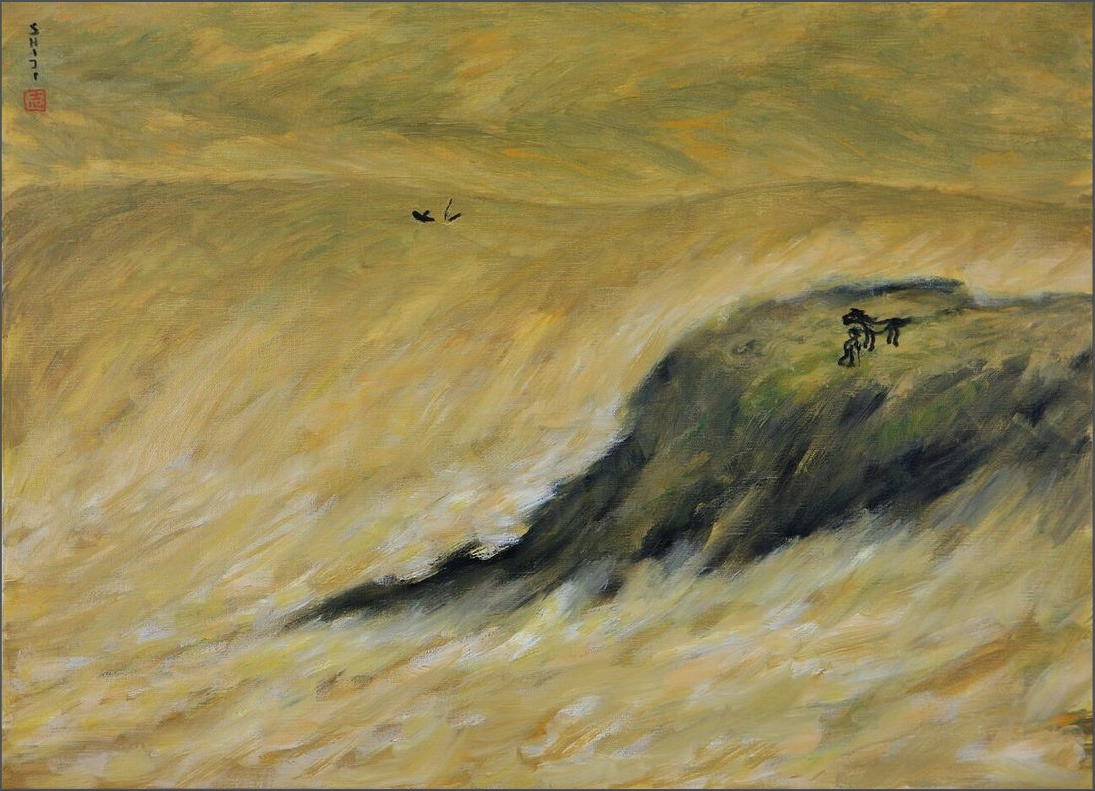
In A Wavering Horizon (2005), light diagonals brush past the edge of dark land. Some marks break short; others continue in long bands. Related movements cross the yellowish fields above and below. Wind-driven rain may come to mind. Yet calling every mark a streak of rain overlooks the possibility that waves, spray and brush marks perform different tasks.
The reason for bringing this picture into a chapter on rain is not to settle its weather. It is to ask what makes wetness and flow perceptible. A line depicting rain and one suggesting rain need not be identical. Maintaining that difference lets rain become a question prompting closer attention to the painted surface, rather than an explanation covering it over.
Withholding the name brings other features into view: where light marks converge or scatter, and how they narrow beside the dark ground. The small human and horse forms gather on land towards the upper right. When a broadly agitated field and small figures occupy such different scales, weather first approaches as a sense of exposure.
Paint Need Not Be Wet to Depict Wetness
The surface of a painting need not be soaked in order to depict something wet with rain. This simple distinction interrupts the immediate reading of dry brushwork as drought or as a longing for moisture. The condition of the material differs from that of the world depicted. Showing moving water with dry paint is not a contradiction of painting but one of its possibilities.
An impression of wetness can arise through relations of value and edge. A light stroke crosses a dark field, while an edge that seemed solid breaks within other marks. The eye moves from reading a fixed mass to following a flowing trace. This transition can suggest a change in an object’s surface without adding actual water to the picture.
Conversely, rough brush marks do not invariably look wet. A similar trace may read as a hard grain in rock and as a broken current on water. Its relation to its setting matters more than a property considered alone. Wetness is not the name of a fixed technique, but one possible sensation obtained by reading a surface together with its surroundings.
Rain and Fog Do Not Make the Same Open Space
Fog, rain and humid air are related, but they are not the same phenomenon. The Met Office describes fog in terms of suspended water droplets and reduced visibility, distinguishing haze caused by small dry particles. These distinctions prevent every blurred picture from becoming evidence of rain or humidity. More precise weather terms also allow us to describe pictorial ambiguity more precisely.
When pictorial edges blur, what we initially experience is uncertainty of distance. Something far away mingles with a nearer field, and cues distinguishing above from below weaken. This can suggest fog. Yet the effect can also occur in a picture that does not depict fog naturalistically. What a passage resembles and what it does within the picture need to be considered together.
In A Wavering Horizon, the distant boundary is weak while a dark rocky mass remains. The whole world has not dissolved uniformly. Because distinct and indistinct passages coexist, the gaze moves between them. Blur can be read less as the final disappearance of form than as a continuing adjustment of what, and how much, can be recognised.
Other Senses Recalled Before a Painting
Someone who has been out in rain may remember the weight of wet clothes or a slippery surface underfoot. Such memories can participate in looking. This does not mean that a canvas emits the smell of rain or that every viewer undergoes an identical sensation. Vision recalling another sensory experience needs to be distinguished from senses consistently combining in one fixed way.
This distinction does not impoverish the encounter. It gives different experiences more room to enter it. One viewer may hear remembered water in light diagonals; another may recall leaning into wind. What matters is returning to the pictorial relation from which the memory began. Freedom of sensation is not the same as freedom to leave the painting behind.
Reading rain in Byun can involve this movement back and forth. The eye sees a mark; the body recalls a time. When attention returns to the picture, a dark area or a small figure initially overlooked comes into view. The painting does more than confirm memory: it can redirect it. Even familiar weather is then experienced again from an unfamiliar distance.
Thinking About Somewhere to Shelter
When a small body occupies a turbulent picture, endurance may be what we first notice. Yet exposure need not be equated with courage, nor seeking shelter with defeat. Endurance is not the only need within wind and rain. Somewhere to move, someone beside whom to stay, and a place to rest also belong to the conditions of life.
This is not an interpretation telling the painted figure to go home. It acknowledges that the picture does not tell us every place the person might go. We can attend to the body without deciding its subsequent fate. Looking longer at the small form becomes less a judgement of the person’s will than attention to the space available to them.
Wind and rain then cease to be a testing ground that selects the strong. They are conditions exposing different bodies in different ways. A painting’s compassion need not arise from praising only the body that remains standing. It can arise in attention that does not overlook a body so small in relation to the picture. This is care before it becomes an explanation of feeling.
Not Promising the Light After Rain
Peace after rain need not become the ending of every painting. One picture remains within movement; another appears to have grown still. Establishing a sequence of actual events between them would require further evidence. A painting can make several kinds of time conceivable within one scene without compelling us to bind them into a single plot.
Below the small figures in A Wavering Horizon, light strokes keep passing obliquely. Actual movement has been arrested, but the looking eye does not stop. One stroke gives its direction to another; contact with a dark area makes the gaze turn briefly. The duration of painted weather is renewed within this movement of attention.
Landscape in the rain thus raises more than the question of identifying rain correctly. It asks about a body within weather and our distance from that body. We attend to a surface that may suggest wetness without turning suggestion into evidence. We keep sensation open without making the small person an instrument of a story. Between these demands lies a place from which to read the painting.
Small forms remain at the edge of dark land. A light stroke passes obliquely below them. The eye returns to that small place.