Research/A Hundred Years of Wind/Ⅰ Nature & Fūdo
Ⅰ Nature & Fūdo · 12 / 100
The Season of Light
How Brightness Becomes a Pictorial Relation
빛의 계절
Before Looking for the Sun
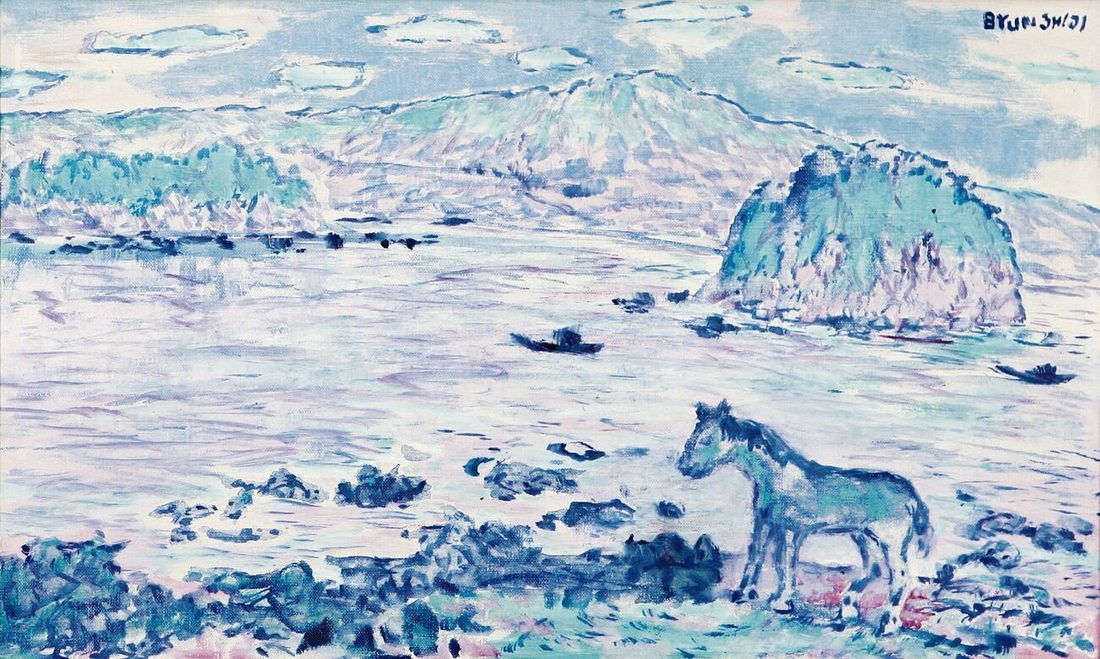
The water in Jeju (1976) is light. Blue strokes lie on a pale expanse, with the ground appearing again between them. We do not first have to locate a solar disc to sense that brightness. Dark foreground rocks and a pale mountain in the distance also alter how the water appears. Before light is an object in one location, it is a sensation arising as we look between parts of the picture.
We need to distinguish the light illuminating the world from brightness rendered in paint. Actual light makes the painting visible. Painted brightness appears under that light through differences of colour and value. Rather than imprison sunlight inside the canvas, the painter establishes relations in which light and dark areas disclose one another. This distinction allows the same landscape to become different paintings.
Chapter 8 examined the circle of the sun. Here the concern is brightness that can be made without that circle. How much ground remains exposed? Where do dark areas gather? In what direction do light strokes continue? Following these questions turns light from an adjective used to describe Jeju into a concrete problem of painting.
Long Sunshine and the Appearance of Brightness
Sunshine duration does not measure the colour of light. In the European Centre for Medium-Range Weather Forecasts’ account of the World Meteorological Organization criterion, it records the time during which direct solar irradiance at the surface meets a specified threshold. How long that threshold is met and what colours a scene presents are different questions. Treating sunshine duration directly as the cause of a palette removes that distinction.
An annual figure for a city requires its observation site and reference period. Once those conditions are stated, the number can support a comparison. Even an accurate figure, however, does not yield the thickness of a black line or the mixture producing dried-grass colour. Weather data can help us investigate an artist’s environment without explaining away the decisions made in a work.
Light is not seen alone. It is experienced with the surfaces receiving it, surrounding darkness and the position from which we look. The same stone presents different faces from different sides. The painter chooses which of these differences will share a picture. Studying light therefore calls for closer attention both to nature and to the particular workings of painting.
No Light Area Is Light Alone
In Where Do We Come From, and Where Are We Going? (1992), light water meets a dark rock face. Rough marks gather in the cliff, while light strokes spread laterally across the water. Although both belong to a similar yellowish range, the surfaces do not look alike. Their different brightness arises not only from colour names but from the direction of strokes and the gathering of dark marks.
The water’s lightness seems more expansive beside the dark cliff, whose weight becomes clearer because water opens before it. Separating either from the other weakens the relation. Painting light does not consist simply in adding more light-coloured paint. It can also involve retaining a dark area so that a lighter field has a place in which to appear.
If we use the term inner light here, it need not mean that illumination literally emerges from inside things. It is closer to a critical description of brightness felt through pictorial relations without locating a single source. Rather than turn the term into a mysterious substance, we can return to the colours and marks producing that impression. Light acquires depth through renewed looking, not through the explanation alone.
Not Separating Eye from Skin
To experience light bodily does not mean abandoning the eye. When we narrow our eyes or move towards shade, looking and adjusting our posture are connected. Recalling such experiences keeps painted brightness from remaining merely abstract visual information. Yet that recollection cannot be recorded on the artist’s behalf as an event that occurred on a particular day.
Even when dried-grass colour feels warm, the experience need not end with that sensation. A broad ground may let the eye rest, while dark strokes upon it bring the gaze to a halt. Warmth and tension can inhabit the same picture. Allowing vision and bodily memory to coexist rather than compete preserves the complexity of what colour can evoke.
Painting can transform this complexity while carrying it over. A shadow seen briefly in a landscape can be retained as a long mark; a passing brightness can become an extensive field. Fidelity to an experience is not identical to copying its visible configuration. As remembered sensation acquires pictorial proportions, light is placed within another kind of time.
A Place Made Visible by Shade
Even a painting suggestive of midday may need dark areas. The information that the sun is high does not require every painted shadow to vanish. A dark stroke, moreover, might be a shadow, a contour or a sign of surface texture. We first need to see how it meets other forms before distinguishing the work that it does.
In the rock face of Where Do We Come From, and Where Are We Going?, dark lines follow folds in the cliff and meet strokes running in other directions. Their encounters suggest thickness. Not every dark passage needs to be read as lack or sorrow. Darkness is also a pictorial resource that lets something hard appear hard and a deep cleft appear deep.
Light and darkness do not fall into opposing camps of consolation and tragedy. A bright sea can make a small body seem more exposed; dark ground can give that body a place. Meaning does not follow value alone. It also depends on whom light reaches and which forms it brings into view from their surroundings.
Choosing What Light Will Remain
Connecting Seogwipo’s light with Byun’s colour does not require the conclusion that one automatically produced the other. What matters is how experienced light became a set of pictorial relations through decisions. A retained light area, an added dark stroke and an arrested edge affect one another. Colour is the outcome of these decisions being placed together.
The season of light need not therefore mean only the period with the most sunshine. It may also name a time when a previously unnoticed difference becomes visible. Before the same picture, we may have seen the cliff yesterday and attend today to the water before it. The viewer’s time of reading light comes to meet the painter’s time of rendering it.
The painting does not fix one instant of actual sunlight for eternity. It preserves relations through which brightness can be recognised, allowing eyes on another day to follow them again. Painted light does not remain only the same in that encounter. Where the gaze pauses can make something near recede and bring texture to life within a dark passage.
Pale water extends before dark rock. One light stroke stops at the cliff’s foot. Its small ending stays with the eye.