Research/A Hundred Years of Wind/Ⅶ Comparison & Context
Ⅶ Comparison & Context · 85 / 100
Abstract Expressionism and Byun Shi-Ji
Retaining the Figure, Reading the Surface Differently
추상표현주의와 변시지
Locating the Shared Period Precisely
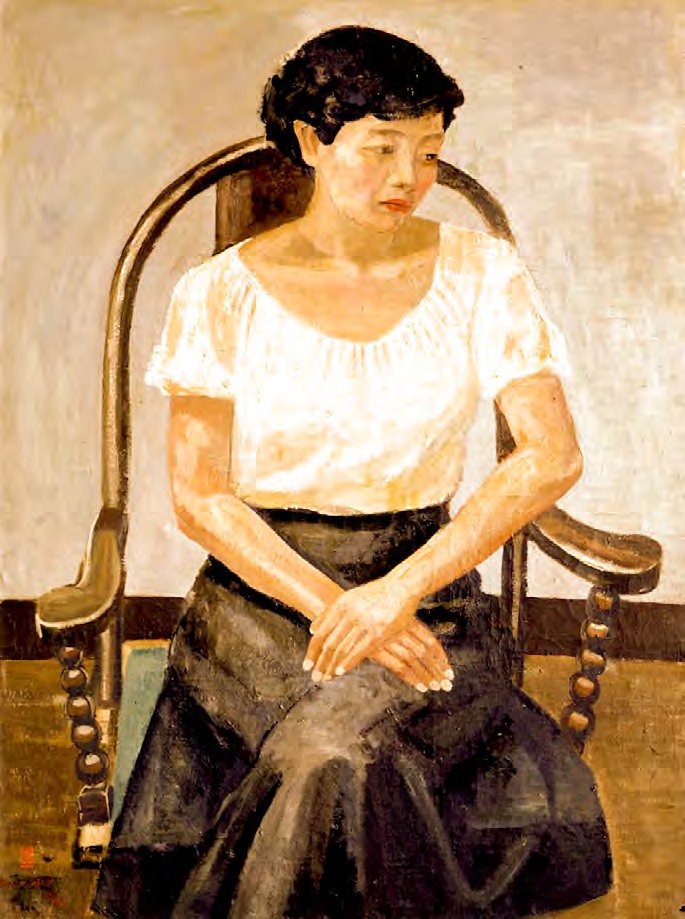
Placing New York Abstract Expressionism around 1950 directly beside Byun’s Jeju painting overlays different moments. His Portrait of Nemo is a figure painting of 1951, while Noon, also considered here, dates from 2007. Comparing contemporary choices and comparing forms from different periods are distinct activities.
De Kooning’s Woman I was made in 1950–52. Its emphatic figure immediately unsettles the claim that Abstract Expressionism erased all human imagery. The New York painters did not move in one direction alone. To identify Byun’s differences, we must first preserve the diversity of the comparison.
A better question then emerges. Rather than simply asking whether a figure exists, we can ask how recognising one changes the rest of the surface. What direction does a person’s presence give to colour and line? Or, when no person is recognisable, what relationship does the viewer’s own body form with the painting?
Action Also Includes Control and Reconsideration
Pollock’s Number 1, 1950 (Lavender Mist) is closely bound to bodily movement and poured paint. Yet the National Gallery of Art’s audio account also records his insistence that he could control the flow. An impression of spontaneity is not equivalent to the absence of control. Chance and judgement need to be considered together.
Woman I also contains time spent revising. MoMA describes de Kooning scraping and repainting over a prolonged process. A rough-looking surface cannot therefore be reduced to an immediate discharge of emotion. The completed picture holds not only the moving hand but also the time of an eye capable of reconsidering.
Byun’s practice likewise included waiting and reworking. An opposition between Pollock’s impulse and Byun’s discipline is consequently weak. Difference should not be sought in a ranking of who was more deliberate. It lies in the roles their judgements gave to paint, surface and recognisable forms.
Rereading Pollock in the Notes
The supplied transcription of Byun’s abstract-painting notes describes Pollock moving around a canvas spread on the floor while pouring paint. It notably likens the picture to looking at a rough sea and relates this to the dynamics of making. Abstraction is not treated as an empty absence in this material.
This does not mean that Pollock depicted the sea. The sea functions as an analogy for sensing the painting’s force. Nor does the note’s account prove that Byun endorsed every proposition or chose figuration specifically to refute it. A distance remains to be examined between what was read and what was chosen in practice.
That distance is productive. If a painting can evoke a sea’s roughness without depicting the sea, how does Byun’s sea work with both recognisable imagery and forces beyond it? How does the same mark change before and after a boat or person is recognised? The notes provide grounds for beginning that comparison.
A Few Marks Recognised as a Body
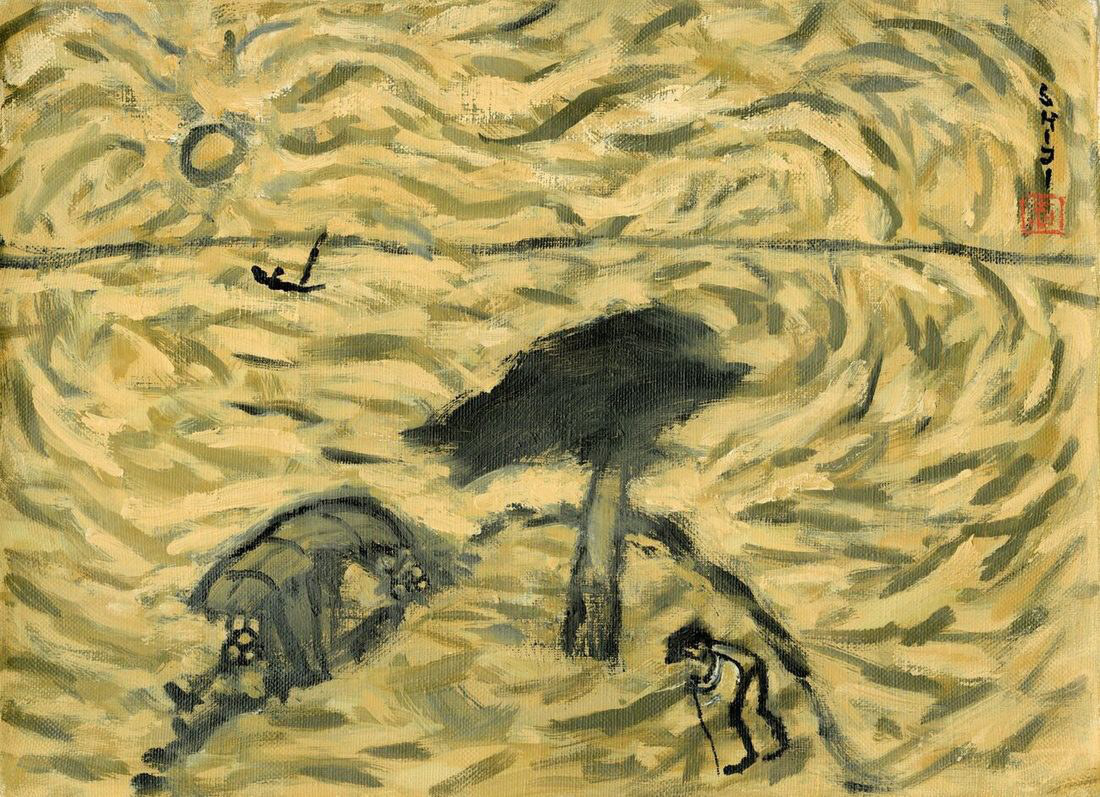
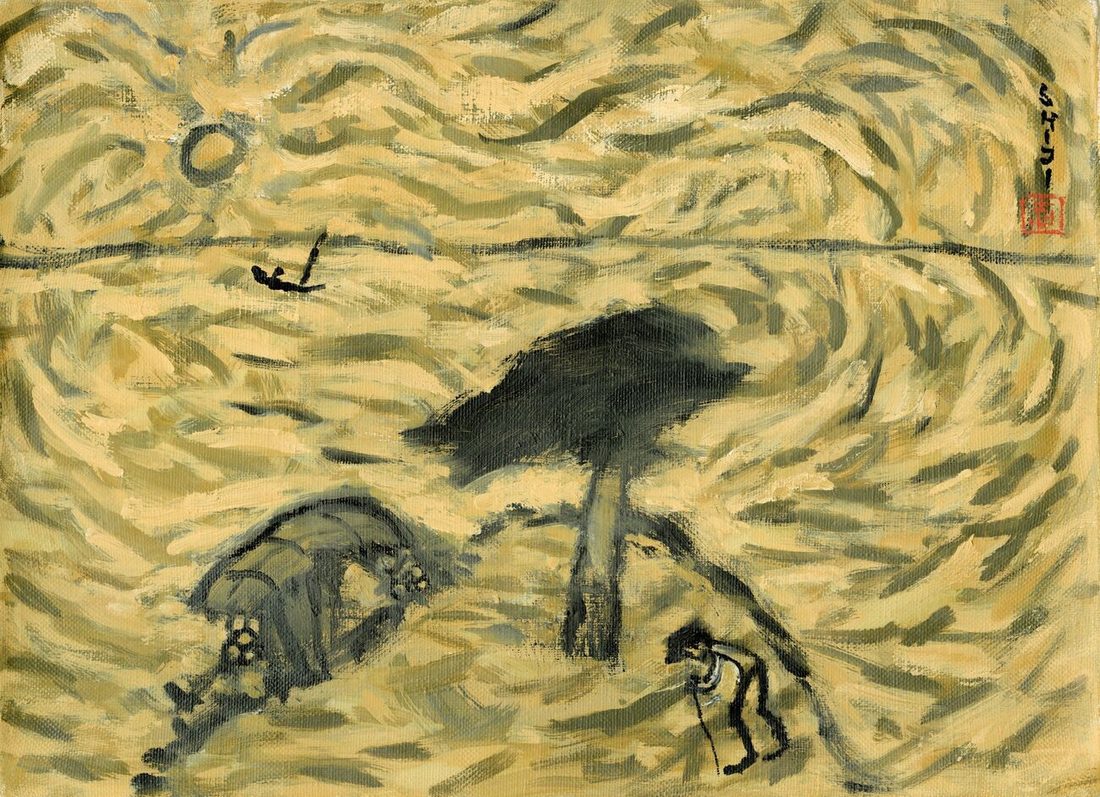
From a distance, short marks set the whole surface of Noon in motion. Closer looking distinguishes tree, house, person and boat again. These two ways of seeing do not cancel each other. Moving into the overall flow and back towards a small body, a viewer encounters both an arrangement of colour and line and a scene of living.
Recognising the person changes the work of surrounding marks. What was simply a curved stroke may begin to feel like wind around a body; a light area becomes a possible place to pass through or remain. The figure is not an obstacle interrupting abstract force. It is a small turning point that lets us perceive the body with which that force meets.
Calling this figuration that falls short of abstraction would miss a significant choice. Elevating it as more human than all abstraction would require erasing other paintings. Byun’s choice can be stated more precisely: to sustain broad pictorial movement while retaining enough form for someone within it to be recognised.
The Making Body and the Depicted Body
Looking at Pollock, we can imagine the maker’s movements through paint’s paths. But viewing the work is not the same as restaging its production. A painting made on the floor is encountered at another distance and height on a wall. The making body and the viewing body are connected without occupying the same position.
Byun’s marks also carry a force that evokes the making body. A depicted body is added to this. The trace of a moving brush and the image of a standing person overlap without becoming identical. A wrist’s direction cannot simply be equated with a figure’s suffering. The surface evokes its maker while opening room for another body to be imagined.
The dark mass of the tree and the person’s small outline in Noon are not marks of the same scale. Lines describing the person are part of the many marks around them, yet also gather into one body. This overlap is a tension within the painting: being seen as a person without ceasing to be paint.
A Different Path Need Not Diminish Others
Grouping Korean abstraction as the following of a foreign fashion would also obscure Byun’s path. The reasons for adopting a form and what was achieved through it must be asked of particular works. Figuration is not conservative merely by being figurative; abstraction does not lose its roots merely by being abstract. An external classification cannot establish artistic agency.
What Byun retained can be read less as exact outward likeness than as legible relationships among people and things. A stick touches ground, a horse stands beside another body, a house lies at a distance. Such relations connect experiments in colour and line with scenes of living. Choosing this connection does not require claiming that other kinds of painting cannot express relationship.
Comparison finally returns to what each work asks a viewer to do: remain before a large field of colour, follow moving marks, or recognise a small person and then see the whole surface again. Different responses do not imply one side’s failure. Byun’s distinctiveness becomes more specific among those differences.
The Question a Retained Figure Leaves
If we use the phrase figurative abstraction, it should name a movement in looking, not a superior stage beyond two categories. I first see marks, recognise a person and return to the marks. Neither the person nor the paint disappears in that recurrence. This back-and-forth experience may come closer to describing Byun’s painting than a classification does.
The retained figure is small, but not a small decoration. Through it, the force of the large surface connects with someone’s day. Yet it does not command a single feeling or conclusion. Rather than asking only how much can be endured, it asks where someone stands and who is nearby. From one person’s position, the entire picture begins to look different.
Short marks pass across the surface. A few become visible as a person. Before them, the eye slows a little.