Research/A Hundred Years of Wind/Ⅶ Comparison & Context
Ⅶ Comparison & Context · 84 / 100
Gauguin’s Tahiti, Byun Shi-Ji’s Jeju
Where Does the Painter of an Island Stand?
고갱의 타히티, 변시지의 제주
Two Journeys towards an Island
Gauguin went to Tahiti; Byun returned to Jeju. The difference matters, but travelling to an unfamiliar place and returning home do not by themselves decide the value of two paintings. We must also ask whom each encountered, what each saw and how those relationships entered the work. The direction of travel begins a comparison; it does not conclude it.
Tahiti was not an empty island awaiting Gauguin’s imagination. When he arrived in 1891, it was under French colonial rule and already a society with changing ways of life. The Museum of Fine Arts, Boston, describes the gap between the paradise he expected and the reality he encountered. That reality must precede the word primitive.
Nor was Byun’s Jeju an island arrested in his childhood. His oral testimony describes changed surroundings prompting memories of earlier landscapes. Remembered home did not replace present sight; what survived in the present stirred memory. Returning still contained a period of learning again.
The Search for Paradise and the Lives Already There
A gaze searching for paradise can decide in advance not to see certain things. Changed clothing and houses, new commodities, conflict and labour may trouble the image of a pure island. Reading Gauguin’s Tahiti therefore means asking both what he made beautiful and what he left outside the frame. Imagination and responsibility for its selections should be considered together.
Yet describing Tahitian people only as passive material for a painter’s fantasy would erase their lives once more, even in criticism. Who named the painted figures? How might the society’s own languages and knowledge support different readings? A painter’s autobiographical account does not make all the island’s voices audible.
This is not a demand to stop looking at the art. It asks us to see more alongside it. While examining colour fields and the arrangement of figures, we also ask within what relationships those figures appeared. Formal invention and questions of the gaze are not rival verdicts that cancel one another; they are two layers requiring attention together.
Homecoming Does Not Grant Ownership
Being born in a place gives particular memories and relationships. It does not confer the right to speak for everyone there. Even on one island, households, bodies and histories differ. The idea of an insider’s gaze matters when it discloses such close responsibilities, not when it guarantees immunity from error.
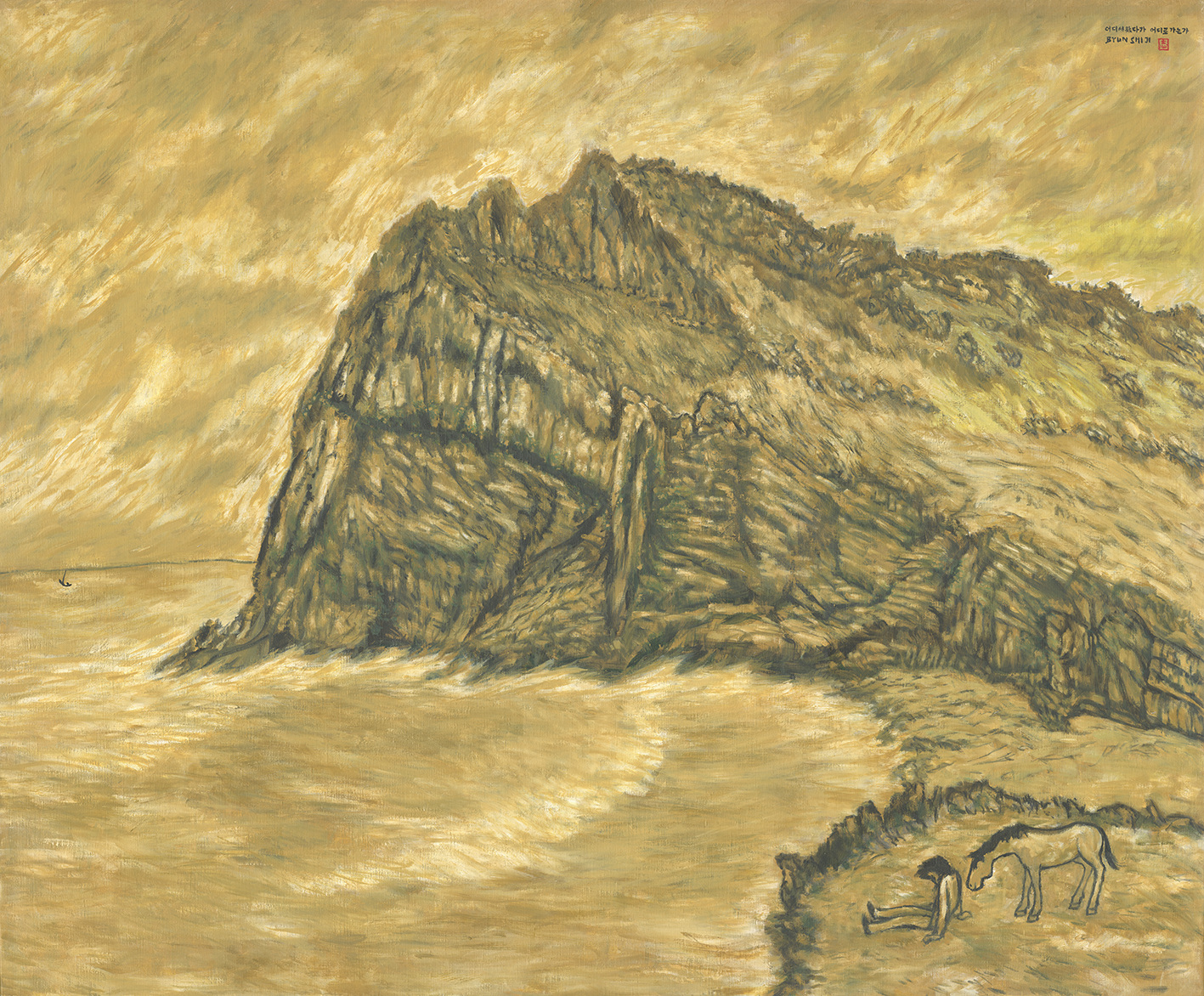
Rather than naming Byun the landscape’s owner, we can read him as a painter placing his own small position within it. The person in Where Do We Come From, and Where Are We Going? does not occupy a position of command over the mountain. Seated small at the lower right, the figure has a horse with its head lowered nearby. Nature does not become smaller because the two bodies are together.
Here homecoming feels closer to finding somewhere to sit than to reclaiming a throne. The painting does not tell us whether that place is safe or permanently one’s own. Belonging can become a relationship of being alongside another creature within a large landscape, rather than a feeling of possessing it.
Retaining the Specific Instead of the Primitive
Treating a stone wall or thatched house merely as a remnant from before civilisation erases the skills of those who built, repaired and used it. A modest house is not a form produced by an absence of knowledge. It is a way of organising lived space. In Byun’s paintings, we should look at the place made by walls, roof and threshold, rather than treating the house only as an ancient symbol.
Dried-grass colour likewise cannot be fixed as the single colour of a primordial earth. It may suggest weathering, yet contains arrangements of value, density, form and interval made by the painter. It is not a specimen transferred directly from the soil, but a pictorial colour reconstructed after encounters with earth and light. Close memory and working judgement are both involved.
Criticising Gauguin’s primitivism while praising Byun’s Jeju as a purer primitive world would preserve the same framework. The productive comparison asks not who was purer, but which realities each painter selected and altered, and whose lives became visible or obscured in that process.
Related Questions, Different Titles
Three questions form the title of Gauguin’s large painting of 1897–98: Where Do We Come From? What Are We? Where Are We Going? Byun’s 1992 title is Where Do We Come From, and Where Are We Going? The middle question is absent from the Korean and is not inserted into its translation. Related questions need not be made into identical sentences.
Similarity of titles also cannot establish direct influence. That would require further records, statements or an account of access to the other work. Comparison remains possible before such a connection is verified. We can ask how a question about life appears through a sequence of people in one painting and through the distance between nature and small bodies in another.
The Boston museum connects Gauguin’s composition with stages of life, moving from an infant at the right towards an older figure on the left. Byun’s image offers no corresponding procession of ages. A mountain’s mass, two bodies below and a distant boat occupy different scales. One invites time to be read among figures; the other raises its question through magnitude and distance.
The Viewer’s Position Also Carries Responsibility
We should also resist dividing their figures into body and spirit. An account in which Gauguin’s figures are only sensual and Byun’s only existential uses bodies too easily. Sensation and questions of life are not separate. What matters is the gaze under which a body appears and the actions or silences it is allowed.
That responsibility does not rest with the painter alone. A viewer can quickly label the horse’s lowered head submission or the seated person defeat. We can delay those names and examine feet against ground, a head beside another body. Looking becomes a closer encounter when painted beings do not remain mere illustrations of our interpretation.
Certainty about knowing home and certainty about knowing elsewhere can both be reconsidered. Not consuming unfamiliarity and not taking familiarity for granted are distinct but necessary tasks. Comparison should not end at judging the two painters. It should extend to changing the position from which we look.
The Mountain’s Scale and the Bodies’ Distance
The mountain in Byun’s painting is not merely a backdrop. A large, heavy form occupies the surface, unsettled by oblique marks. Below, the person and horse remain at another scale. What matters is not an illusion in which the large becomes small and the small large, but the persistence of the difference between them.
The boat out at sea lies farther away than the two bodies. Looking towards it lengthens the pictorial distance; returning to the person brings a small patch of ground close again. The eye moves between expanse and proximity. The question of where we go becomes active in this movement before any destination is named. Without knowing every route within the picture, the viewer’s eye is already travelling.
There is no need to explain open space as a privilege available only in familiar surroundings. A visiting painter can leave space; a returning painter can paint densely. This painting’s expanse is distinctive not because of nationality, but because it preserves both enough place for the small bodies not to vanish and enough distance for nature not to diminish.
The Sea That Remains after Returning
Years of residence cannot prove that homecoming is complete. A person continues to revise relationships even while living in one place. Byun’s oral testimony also describes placing himself in European scenes. A deep relationship with Jeju did not close other places to him. Homecoming’s significance does not lie solely in ending movement.
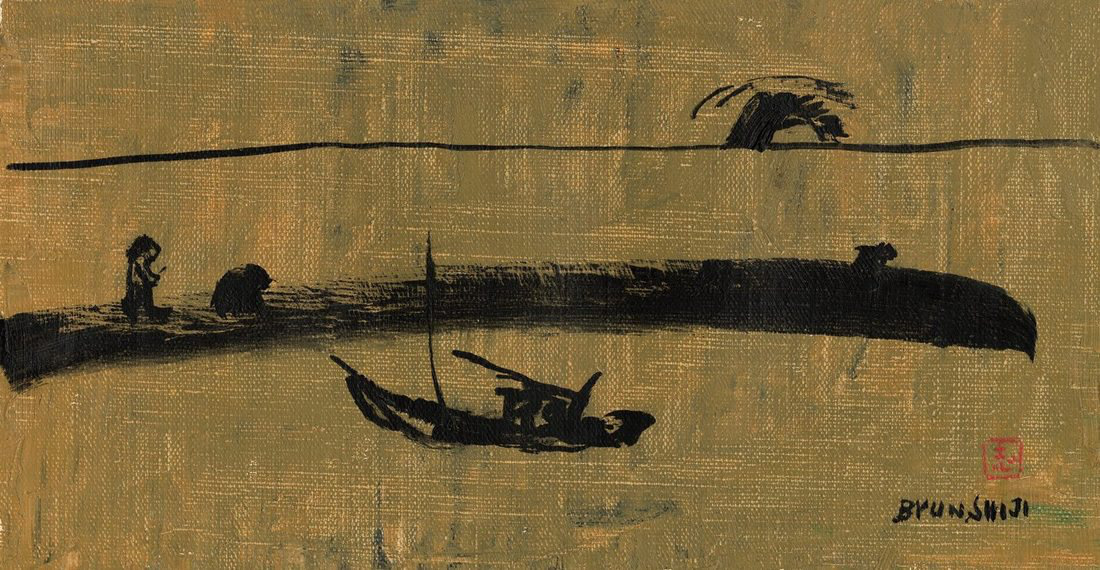
In The Jetty, the boat is close to shore, yet closeness alone does not complete every encounter. Water remains between boat and person. Even a small interval can make the difference between returning and fully reaching palpable. A painting of home may offer less a promise to restore every loss than a form for living with that distance.
A person sits beneath the large mountain. The horse lowers its head nearby. A small boat lies at sea. Even if the two bodies turn, that much sea remains.