Research/A Hundred Years of Wind/Ⅶ Comparison & Context
Ⅶ Comparison & Context · 83 / 100
Delacroix and Laozi
A Comparison of Colour Relations and Restraint
들라크루아와 노자
The Position from Which a Comparison Begins
Placing Delacroix and Laozi in one sentence readily produces a large story: a painter who expands colour and a thinker of reduction ultimately reach the same truth. Comparison need not decide its conclusion in advance. The difference left when one is translated through the other can itself become a place for thought.
The supplied colour-note transcription records Delacroix’s observation, journal and remarks on grey. Reading that record is different from claiming that Byun declared a meeting between these thinkers. This essay begins with the verified trace of reading and asks what questions arise for Byun’s painting when it is considered beside passages from Laozi.
The question is not simply whether colours are many or few. What addition gives a relationship life, and what addition obscures it? A painter repeatedly stands between these judgements. Richness and restraint need not divide works into opposing camps. They may be capacities required together within the same painting.
Reading around the Word Grey
The transcription attributes to Delacroix’s journal the claim that grey is painting’s enemy. The following page discusses pictures appearing darker under oblique illumination and the adjustment of tones; a later passage warns that excessive light can suppress intermediate colours. In context, the concern becomes a relationship between colour and viewing conditions, rather than a prohibition against one pigment.
There is no need, then, to assign death to grey and life to vivid colour. A subdued tone can make a stronger one’s position perceptible. When every part speaks loudly, differences become harder to hear. How grey functions depends less on its name than on what lies beside it.
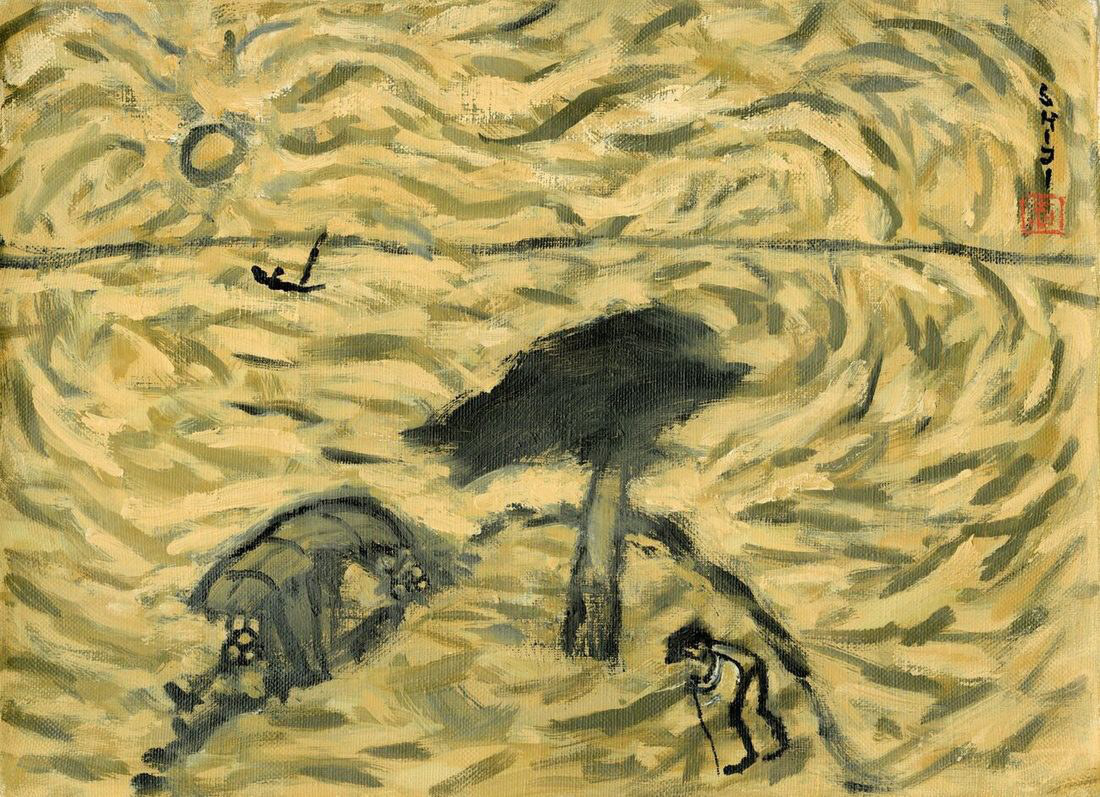
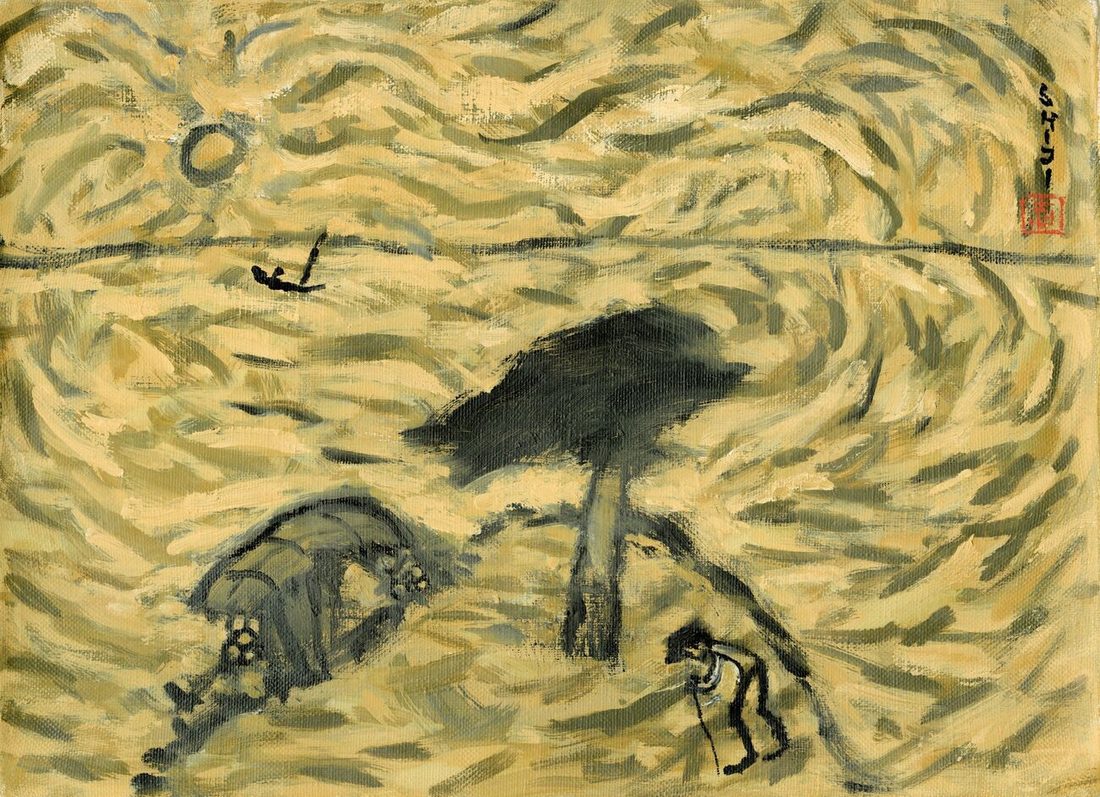
The dark marks of Noon are not uniformly black. Some weaken as though sinking into the light ground; others gather into the tree’s mass. Erasing those differences in favour of a yellow–black opposition would simplify the painting too far. Within a limited range of colours lie relationships of density and brightness.
What It Means to Question the Five Colours
Chapter 12 of the Daodejing speaks not only of colours but also of sounds, flavours, hunting and hard-to-obtain goods. It cannot simply be transferred into a rule for reducing a painter’s palette. Read as a concern about stimulation and desire overtaking the needs of life, it also raises questions about our habits of looking.
What first catches the eye? Does what catches it also endure? Is there something left to see after spectacle is reduced? These questions do not elevate monochrome morally above many-coloured painting. They examine the possibility that attracting attention and sustaining attention are not the same achievement.
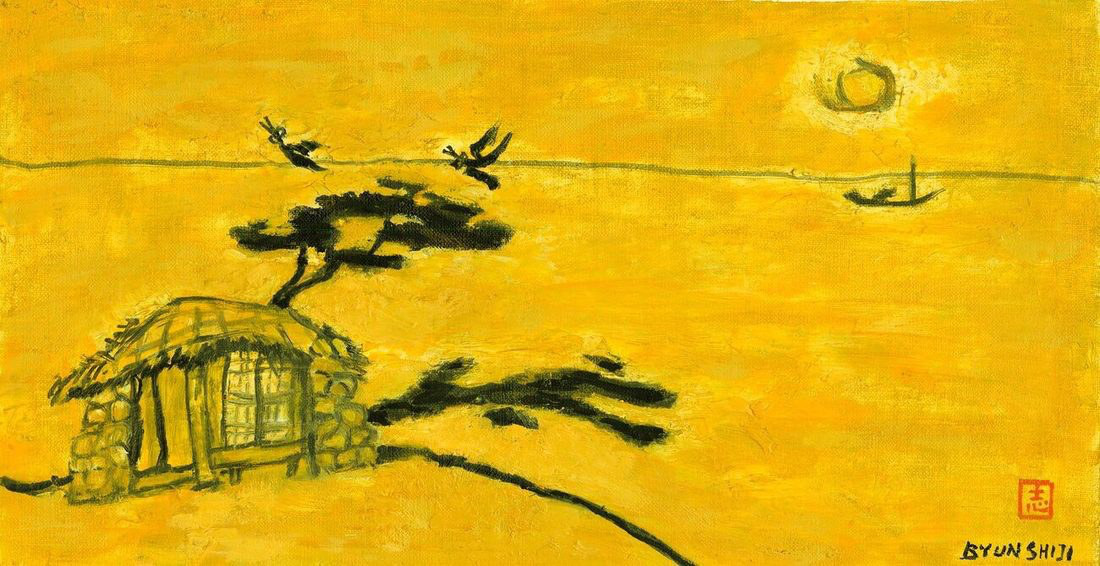
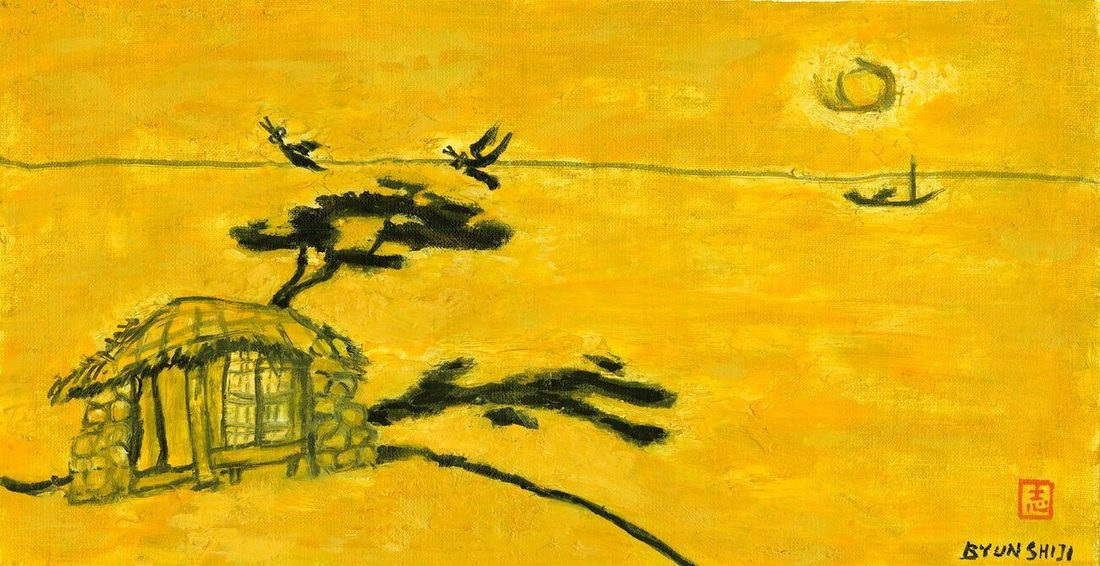
Byun’s dried-grass colour can make a powerful impression. Its apparent modesty does not place it outside desire. What matters is how a small house, a person, branches and intervals become visible after that initial impact. Restraint may mean not preventing anything from standing out, but allowing the eye to move once more.
Without Forcing Does Not Mean Without Work
Equating Laozi’s ziran directly with the English word nature narrows its sense. Chapter 25 concerns being so of itself. Read with the reduction and non-action of Chapter 48, it can prompt the question of whether greater intervention always means doing better. That is different from requiring a painter to exercise no judgement at all.
Byun’s testimony describes losing a good effect by continuing to paint in the hope of improving it, then finding the earlier state difficult to recover. This is not proof that he implemented Laozi’s thought. It is a practical problem that invites reflection on intervention and stopping together. Deciding what not to do is also part of work.
Saying that the brush moved by itself does not explain such judgement. An experienced eye, time spent waiting for paint to dry and memories of earlier revisions can all enter into a pause. An unforced mark is not necessarily a mark made without effort. It may result from directing effort where needed and leaving the rest alone.
The Difference between Freedom and Ziran
Calling Delacroix’s colour experiments and Laozi’s non-action two names for one concept would conclude the comparison too quickly. One concerns the particular making and viewing of paintings; the other extends to living and governing. They can be read closely together without substituting completely for one another. Their difference is not a failure of comparison but a reason to continue it.
The Louvre holds Delacroix’s pencil studies for Women of Algiers. The painter associated with passion also prepared by looking and drawing. Rich colour cannot simply be assigned to impulse and restraint to discipline. Preparation may produce an intense result; prolonged hesitation may leave only one small mark.
Rather than appointing Byun their reconciler, we can read him as a painter working amid differences. Giving colour life and stopping an addition do not cancel each other. They demand alternating judgements within a painting. Freedom may lie less in abolishing every limit than in choosing which limits to accept as conditions of one’s work.
The Meeting Point Lies in Relationships
There is no need to declare yellow a colour acceptable to both Delacroix and Laozi. A painting does not exist to pass two thinkers’ examinations. In Empty House, brightness encounters the tree’s darkness, and both establish an interval towards the distant boat. Such specific relationships give the discussion of colour and restraint something to hold on to.
Nor is black and yellow accurately described as a complementary pair. What matters here is less opposition on a hue circle than the relations of light and dark, dense and thin, broad and narrow. Fewer dark marks allow the wide colour field to emerge; that field lets a small mark remain distant. Each element’s force develops through the others.
Read through these relationships, a simple painting takes on another meaning. Simplicity need not indicate a scarcity of material or thought. It may mean that mutually necessary things remain. Where adding or removing one element changes the whole rhythm, colour experiment and the judgement of restraint genuinely meet.
A Note’s Sentence and a Painting’s Silence
Short texts are not all written in the same way. A journal fragment may be anchored in one day’s observation, while a Daodejing passage is read through recurrence and paradox. Byun’s notes also contain words attributed to others. Brevity and sensuousness do not make these three kinds of text identical.
The act of copying and comparing itself discloses a painter’s attention. Which sentence was retained, and why was its explanation retained too? Reading grey together with oblique illumination and intermediate tones yields thought closer to practice than an isolated maxim. Reading need not amplify the artist’s voice; it can distinguish its different textures.
A similar restraint is needed before the painting. A reticent surface need not immediately be called Daoist silence. First we look at where marks occur and where they do not. Words can follow that difference and then stop. What remains unexplained need not mark interpretive failure alone; it can leave room for the painting to remain visible.
A Place to Look Again, Rather than One Truth
The comparison does not conclude that Delacroix and Laozi said the same thing. It leaves a question about how richness that gives a painting life and restraint that prevents its obscuring may require one another. Byun’s colour and line keep that question from remaining an abstract declaration. They return us to a light area, a dark mark and a small house.
Reduction, too, needs reconsideration at the end. Fewer marks do not ensure greater depth, nor do more marks mean less purity. The openness of Empty House and the density of Noon call for different judgements. Asking how both can remain alive makes restraint an approach to relationships rather than a count of strokes.
A small person stands beneath the tree in Noon. Many short marks fill the surroundings. The eye passes between them and returns once more to the person.