Research/A Hundred Years of Wind/Ⅶ Comparison & Context
Ⅶ Comparison & Context · 82 / 100
Expressionism and Saui
How Feeling Becomes Form and Distance
표현주의와 사의(寫意)
Distinguishing Expression from Expressionism
A bent back and a leaning tree do not automatically place a painting within Expressionism. An expressive quality and the name of a historical movement need to be distinguished. Nor does every picture made with a few strokes become saui painting. Comparison begins by noticing related marks but must also ask about the different circumstances in which they arise.
Here saui names a painterly orientation towards conveying intent. That intent can include feeling, attention, judgement and relations with things. The English retains the Korean reading saui, identifying it with the characters 寫意, read xieyi in Chinese. No single English word is assumed to replace all these layers of meaning.
Rather than locating Byun halfway between two traditions, we can approach him with two questions. What does the alteration of form make palpable? Where does omission leave our attention? Meeting within one painting, Expressionism and saui become two entrances into looking rather than two labels attached to the artist.
A Crowded Street and Two Bodies Close Together
Kirchner’s Street, Dresden pushes the viewer into a constricted space through a high viewpoint, strong colours and closely overlapping pedestrians. MoMA records the 1908 painting as reworked in 1919. An image that appears intense also contains time spent returning to it. Rough expression cannot simply be equated with an uncontrolled impulse.
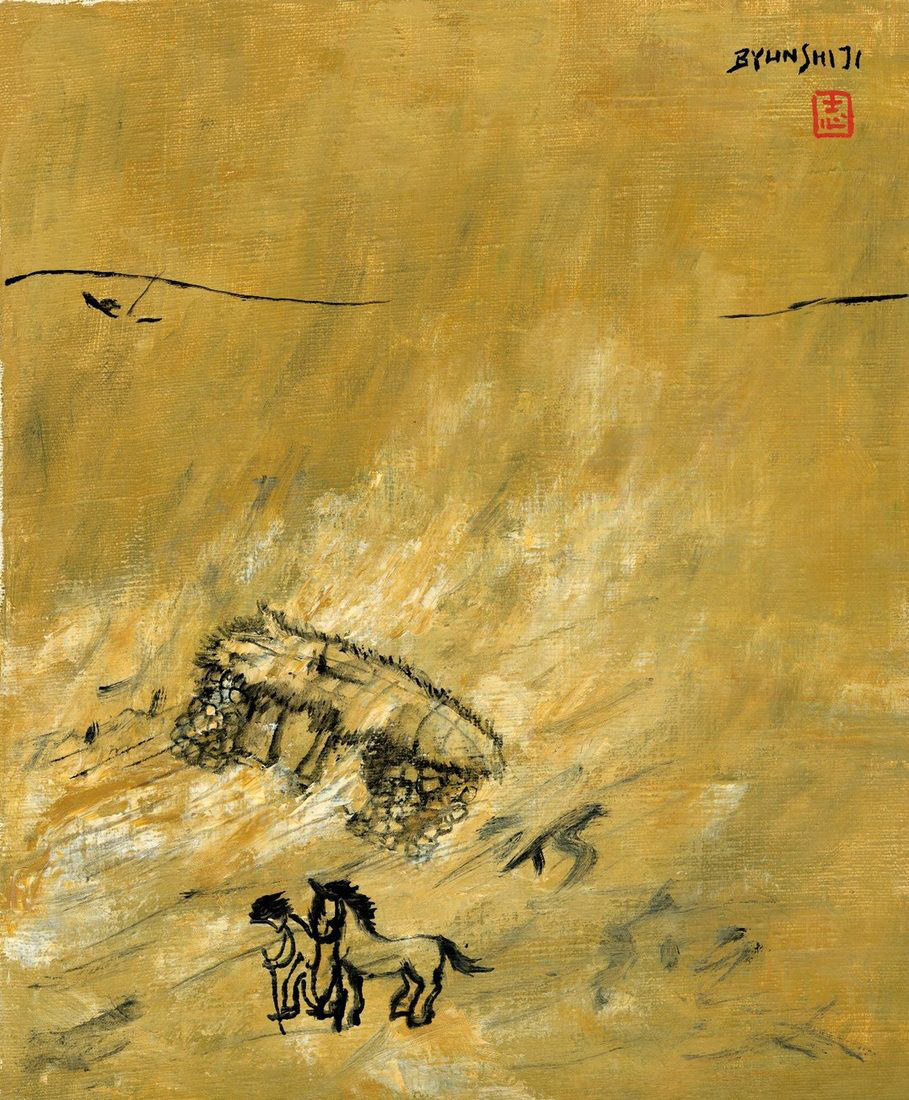
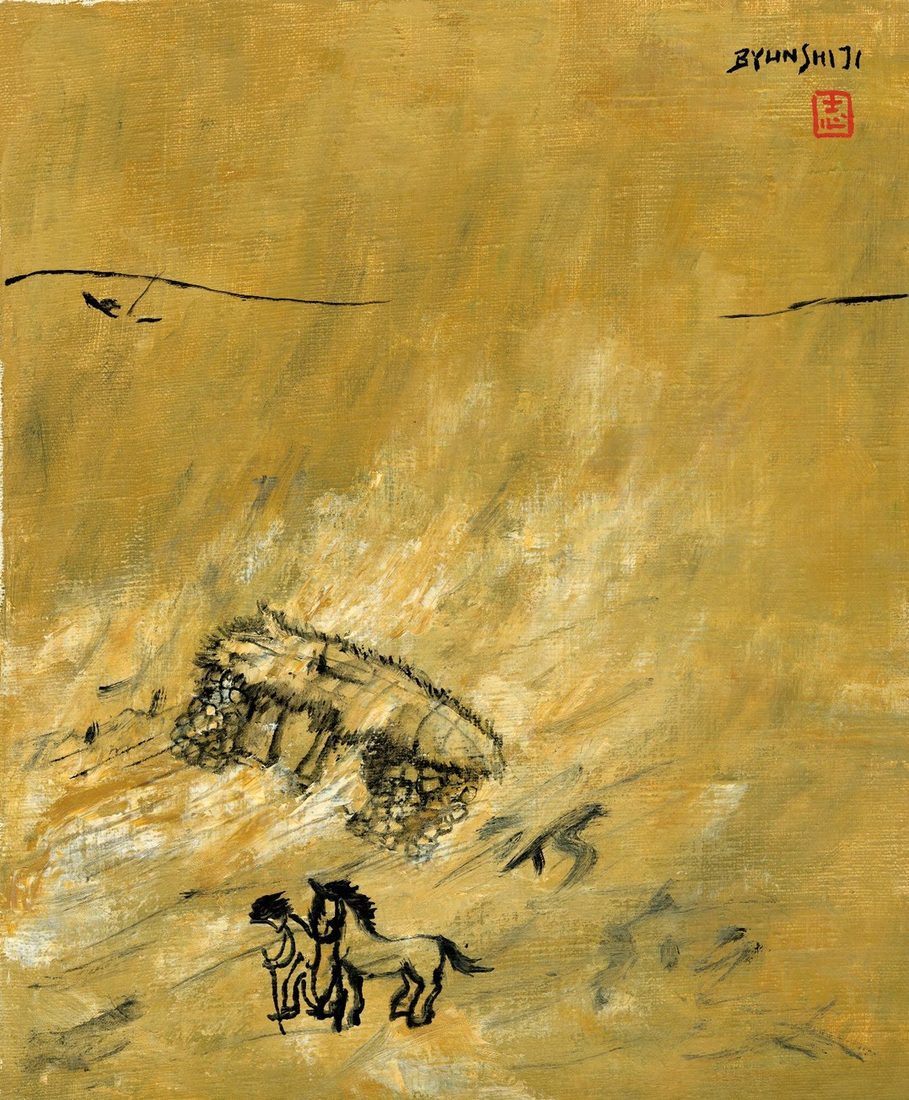
In Stormy Seas, a person and horse stand close together near the bottom. A house lies above them, while long, swept light marks cross their surroundings. Even without a detailed facial expression, we can register how near the bodies are and how exposed they remain. Feeling develops not only within a face but also in the distance between bodies.
The street’s crowd and the shore’s two bodies do not articulate loneliness in the same way. In one arrangement, proximity can become constriction; in another it can offer the possibility of support. Stronger colour or greater distortion does not necessarily produce deeper feeling. What matters is the relationship these intensities establish.
Saui Can Also Be Unsettling
An account of saui as invariably calm and harmonious leaves little room for Bada Shanren’s unsettling birds. Bent lotus stems, large leaves and small birds create tensions in Birds in a Lotus Pond. The Metropolitan Museum records this handscroll as ink on satin. The habit of imagining every ink painting on white paper must also pause here.
An abbreviated form is not necessarily peaceful. As its surroundings recede, a small eye, beak or bodily orientation can become stranger. The division in which the West distorts and the East omits is therefore too simple. Distortion and omission can work together in a single picture; neither has exclusive possession of feeling.
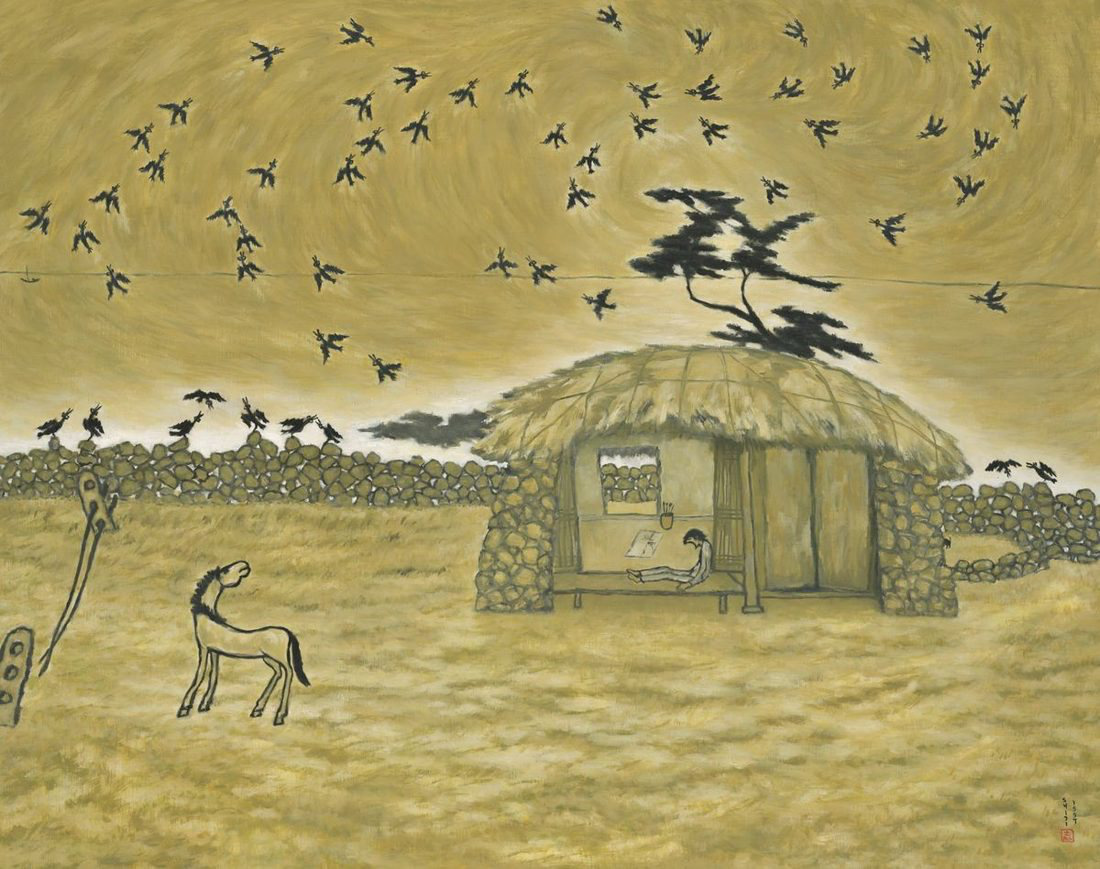
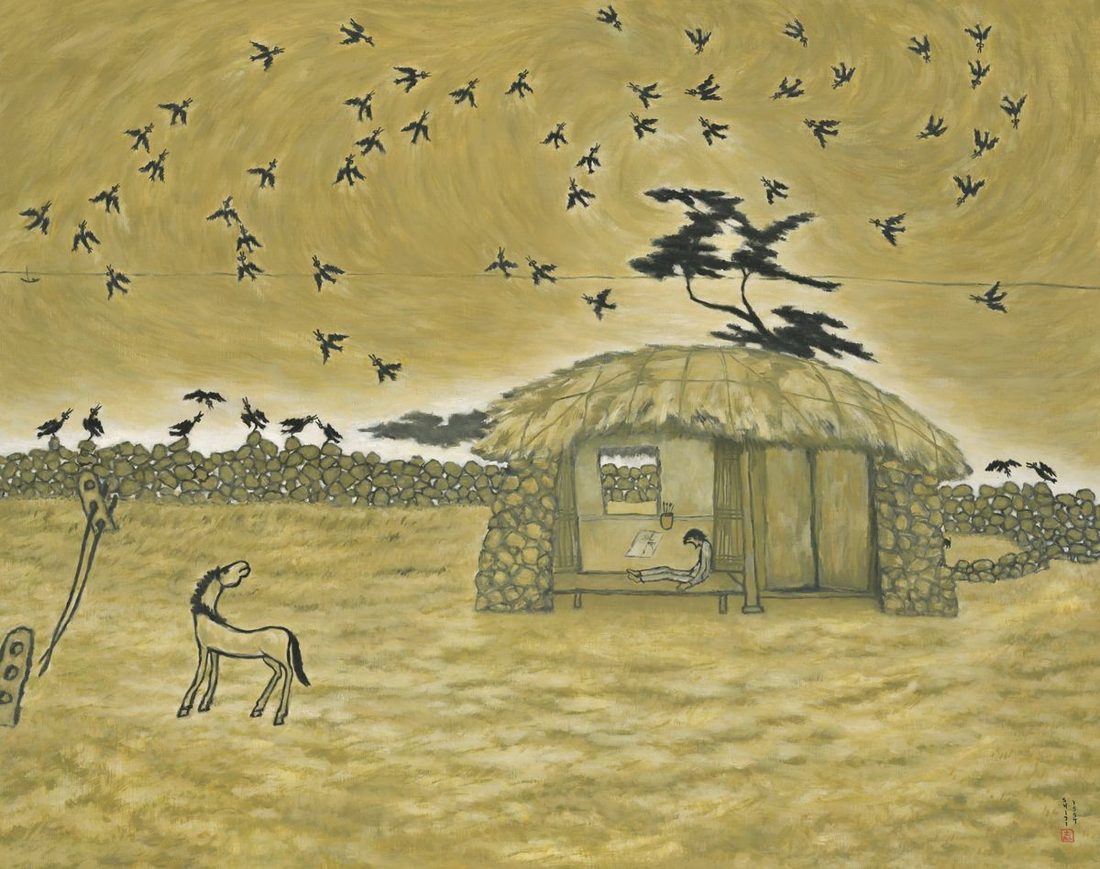
The birds of Wild Dance are not all in the sky. Some remain along the stone wall, while places for a person and a horse survive below. Small dark forms recur without all occupying the same condition. Through a saui-oriented reading, the question is not only how few strokes make a bird, but how many different relationships remain between the abbreviated forms.
Alteration and Omission Work Together
Alteration is not simply drawing an object incorrectly. It may reorganise direction, weight and movement within a painting. Omission is likewise not a numerical matter of using fewer details. It decides what we are invited to notice. We should ask what becomes clearer after a form is changed or reduced.
The low, tilted-looking house in Stormy Seas need not signify an Eastern ideal of refuge. It can instead disclose the exposure of the bodies nearby. The presence of a house is different from the ability to enter it. Placement, rather than a facial expression, makes that difference palpable.
Calling nature’s turbulence Western and the figure’s restraint Eastern divides relationships made by the same painterly practice. A tree’s bend and a person’s bend illuminate one another; light marks pass around house and body alike. Rather than distributing a painting’s interactions between two civilisations, it is more precise to examine what its parts do together.
The Lives Hidden by the Word Primitive
Primitive is sometimes used to praise direct, unadorned expression. Applied to actual people or cultures, however, it can push their histories and learning into an imagined time before civilisation. A simple form should not be equated with the supposedly pure instinct of a primitive person. Few marks do not imply a short path to making them.
This issue does not concern only foreign painters. A person painting home can also make a vanished way of life seem too pure. Reading a poor house only as modest beauty, or a strained body only as fortitude, can erase discomfort and need. Close attention to Byun’s landscape requires another pause before turning its bodies into beautiful symbols.
The horse in Wild Dance does not move as the birds in the sky do. For the person, too, a threshold and the ground’s level matter. Retaining different conditions of life allows a simple painting to hold a complex inhabitation. Small, modest forms can carry more when they are not reduced to a single purity.
Seeing the Scene before Naming Its Feeling
Titles such as Despair or Anguish strongly direct attention, but cannot furnish a figure’s expression or action by themselves. Instead of assuming the images behind those two titles in the earlier draft, this comparison returns to the examined reproduction of Stormy Seas. Before naming sadness, it asks how bodies, a house and light marks are placed.
The person’s nearness to the horse may be read as consolation. Yet the painting offers no ending in which safety is secured. A small relationship resembling contact does not remove the vast surrounding world. Precisely because that world remains, the closeness can approach us tentatively. Consolation may come on a smaller scale than resolution.
Nor should Byun’s feeling be placed wholly outside society and history as something primordial. In his oral account, he discusses transforming the political circumstances of his time through form and colour. Not every storm can be decoded as a particular event, but neither must we choose between fūdo and history. A posture can pass through both.
Feeling with a Form Is Not Becoming Identical to It
One passage in the supplied aesthetics-note transcription discusses empathy under Volkelt’s name: past experience and knowledge meet present perception. A subsequent example of a marble sculpture distinguishes material properties from feelings experienced in an artwork. These passages invite consideration of how a viewer’s feeling encounters form.
From this perspective, seeing a bent back may make me conscious of my own shoulders. That sensation does not mean I have become the painted person. Our lives differ. Empathy remains possible without erasing the difference. Here, too, unity of self and things is better limited to a comparative language of felt relationship than treated as proof that boundaries have actually vanished.
If I entrust all my sadness to the person in Stormy Seas, I may cease to see that figure again. Even after acknowledging that my memories have stirred, I need to return to the horse’s legs and the position of the house. Looking deepens through movement inward and a return outward. The painting outlasts the name of my feeling.
The Expressive Intent of Storm: A Proposal
The expressive intent of storm may serve as a proposal. It is neither the name of a new movement nor the painter’s own declaration. It offers a way to read a painting that makes rough forces visible without losing their relation to small beings exposed to them. Questions from Expressionism and saui work together, but not as a formula in which one repairs the other’s deficiencies.
The value of this proposal lies less in an imposing explanation than in its ability to renew looking. Returning to Wild Dance, we find stillness between flights and open ground between small bodies. Feeling passes across that ground without settling permanently in one place. Sadness and consolation can be named cautiously after sustained attention to the scene.
Birds scatter above. The horse stands on the ground. A low threshold remains for the person. The wind does not make the three alike.