Research/A Hundred Years of Wind/Ⅶ Comparison & Context
Ⅶ Comparison & Context · 81 / 100
The Spirit of Literati Painting, the Materiality of Oil
Where Related Marks Meet Different Grounds
문인화의 정신, 유화의 물질
Spirit Is Not Outside Matter
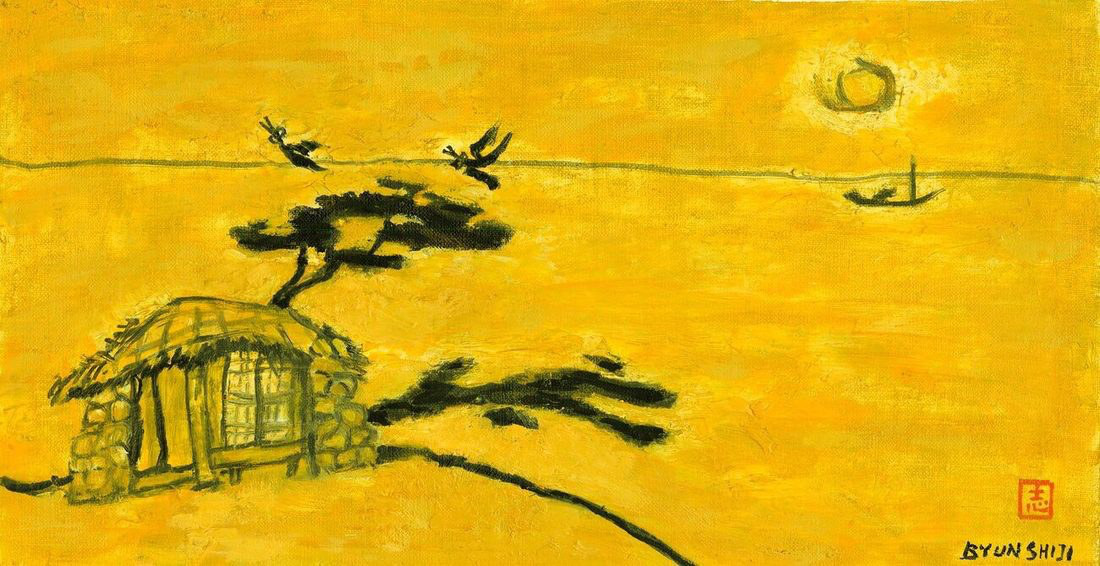
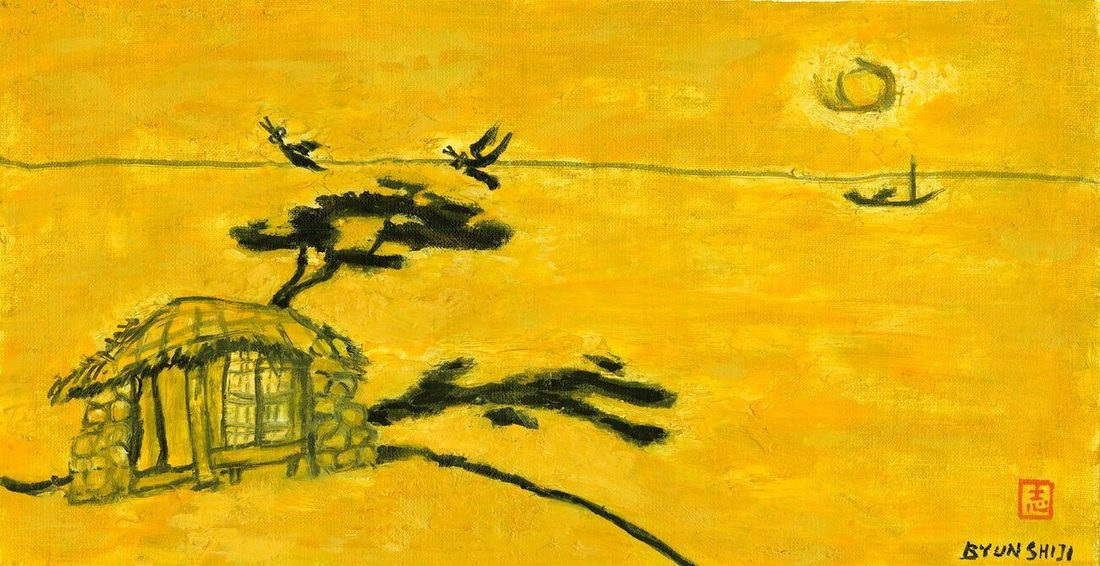
In Empty House, an expanse of dried-grass colour meets the eye first. House and tree gather on the left; a small boat and sun remain far away on the right. Dark marks hold forms together without removing the distance between them. An ink painting may come to mind, not simply because the marks are black, but because spare forms and open intervals bring each other into view.
Yet an evoked tradition is not the same as a material. An oil-painted surface does not become paper because it resembles it. Assigning spirit to the East and matter to the West obscures how both traditions have thought through materials. This painting is better approached as an encounter in which intention and material conditions alter one another, rather than a spirit poured into a foreign vessel.
A different ground can leave a different mark even under similar pressure. A painter may resist that difference or make it part of the work. The question in Byun’s painting is not which tradition has defeated the other. It is what relationship a mark, passing through changed conditions, establishes between a person and the wind.
A Written Line Must Also Be Seen
In Zhao Mengfu’s Twin Pines, Level Distance, the Metropolitan Museum connects the rocks’ flying-white strokes and the pine outlines with calligraphic practices. Ways of writing organise a landscape. Reading a painting can therefore involve recognising the cultural memory of a mark. This does not turn the entire experience of looking into the decoding of writing.
Expressive intent is not confined to personal emotion. It also concerns what receives attention and what relationships are retained. Knowing that a pine can signify steadfastness does not tell us where this particular tree stands or how far its branches reach. Identifying the symbol too quickly can make us overlook the tree in front of us.
In Byun’s Empty House, explanation becomes easy once the tree is translated into endurance. But a trunk beside a house and branches reaching towards an open expanse are more specific than that single word. Tradition can help open our eyes to these relationships. It need not supply an answer that brings looking to an end.
Broken Marks and Time Spent Waiting
A dry-looking, broken line reveals both contact and interruption. Its effect can be compared with dry-brush work. Visible roughness alone, however, cannot establish how much oil was removed or which additives were used. Dry brush is used here first as a way of examining a mark’s appearance, not as the name of an unverified recipe.
Byun’s oral testimony describes waiting for oil paint to dry to a degree before working over it. During the interval he might reconsider the composition. A finished mark that appears immediate is not evidence that an entire painting was completed in one sitting. An impression of speed may contain a long period of selection.
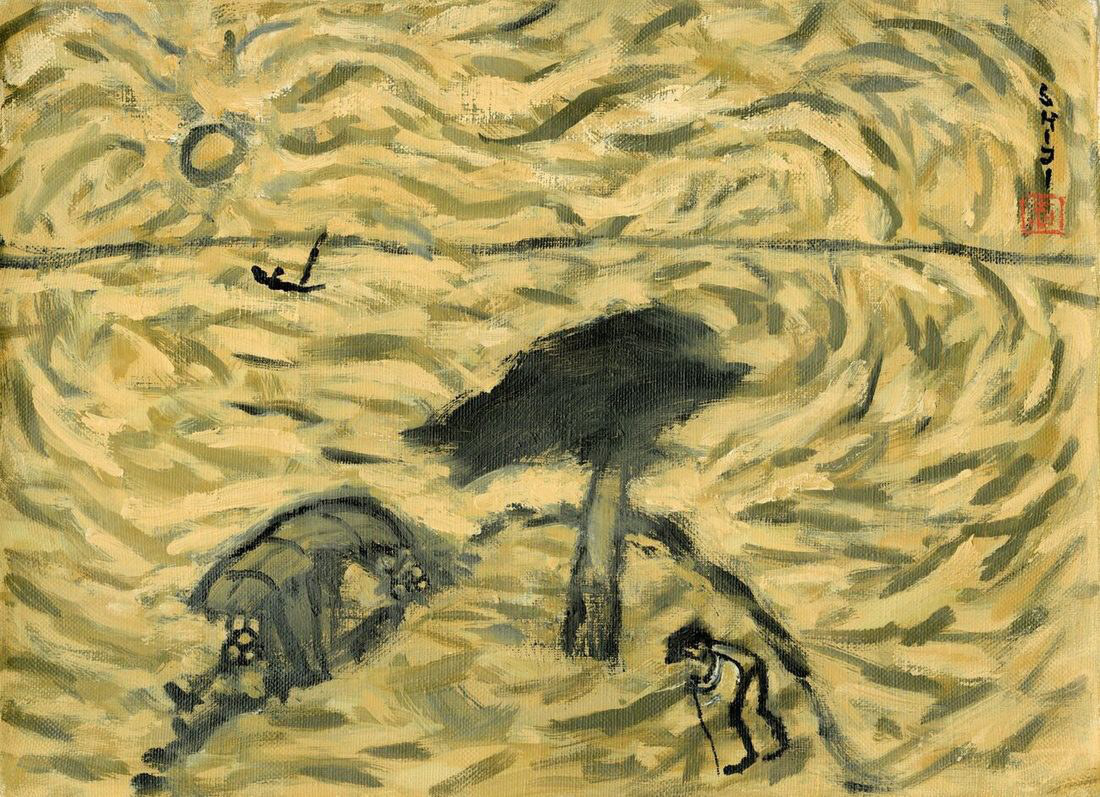
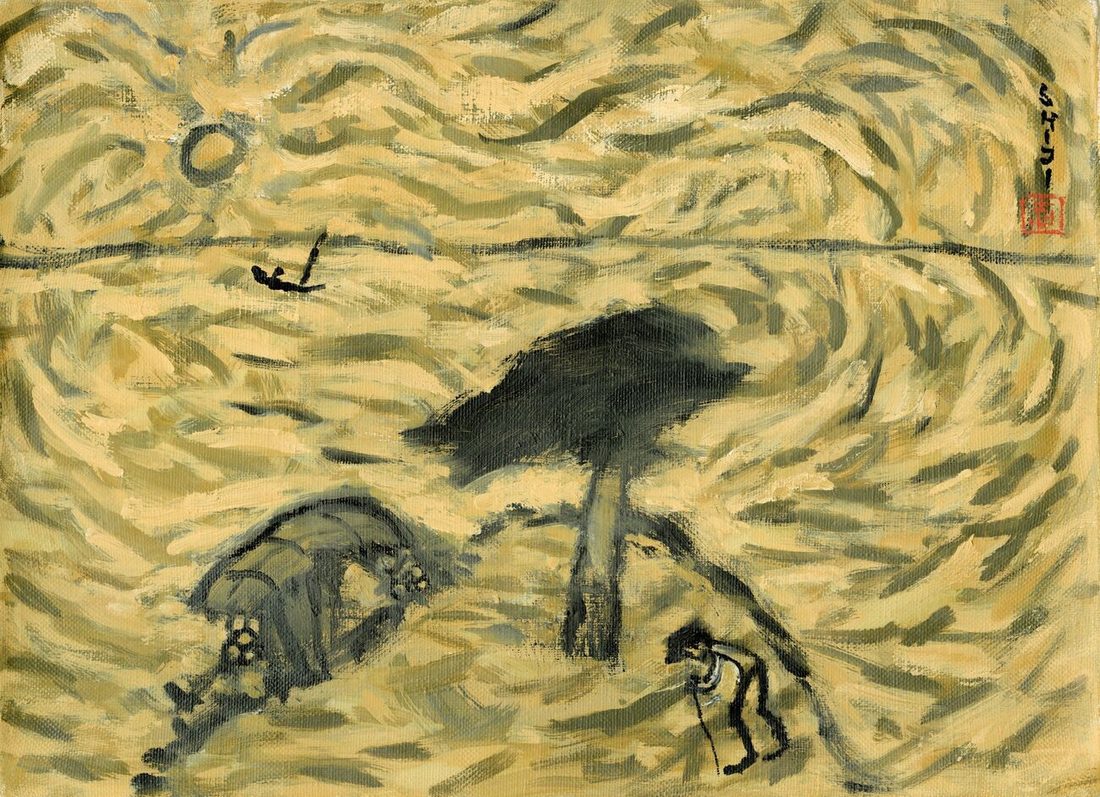
In Noon, short marks recur across the surface. The dark mass of the tree, the outline of the house and the small human body carry different weights within that movement. The force of one stroke cannot explain the whole painting. Looking at where marks accumulate and where they stop brings judgement into view within the roughness.
Not Assigning the Universe to Two Colours
A reader may associate black and yellowish tones with the classical phrase about dark heaven and yellow earth. There is no need to prohibit that association. But recalling a passage is different from showing that the painter used it as a compositional blueprint. Assigning colours to heaven and earth in advance can restrict a painting whose tonal field moves between water, ground and air.
In the oral testimony, Byun connects black with the practice of writing letters in ink. He also explains that his yellowish tones vary with what he paints. Learned everyday sensibility and fresh decisions coexist here. To call this an inborn national sense of colour would erase the time spent learning and choosing.
Nor does black perform only one task. It encloses a house, establishes a tree’s weight and leaves a distant boat as a small trace. A bright ground is not invariably comforting. It can increase apparent distance or make a body’s exposure more palpable. Meaning arises where colours meet, rather than remaining fixed inside their names.
Asking about Vitality across the Whole Painting
The preface to Xie He’s Guhua pinlu lists vitality or spirit resonance alongside brushwork, form, colour, placement and copying. It cannot readily be reduced to a demand to abandon detail and technique. Vitality can be approached not only as a mysterious force beyond form, but as a question that directs attention to several formal elements together.
Applied to Byun, this concept offers a comparative possibility rather than proof of descent. When a line seems alive, what produces that sensation: thickness, a bend, an interval, or a placement that prevents a small person from disappearing into a larger flow? A classical term can be useful precisely by making observation more specific.
The small figure in Noon is no larger than many surrounding marks. Yet a head, a back and an orientation towards the ground remain legible. A seemingly moving field and a few marks recognised as a body hold one another in place. Vitality need not consist only in displaying the painter’s force. It can also let a fragile form remain recognisable as a body.
Crossing a Boundary without Erasing Difference
Calling this ink painting in oils can offer a useful entrance for a first-time viewer. Remaining at that entrance, however, risks treating oil as a shell and ink as the true content. Byun’s work retains the waiting and revision made possible by oil paint. Related effects do not make different conditions of production disappear.
The supplied transcription of his ink-painting notes considers a rhythm between moving ink and still paper. That concern can illuminate the relation between line and ground in his oils. Yet replacing the whiteness of paper with a painted dried-grass field does not simply repeat the same relation. The analogy continues while the painting changes.
The novelty need not mean that two substances have combined into a third. A question associated with one practice may receive a different answer in another medium. Where should a line be placed so that an interval becomes active? Where would another layer obscure the initial relationship? Experiments at the boundary occur within decisions as small and concrete as these.
Where Learning Meets Lived Experience
Byun recalled looking at Chusa’s calligraphy in albums and sensing a formal affinity with bent branches encountered on the road. He also insisted that his houses and trees differed from those in Sehando. He connected inherited forms with observed surroundings while distinguishing them. Such discrimination does not diminish the importance of influence; it asks what was actually learned.
A feeling for literati painting did not reside automatically in his hand because he was Korean. Looking, reading, comparing and remembering intervened. Turning surroundings into a painting also required selection. To speak of lived fūdo does not replace training. It asks what that training came to do within a particular life.
This helps explain why the same tree can lead to different paintings. A place does not dictate a single style. A painter arrives with what has already been learned and revises that learning there. In Byun’s work, tradition is neither a discarded past nor a framework that must remain intact. It is rewritten in company with the landscape before him.
A Painting That Remains Oil Painting
To speak meaningfully of the spirit of literati painting, we should not belittle matter. To speak of oil’s materiality, we should not erase intention and judgement. Byun’s distinctiveness does not depend on his single-handedly completing two deficient traditions. It lies in the relationships through which learned forms are changed by his life and place, relationships available to scrutiny in the paintings.
Naming the picture simply Byun is not the end either. A proper name remains productive when it opens paths of comparison. Moving between calligraphy and painting, memory and observation, a narrow mark and a broad ground, we ask how this work finds its rhythm. To say that no single tradition fully explains it is not to say that comparison is unnecessary.
Beside the house, a dark branch reaches out. Where the branch stops, dried-grass colour continues a little further. A boat lies in the distance. The line does not reach all the way to it.