Research/A Hundred Years of Wind/Ⅶ Comparison & Context
Ⅶ Comparison & Context · 80 / 100
Terauchi Manjirō and Byun Shi-Ji
Learning a Resemblance, Learning to See Differently
데라우치 만지로와 변시지
A Relationship Beginning on a Bus
Byun Shi-Ji recalled first encountering Terauchi Manjirō on a bus. He asked whether this was the painter he knew from photographs, then asked permission to visit. On the next occasion he brought a painting. Their relationship did not begin as an already completed lineage. It began with a young man’s small act of asking to show his work.
There is no need to embellish the encounter as destiny, one genius instantly recognising another. What matters is that a door opened through which a painting could be carried. Work still being developed could be put before another pair of eyes. Learning became not only the acquisition of technique, but a testing of one’s judgement.
The Tokyo National Research Institute for Cultural Properties records the name 寺内万治郎. Terauchi lived from 1890 to 1964 and worked as a painter and educator, particularly associated with figures and nudes. Getting a name and a record right is a first step towards the actual person rather than an imposing symbol of the master.
Carrying Paintings Back and Forth
In his testimony, Byun distinguishes staying in his teacher’s studio to paint from bringing his own paintings for criticism. After receiving comments, he returned to revise the work and carried it back again. The teacher’s room was not the only important site of learning. Returning to one’s own picture after hearing advice belonged to the process too.
A translation takes place in that interval. The painter must find with his own eyes what another person has called insufficient, and cannot merely add paint because advice has been given. A comment does not move the brush. Deciding what to change and answering for the changed picture remain the work of the person painting.
Repeated visits need not be understood simply as exercises in copying the teacher’s form. A painting encounters another gaze and returns to its maker’s hand. As the same work is carried back several times, the criteria for what to look at may change along with the picture.
Yellow Reflected on a White Cup
Asked what he remembered of his teacher’s comments, Byun discussed light and reflection: something yellow affecting a white cup so that its white appears yellowish. The central lesson of this recollection is not to confine an object’s colour within the object itself. Colour becomes visible through relationships with its surroundings.
The pictorial question is substantial without turning the recollection into a scientific law for every colour phenomenon. Can a white garment be completed with white paint alone? Where do face and background alter each other’s colour? Brightness describes form while also creating relationships among forms.
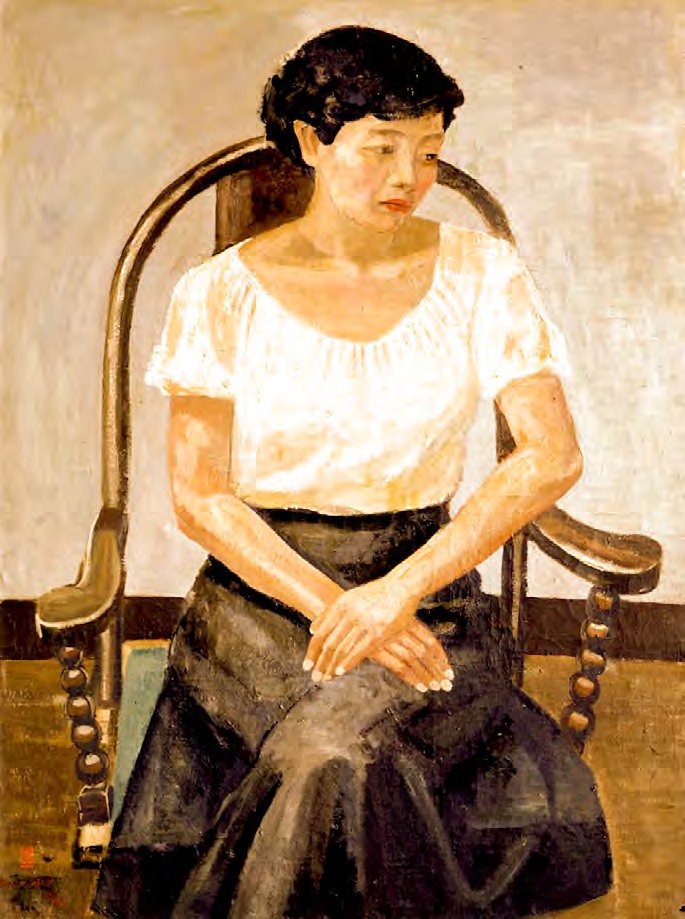
In Portrait of Nemo, the white blouse, flesh tones, dark skirt and wooden chair are not isolated from one another. The slight inclination of the overlapping hands and the brightness of the clothing together establish the sitter’s posture. Rather than making a one-to-one match with a particular Terauchi painting, we can examine the choices a trained eye makes here.
The Question Did Not Wait until Mastery
It is tempting to make originality a final stage reached only after technique has been mastered. Yet Byun recalled discussing the removal of unnecessary elements with fellow artists during his years in Japan. Wanting to paint a person did not require adding a flowerpot or table merely to fill the space. Learning and choosing proceeded together.
An award may offer recognition of such choices. It is not proof that one work surpasses a teacher’s entire art. The record of a prize and the comparison of paintings answer different questions. Keeping them distinct allows us to recognise the young Byun’s achievement without exaggeration, and to see that he was already making judgements of his own.
A pupil’s growth need not occur only when the teacher’s voice disappears. Learning becomes one’s own work when advice can be understood and there can also be reasons not to apply it unchanged. Independence lies less in claiming to have received nothing than in deciding what the received knowledge will be asked to do.
Wind Did Not Require the Abandonment of Light
To discuss the wind in the Jeju paintings is not to leave light and observation behind in an earlier period. Byun described seeing storms on site and later painting them at home in his own style. What he observed and what he transformed were both necessary. A painting of wind also passes through visual judgement and time spent making.
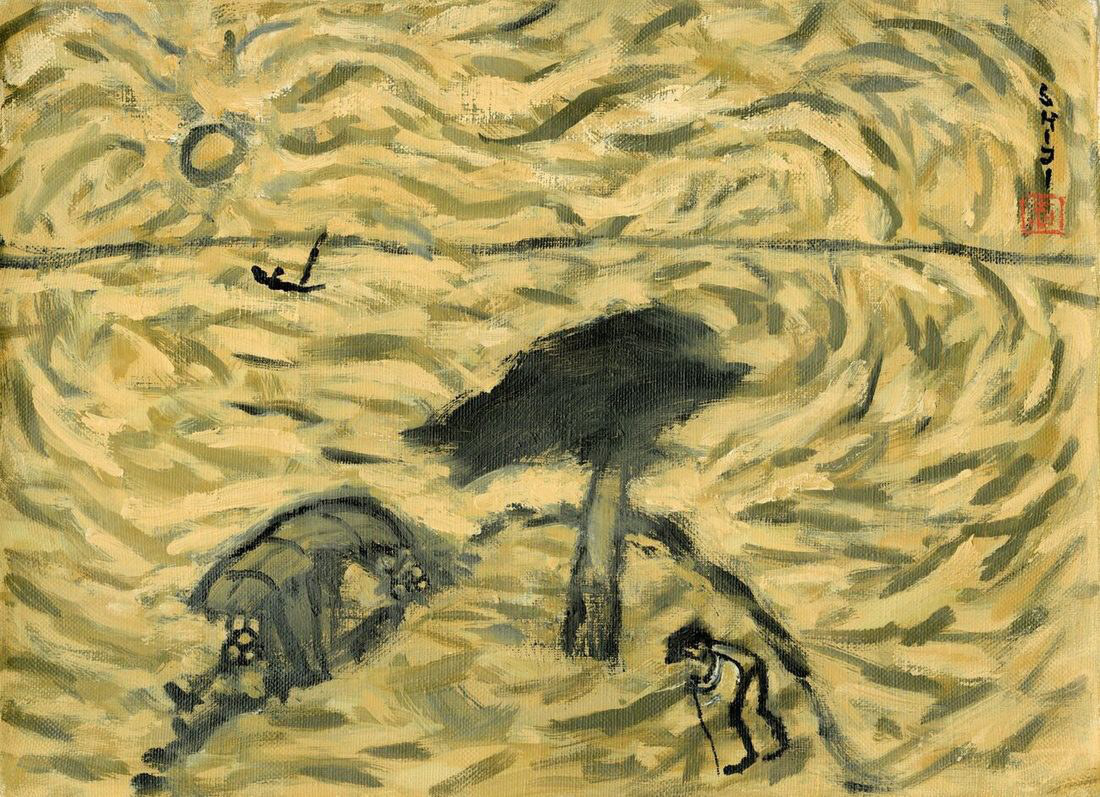
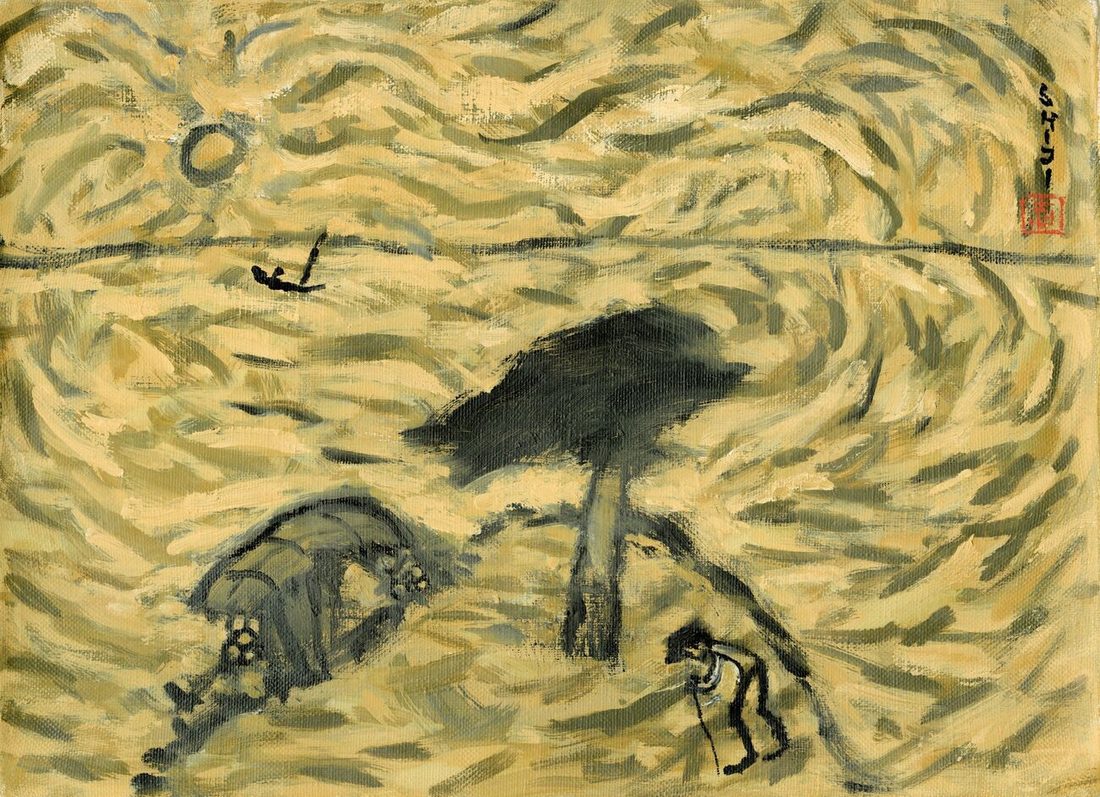
In Noon, the light ground appears among many short marks. A dark tree stands between the small person and the house. Light is not the opposite of wind here. Bright intervals between marks help movement to be felt, while the dark mass makes that brightness visible again. The relationship between colour and form continues in another configuration.
This difference need not be called a one-way ascent from realism to expressionism. The early paintings also express, and the later paintings also observe. We can read Byun’s transformation not as an abandonment of seeing, but as a change in how the observed and the lived come together within a picture.
A Teacher and Pupil Also Belong to History
Terauchi’s name also appears in the Tokyo institute’s record of painters selected for army dispatch in 1942 to produce war-record paintings. By contrast, Byun dated the beginning of his instruction to around 1946, after the war. Distinguishing these moments prevents their relationship from becoming a purely uplifting story outside history.
This record does not transfer a teacher’s past to his pupil. Nor should every piece of advice be called the language of empire without examining what was actually taught. Historical conditions and personal encounters belong in the same inquiry, but the actions of one person must not be confused with those of another.
The contrast between respectful Eastern pupils and rebellious Western ones cannot contain this complexity. Respect, rivalry, criticism and closeness can coexist within one relationship. With Byun, beginning from what was actually said and changed in the work is more precise than assigning a character to an entire continent.
An Eye for What Should Not Become a Resemblance
Byun valued instruction that recognised and developed a pupil’s distinctive ability. He also spoke of a distance from excessive resemblance to the teacher. We need not adopt the national generalisations in his recollection to recognise what he valued in good teaching: an eye for another possibility rather than the repetition of a form.
From this perspective, a good teacher does not simply give a pupil finished answers. The teacher helps the pupil see more clearly what commands their attention. A good pupil, in turn, does not hurry merely to look different. The need for another form must be discovered within the work.
To read Byun in relation to his teacher is not to bind him forever to the role of pupil. It means knowing where he learned while examining his subsequent choices in their own right. The more precisely reception is acknowledged, the more specifically transformation can be described. Gratitude and independence can remain together.
Back before One’s Own Painting
To close the relationship between Terauchi and Byun with the single word transcendence would lose the time of going back and forth that made learning possible. A picture was taken for criticism, brought home and revised. Some advice may have endured while judgements changed. Transmission does not consist only in repeating the same result.
Rather than announce in advance that the pupil completed what the teacher could not reach, we can read each artist’s work in its own setting and follow learning into another life. Remembering a relationship does not require staying in the same place. It can mean recognising what was received along a changed path.
The young man who had carried a painting to his teacher brought it home again. The criticism was over, but the painting was still before him. He had to see with his own eyes where to work.