Research/A Hundred Years of Wind/Ⅵ Time & Memory
Ⅵ Time & Memory · 79 / 100
The Possibility of K-Modernism
The Forms to Examine before the Name
K-모더니즘의 가능성
A Working Hypothesis, Not a Verdict
In this essay, K-modernism is a working hypothesis proposed for reading Byun Shi-Ji, not an established art-historical classification. Nor does it mean simply a painting made by a Korean artist. It asks what a learned pictorial language comes to do differently when it encounters particular ways of living and particular places. The name concerns that process of transformation.
When a name is settled first, works can become mere examples enlisted to prove it. A concept should instead remain open to revision through looking. Some pictures will fit a hypothesis, others resist it. Preserving that resistance is what distinguishes a critical concept from a promotional phrase.
We therefore do not claim that Byun single-handedly completed Korean modernity. A close reading of one painter’s path can expand the ways of discussing Korean art. Distinctiveness is not another word for exclusivity. The specificity of one path can be described without abolishing others.
Learning Is More than Borrowing
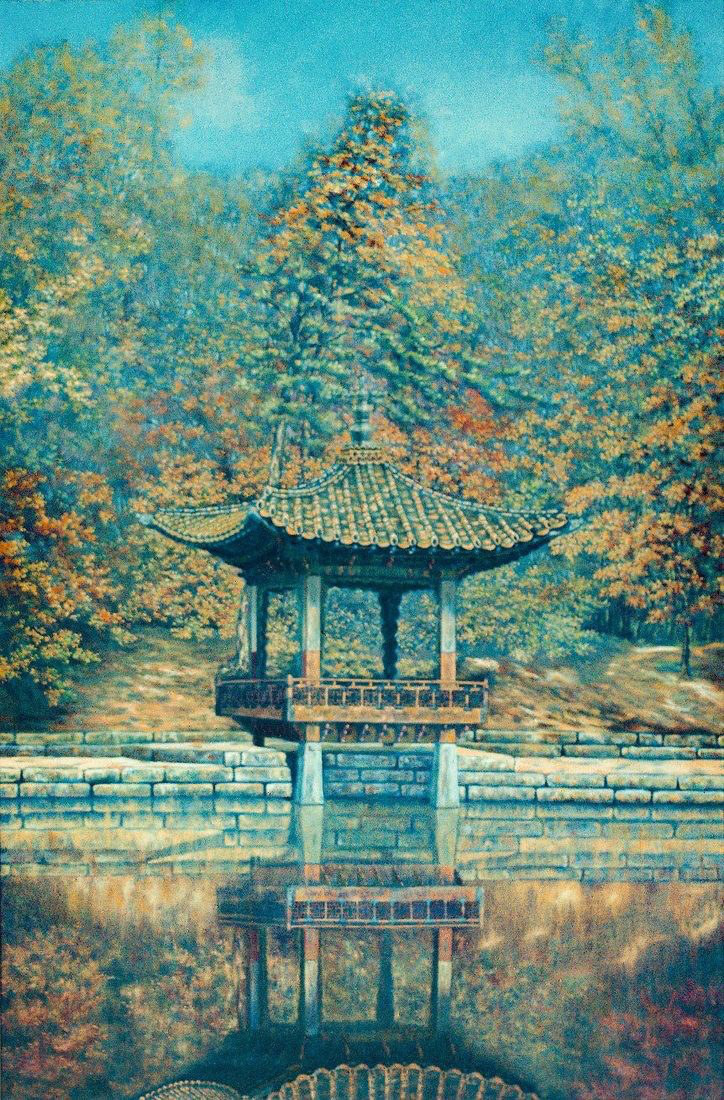
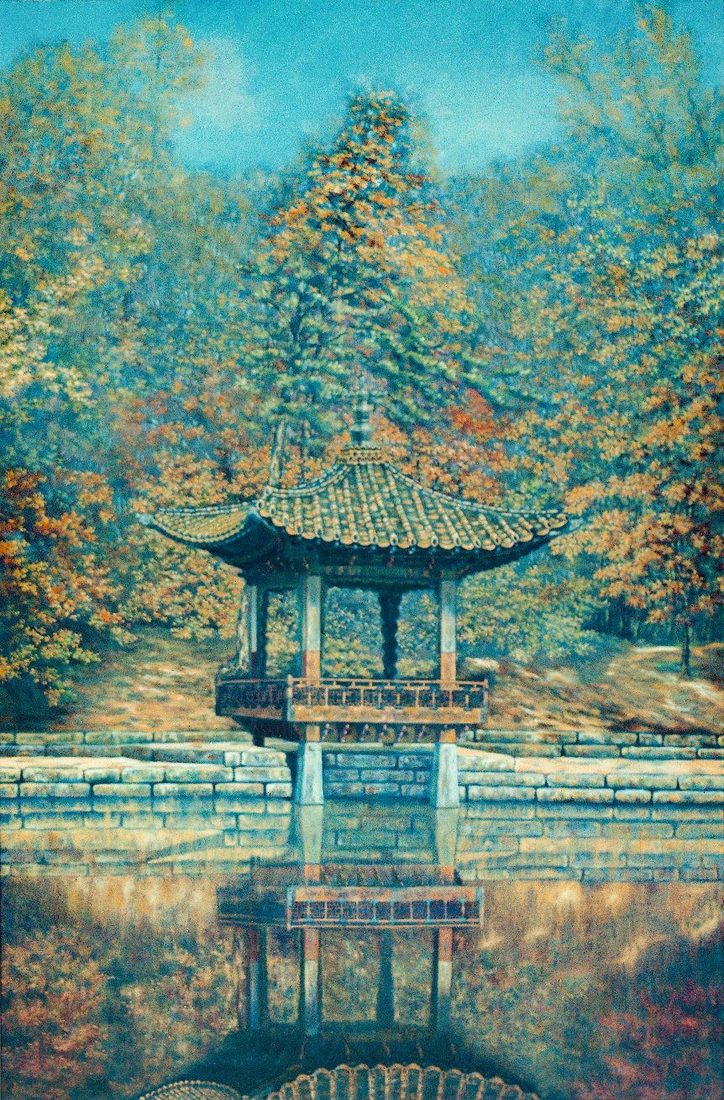
In Portrait of Nemo, a white blouse, overlapping hands and the curve of a chair establish the sitter’s place. In Aeryeonjeong Pavilion in Autumn, building, trees and reflections form another order. To explain these pictures simply as Korean subject matter inserted into Western technique would obscure the different decisions made in each.
A learned technique is not an empty vessel indifferent to content. Decisions about scale, colour and the placement of a gaze are connected with what deserves attention. When these decisions are readjusted in another place, transformation goes beyond a change of subject. A way of seeing creates new relationships.
Understood in this way, learning is not the opposite of originality. An ability acquired through looking at another person’s work can perform a different task in one’s own. What matters is not a claim never to have borrowed, but the specificity with which reception and transformation can be described.
Technique, Form and Thought Do Not Belong to Separate Periods
The scheme is concise: technique in Osaka and Tokyo, form in Seoul, thought in Jeju. Yet early portraits also contain judgement and feeling, while the Jeju paintings also depend on technique and composition. Assigning one element exclusively to each period makes change look clear at the cost of the works’ complexity.
Byun recalled discussing beauty with fellow artists in Japan and questioning the addition of unnecessary objects beside a figure he wished to paint. An interest in reduction did not suddenly begin on arriving in Jeju. We can instead examine how that interest changed through other subjects and other spatial arrangements.
Continuity and change do not exclude one another. A long-held question can receive another answer; a familiar technique can serve a new purpose. An account of transformation through fūdo need not invalidate the earlier years. It can show earlier abilities coming to work again within new relationships.
The Relations of Colour, Not a Claim to Its Invention
There is no need to claim that the colour of dried grass did not exist in other cultures. Byun himself said that the yellowish tone varied according to what he painted. Rather than entrusting distinctiveness to one colour name, we should examine what the colour does together with dark lines, small bodies and broad intervals.
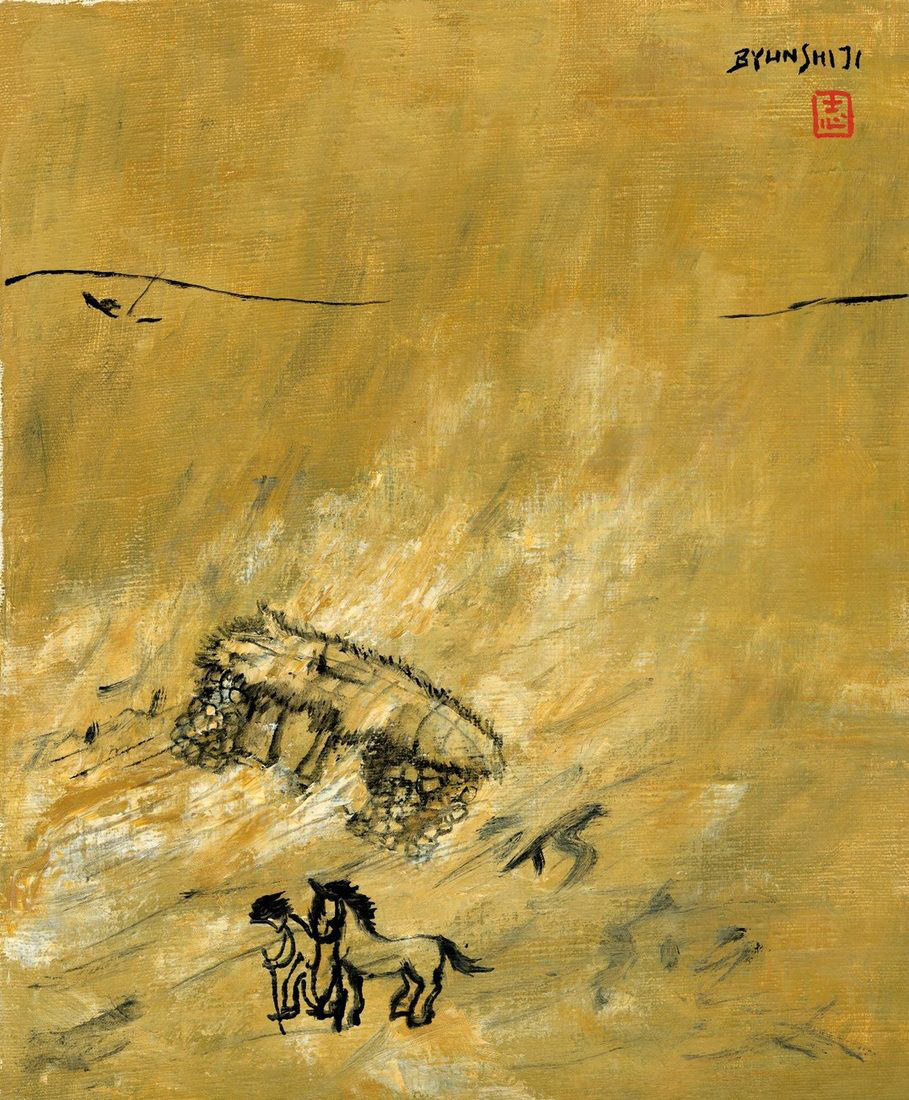
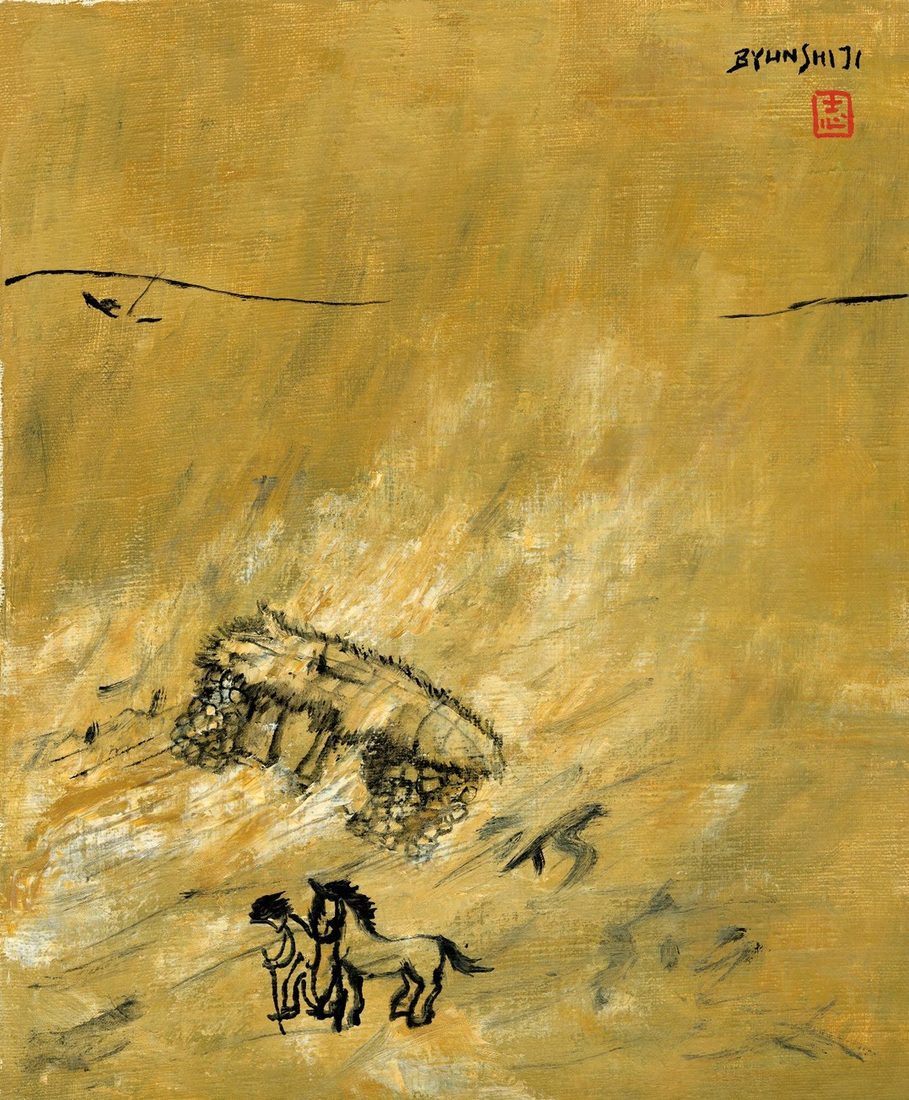
In Stormy Seas, pale marks pass around the house while the person and pony below are placed close together. Colour does more than describe a sea’s surface. It establishes a field in which distance and proximity, broad movement and small contact can be felt together. This organisation matters more as a unit of comparison than the rarity of a colour.
Here fūdo is not a pattern stamped upon the painter by an external environment. It is a condition in which bodily sensation, lived memory, learned painting and pictorial choices meet. If climate automatically determined style, painters in the same place would all be alike. Byun’s work invites us to question rather than assume that automatic connection.
An Exhibition Is Evidence, Not a Verdict
The Smithsonian’s official record identifies the Korea Gallery as an exhibition at the National Museum of Natural History, operating from 2007 to 2017. Discussion of Byun’s international exhibition history likewise needs precise institutional and exhibition contexts. A prestigious name must not conceal distinctions between display, ownership and loan.
Presentation by an institution is an important record of reception. It does not, however, prove the truth of a theory or the response of every visitor. Examining how a work arrived, how it was labelled and what stood beside it makes it possible to ask more precisely what was communicated, and how.
If international significance means only external approval, a locality becomes a place forever awaiting certification. Yet dismissing responses from elsewhere would lose the history of actual exchange. What we need is neither approval nor pride as an absolute, but criticism that follows how a work reaches another reader.
Three Different Neighbours
Kiefer’s Margarethe (1981) uses actual straw. It can be placed beside a discussion of Byun’s dried-grass colour, but plant material incorporated into a work differs from colour that evokes a plant. The comparison gains force less from calling both painters of the earth than from distinguishing how material and memory meet.
Goldsworthy’s Storm King Wall develops through an actual site, incorporating the remains of a wall and passing trees and a pond. Byun’s painted walls organise distances between bodies and houses within a picture. One alters ground through which viewers can walk, the other space traversed by the eye. Their shared concern with place preserves a difference of medium.
Kapoor describes how the dark opening in Descent into Limbo can read as a flat surface. A comparison concerning colour and depth becomes possible. But this cannot simply be gathered under Indian and Jeju spirituality. The comparison must begin again with the relationship each work establishes with the viewer’s body.
How to Test the Hypothesis
To use the term K-modernism, we must be able to say what changes in which work. A reduction in colours alone is not enough. Contour and ground, bodily scale and the movement of attention need comparison. Where different arrangements coexist within a period, the hypothesis should adjust rather than discard them as exceptions.
Nor should birthplace carry the whole explanation of change. Migration, education, encounters with other pictures, exhibitions and reading all require attention. The question of what is Korean then becomes less a matter of fixed descent than of what was selected and transformed within a particular history.
Finally, the concept must open questions for other artists too. Criteria designed solely to favour Byun would make comparison circular. By placing different works before the same question while allowing different answers, language developed around one painter may become useful to a wider critical conversation.
Set the Name Aside and Return to the Painting
The title retains possibility not because its conclusion lacks force, but because works can say more than a concept. K-modernism or fūdo-based modernism may offer a route towards a painting. The painting need not exist only within the limits of that terminology.
Language for reading Byun internationally gains strength from precise distinctions rather than expansive praise: reception and imitation, place and local colour, material and sensation, exhibition history and aesthetic judgement. Within those distinctions, his paintings can converse with other works without losing their particular appearance.
We return to Stormy Seas. The person and pony are close together. The house is a little way off. Having read all the names, the eye pauses between the two bodies.