Research/A Hundred Years of Wind/Ⅵ Time & Memory
Ⅵ Time & Memory · 71 / 100
Paintings in His Twenties, Paintings in His Eighties
Changing Pictures, Continuing Questions
20대의 그림, 80대의 그림
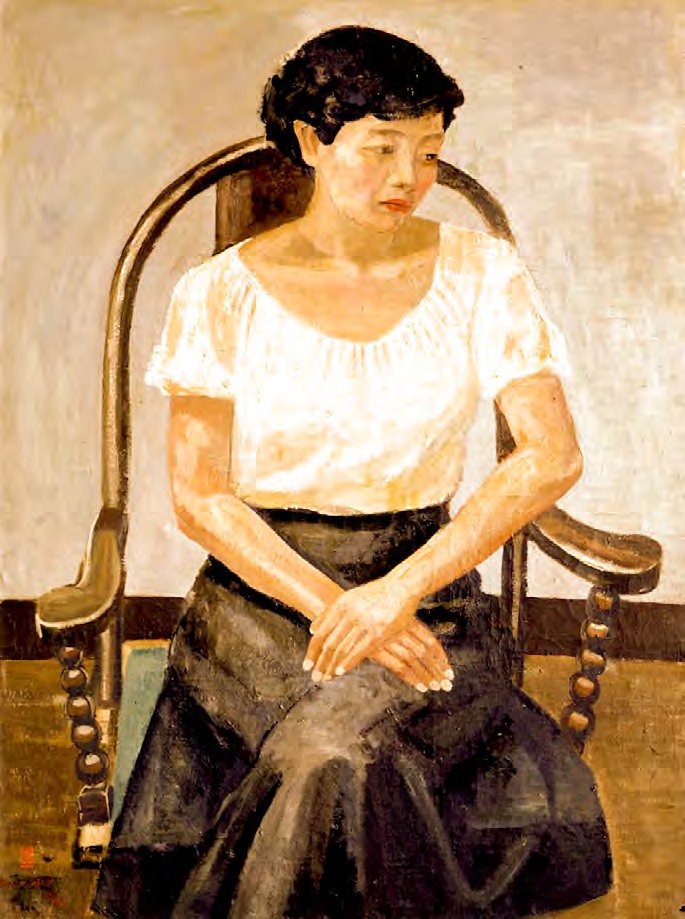
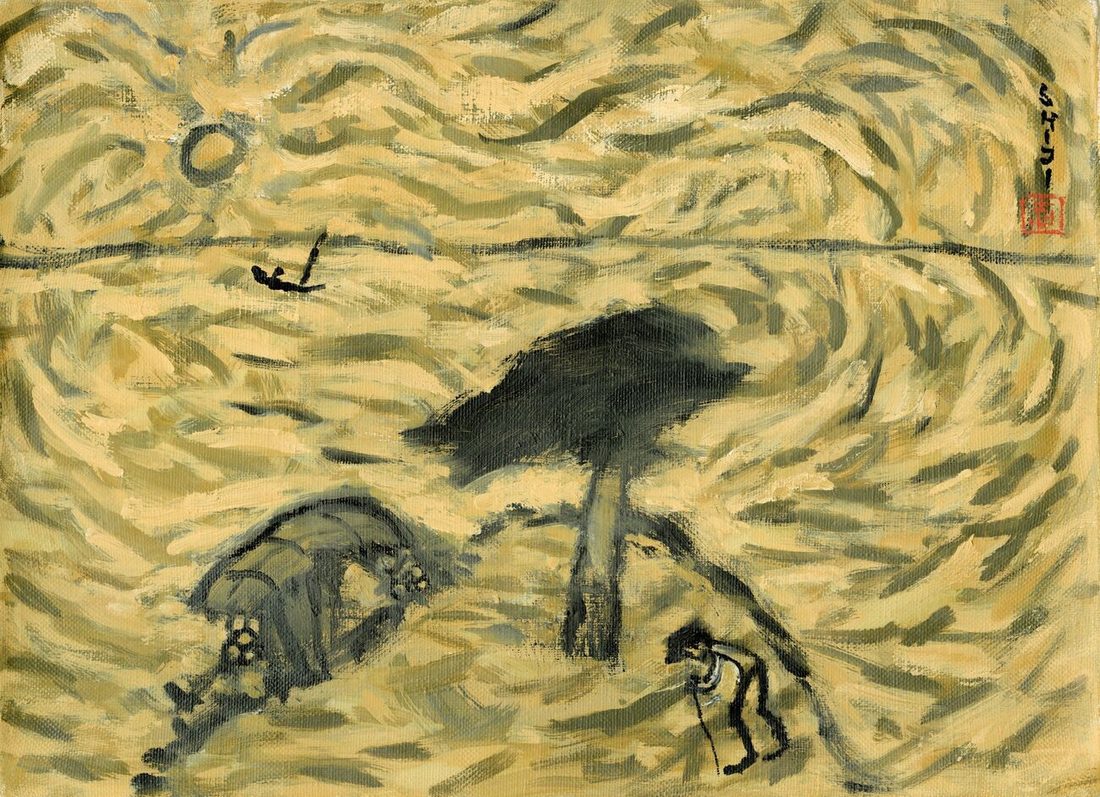
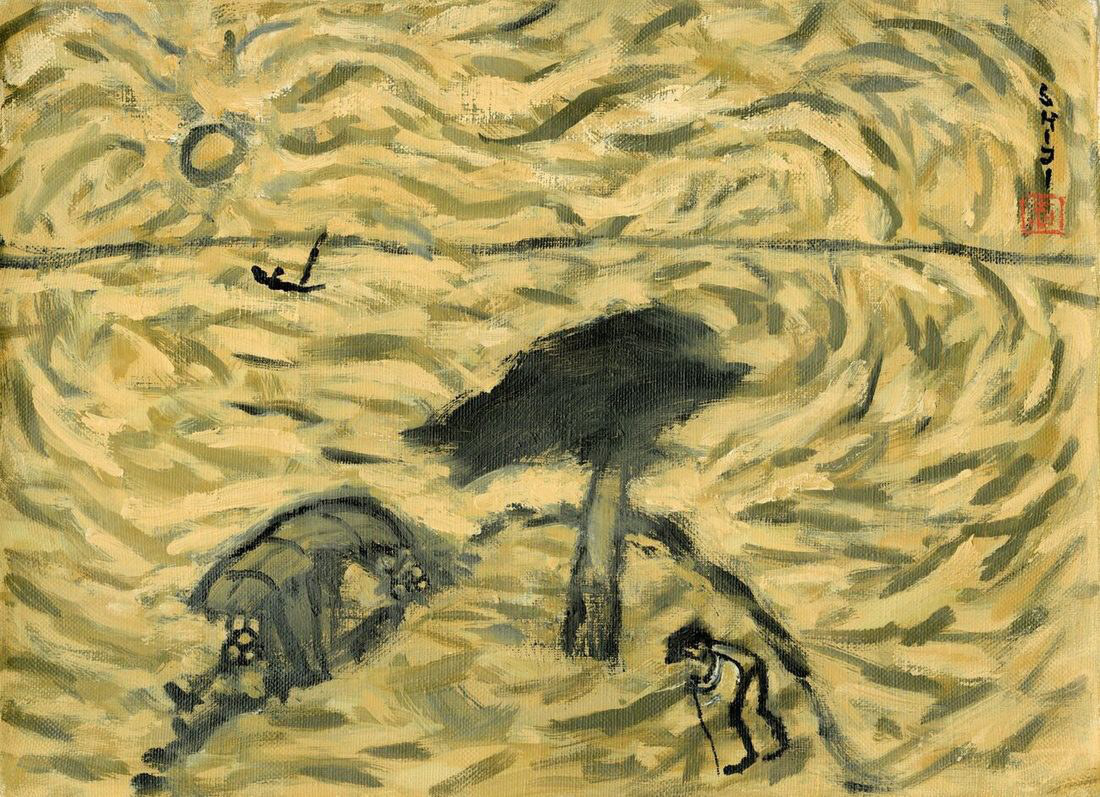
Placing Two Paintings Side by Side
In Portrait of Nemo, the woman rests her hands one over the other on her lap. Light falls on her white blouse; the wooden chair back curves behind her shoulders. The painting is dated 1951. In Noon, dated 2007, a small figure stands below the tree. The two bodies were painted by the same artist, yet even the route by which our eyes reach them is different.
The two dates are fifty-six years apart, not the span of the artist’s entire career. Nor are these pictures being designated its beginning and end. The question is what paintings from his twenties and eighties can ask of one another without either cancelling the other.
Scale is the first difference we notice. In one picture, the figure holds the viewer close. In the other, an eye searching for the person passes the house, tree, horizon and short strokes. Does a smaller face mean a diminished human presence? For a moment, we leave that question between the two pictures.
Hands and Chair in an Early Painting
The hands in Portrait of Nemo do more than demonstrate skill in depicting anatomy. The height at which they overlap and the distance between the elbows establish a seated posture. The chair is not merely an accessory. The supporting object and the person resting upon it together make a place.
The folds of clothing suggest the body without explaining it completely. Her gaze turns towards the right of the picture; her mouth is closed. We do not know what she is thinking. Even a carefully described face retains something unspoken. An interval already exists between that face and its viewer.
There is no reason, then, to treat this picture as a specimen of technique that had to be discarded. Refusing to explain away a person close at hand is itself a painterly achievement. Even when we return knowing the later landscapes, the woman remains in her own place. She is not seated there merely to stand in for an old man yet to come.
A Smaller Figure, a Wider Network of Relations
In Noon, a dark tree first catches the eye. Below it is a bent figure; on the opposite side stands a low house. Higher up are a small boat and a round sun. The person becomes more distinct when read among these differently sized forms rather than detached from them.
The intervals around the figure now share work once carried by facial expression. Distances from house and tree alter the body’s situation. This is not adequately described as a retreat into inwardness. On the contrary, it is a picture in which understanding a person requires us to look beyond that person.
Where the early chair supports a body, the later landscape surrounds one with ground, a walking stick and neighbouring places. This does not mean that a chair has evolved into nature. Different scenes offer different ways of situating a person. Continuity may lie less in recurring shapes than in asking where a body finds support.
Looking at Relations Before Naming Colours
Portrait of Nemo brings together white clothing, warm flesh tones, a brown chair and a dark skirt. This work alone makes it difficult to group all the early paintings under a cool blue. To discuss changes in colour, we must first see which colours neighbour one another within each picture.
Across the colour of dried grass in Noon, countless darker and lighter marks pass. The chromatic range may seem narrow, but the surface has not lost its movement. Selecting only spacious late paintings would conceal this density. The claim that ageing always meant painting less must pause before this work.
In his oral account, Byun says that the yellowish tone varies with what he paints. This is not a story of finding one colour and repeating an unchanging value for life. A common tonality may provide the conditions for noticing small differences rather than abolishing them. Each painting therefore asks to be seen anew.
The Continuing Work of Looking
A major change in painting need not mean abandoning learning through the eye. Byun recalls closely observing roof tiles and railings in Biwon, and explains that on Jeju he saw storms before painting them at home. Observation on location and later composition need not displace one another.
He also says that transferring what he has seen means translating it into his own style, not copying the scene unchanged. Memory here is more than a storehouse of details. It is a capacity to remake relations among things seen. As the pictures change, trained observation and selective judgement remain at work together.
To seek continuity is not to decide that the painter had only one question. What persists may be a habit of reconsideration rather than a finished answer. Yesterday’s painting cannot entirely substitute for today’s eye. Even before a familiar form, the hand needs another moment of pause.
Not Giving Late Life a Single Expression
A late work may suggest serenity. Yet that serenity cannot simply be equated with the artist’s inner state. A sparse picture can contain uneasy intervals; a dense one can offer resting places. Its date is an important condition, not a facial expression that determines its feeling in advance.
In his oral account, Byun describes waiting for days when he can concentrate, looking again at a prepared painting and changing its composition. He allows that such waiting may bring greater care. Late life was not simply a time of relinquishing desire; it also involved finding a workable rhythm again.
Choosing only a story of success or decline would erase that working time. There are pauses and days of returning to the surface. A sense of sufficiency and a sense of not yet enough may inhabit the same work. Painting for a long time may mean never being excused from making that judgement.
Beside Monet, without Reducing the Causes
The same care is needed when considering Monet’s late water lilies. The National Gallery of Art discusses the garden and pond he cultivated alongside painterly choices concerning surfaces and reflections. Explaining a late style through illness alone would push aside the long work of making and observing a place.
Monet’s water and Byun’s ground are not the same pictorial world. Yet placing the painters together raises a question: can what has long been seen become unfamiliar again? How much of a reflection should remain? How small should a figure beneath a tree be? Repetition does not make these particular decisions for the artist.
Comparison is not a ranking of who saw more deeply. It tests whether the language used for one painter can stand before another. When Monet is not reduced to an eye and Byun to pure spirit, the paint and places of both become more particular.
Returning to the Early Painting
After looking across time, the first picture changes too. Seen after Noon, Portrait of Nemo draws attention to the space between folded hands and chair. Conversely, looking long at the woman’s face makes us less quick to name the small figure’s state of mind. The two paintings do not explain one another in only one direction.
It is useful to arrange a painter’s life as a path. But we must also be able to see the pictures left outside that path. Some early works are already quiet; some late ones remain densely worked. A chronology can help us meet the paintings in sequence without closing off what each may say.
The woman rests one hand over the other. In the much later painting, a person stands beneath a tree. For a while we look from one picture to the other. In neither do we hurry past the place a person occupies.