Research/A Hundred Years of Wind/Ⅵ Time & Memory
Ⅵ Time & Memory · 70 / 100
Going This Way
Resignation or Acceptance?
이대로 가는 길
Before the Words “This Way”
Going This Way opens both a continuation of the present condition and a following of the present direction. The Korean idaero does not, on its own, establish a feeling of helpless inevitability. It can sound resigned in one context and like a considered decision not to change further in another.
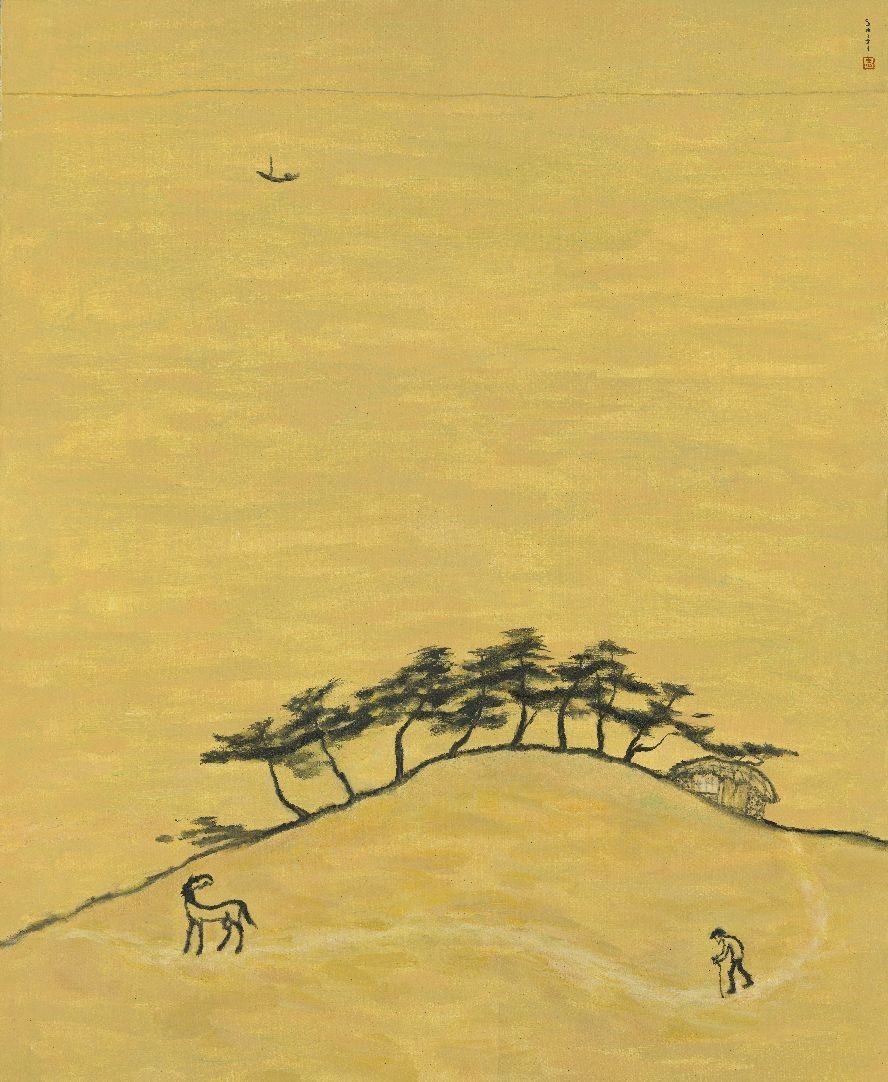
After reading the title, we must return to the image: who is placed where, what is near and what is distant? If philosophical language speaks for the figure too soon, the small body becomes an instrument for proving a thesis. What matters is how the forms complicate the question opened by the title.
The English title Going This Way leaves direction quietly in place. Rather than force every nuance into a title, the accompanying reading can explore the difference between continuation and choice. Translation need not remove the question; it can enable another reader to pause before it.
The Person Is at the Lower Right
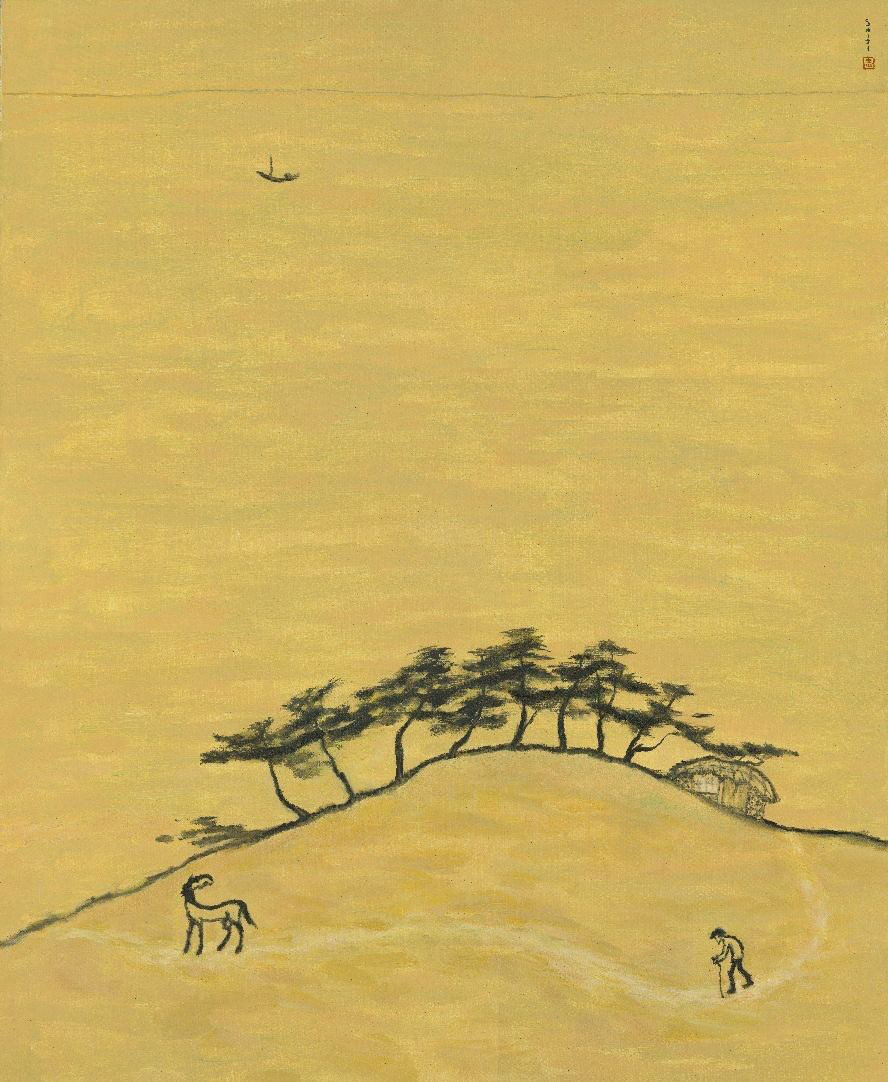
In the reproduction, the person is at the lower right. A pony stands at the lower left, and trees follow the low ridge above them. A small house is at the ridge’s right end. Higher still lie an open expanse of sea, a small boat and a faint horizon. This is not a stage containing only a person.
Person and pony are not close together, but they are not necessarily unrelated. As the eye crosses the broad ground between them, the ridge’s curve becomes visible again. The painting’s path is not only a line beneath a figure’s feet. It is also a route of attention through separated things.
An unseen destination is not the same as no destination. Nor can the house be fixed as the person’s goal. The painting leaves what follows open. The title names a way of going; the image shows the world in which it lies. The question of movement remains even without a complete account of purpose.
The Limits of Loving Fate
In section 276 of The Gay Science, amor fati appears as a task of affirmation: learning to see necessity as beautiful. It raises the question of how to receive a life already given. That question cannot simply be transferred into the painted figure as an established psychological state.
A walking stick does not prove an absence of resentment or a love of fate. A bent posture is not an emotional confession. We may read persistence in this body without claiming the right to supply every feeling contained within that persistence.
Affirming life is also different from declaring that harmful conditions cannot be changed. Asking for help or changing direction can be ways of caring for one’s life. That is a possibility worth preserving in the title. To continue does not necessarily mean leaving everything unchanged.
Reducing Force, Not Abandoning Judgement
When invoking Laozi’s wuwei, we should distinguish it from a production story in which the hand moved without thought. The diminishing described in chapter 48 of the Daodejing can be compared with painting, but it is not evidence that learning or judgement was unnecessary. Philosophical analogy and records of an artist’s work occupy different levels.
Byun’s testimony includes a process of taking an idea about colour from observed light and testing it in painting. It also describes waiting for paint to dry, reworking it, and the risk of losing a good effect through further additions. Reduction is closer to judging what not to touch than to the absence of judgement.
From this perspective, “this way” differs from unconditional neglect. It may name a choice not to cover an existing relation with further explanation. The broad space among house, trees and two bodies suggests that adding is not the only active deed. Stopping can also be a way of caring for a painting.
Not Calling a Resting Body Resigned
The distinction “the resigned person sits down; the accepting person walks” is too easy. It assigns failure to a resting body and affirmation to a moving one without knowing either mind. Bodily movement is not a one-to-one table of psychological states. This distance must be respected in reading painted postures too.
The person in Going This Way is small. Smallness does not mean insignificance. Against a broad ground, the place occupied by one body can become more distinct. The figure has sufficient weight within the image without being enlarged into a hero of perpetual walking.
When asking about resignation and acceptance, we might consider whether relations remain open rather than whether a step is being taken. Even that is a viewer’s reading, not a diagnosis. Leaving room for the mind the picture does not disclose allows a small posture to remain with us longer than a single moral.
Names to Keep When a Work Travels
The title has been introduced in connection with the Smithsonian exhibition history. But an exhibition record, identification of the loaned original and the reproduction being read here must be distinguished. A shared title alone does not certify the same object. International presentation makes precise identification more, not less, important.
A viewer elsewhere may find their own life between the small body and distant boat. There is no need to speak for everyone by claiming that all felt the same thing. Resonance is a possibility, not a fact established without records of reception. A work can meet unfamiliar experience and still retain its unfamiliarity.
The name Jeju is not a burden obstructing that meeting. Knowing the living contexts of house, pony and sea can change an interval already felt. Instead of erasing place for universality, place can generate another reading. Translation and the archive have a role in enabling that encounter.
Late Paintings Do Not Have One Expression
This painting from 2006 can be called a late work. But lateness does not automatically mean peace or detachment. There are wide intervals and small forms here. Whether that expanse brings reassurance or desolation remains open anew for each viewer.
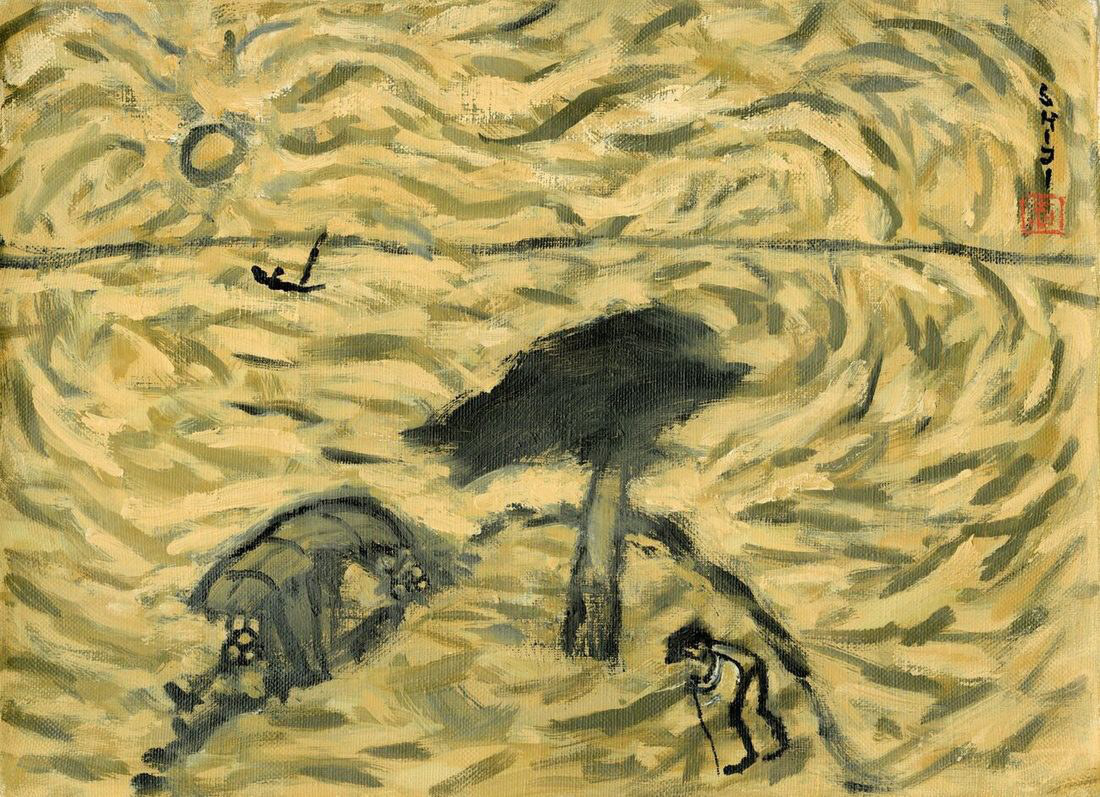
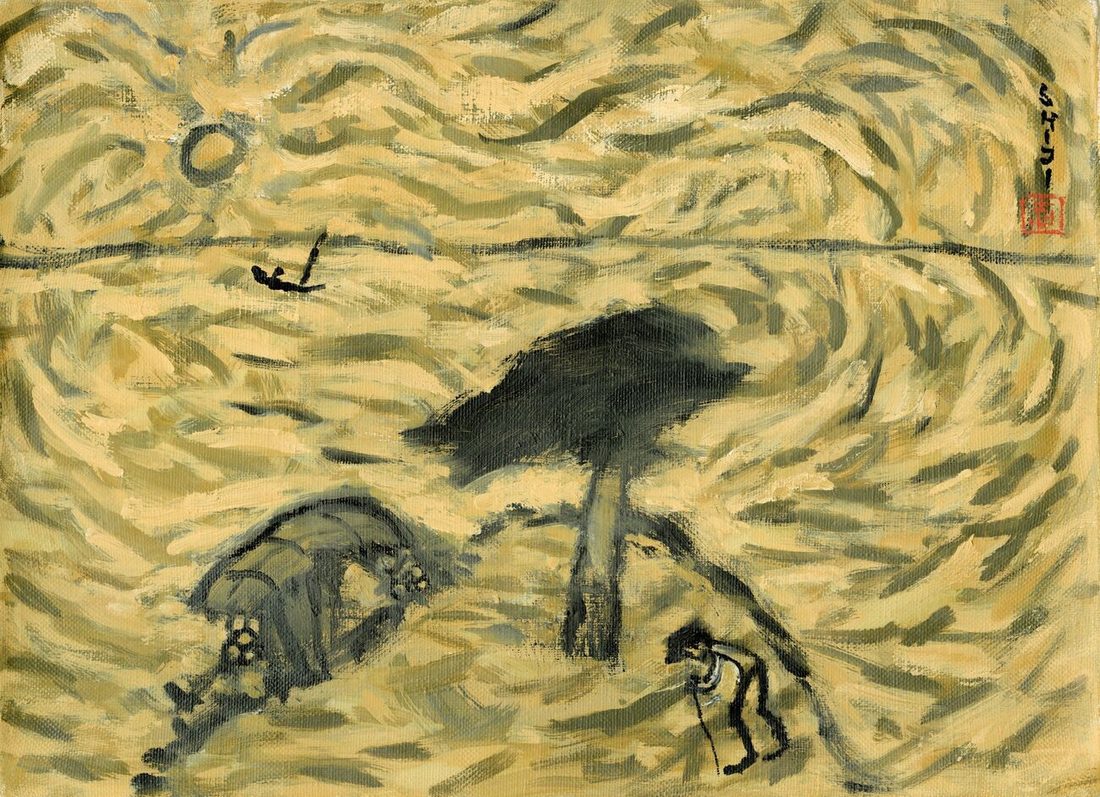
Noon, painted the following year, makes the distinction clearer. Many marks fill its field, yet a small person and house remain. Sparse and dense arrangements coexist within the same painter’s late years. Lateness need not be a period in which one expression settles everything.
“This way” can be read within that variety. Rather than a conclusion that nothing will change again, it may remain the particular breathing of this work. A different interval can emerge in the next painting. The quiet of one work does not bring every subsequent wind to an end.
A Painting That Does Not Tell the Whole Road
The initial question was resignation or acceptance. Instead of choosing one, we can now set out again what the painting has offered: a small person, a separated pony, a tree-lined ridge, a distant boat. Their relations leave room for different moments of life rather than resolving into one emotion.
The painting does not order us to go forward. It does not tell us which direction is right. It leaves sufficiently wide the world in which one body is placed. Within that expanse, a viewer may recall their own pace. Before an answer, there may be a moment of seeing one’s place again.
The person is at the lower right. The pony is on the left. Above them, one boat remains on the broad sea.