Research/A Hundred Years of Wind/Ⅴ Life & Place
Ⅴ Life & Place · 69 / 100
Descent
The Wisdom of Coming Down
하산(下山)
A Low Place Seen before the Summit
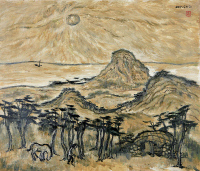
The supplied reproduction of Descent contains a distant central mountain, a ridge on the right, foreground trees, a pony, a small figure and a low house. A sun and distant boat are visible too. The title names a descent, but the image does not map the figure’s route. The forms of daily life placed nearer than the mountain first draw the eye.
The editorial source dates this work to 1986. It should therefore not immediately be described as part of a late series from the 2000s. Descent can be read without presuming a final scene in the artist’s life. It becomes not only coming down from a height but also the return of an upward-looking eye to the ground.
The smaller the reproduction, the more necessary it is not to supply details from the title. We cannot tell which foot steps first or whether a summit has been reached. We can attend instead to visible relations: the mountain is distant, trees are near, and the small bodies occupy the lower area with trees and a house.
Coming Down Is Not Another Victory
Saying that coming down is higher than climbing may merely reverse a familiar ranking. It creates another competition in which the person descending is wiser than the climber. What this painting invites is less a reversal of heights than a temporary withdrawal of the eye that measures life by height.
One need not have reached a summit in order to come down. A person changing course, returning to rest or choosing not to climb farther can descend too. That choice need not be justified by a record of victory. Making descent a return permitted only after conquest narrows the small body’s place again.
The low ground is not a leftover space for those who failed to reach the heights. It is where people eat, rest and encounter others. While the mountain remains distant, houses, trees and bodies make a day on another scale. Descent can begin to mean returning to that day.
Not Reading Simplicity as Decline
A small figure rendered in few marks does not by itself demonstrate a loss of skill. Nor should every rough or abbreviated form be elevated into mastery beyond technique. Judgement must follow attention to what those marks meet and what space they create.
The small person and pony in Descent are modest in relation to the trees. Instead of dominating the whole, they direct attention back between trees and house. Without enlarging the figure to explain a facial expression, surrounding relations give the body a place. This simplicity reduces detail while opening space.
The word maturity cannot substitute for those relations. We must first attend to the intervals made by a particular work, then compare it with paintings from other periods. Organising a life into ascent and descent is convenient, but it risks confining each work’s time to a single curve.
How a Body Places Its Weight
A descending body is not a body that no longer needs anything. It needs a place for the foot, perhaps a walking stick and somewhere to rest. Thinking about lowering must retain these specific needs. A grand account of renouncing desire should not conceal the body’s small requests.
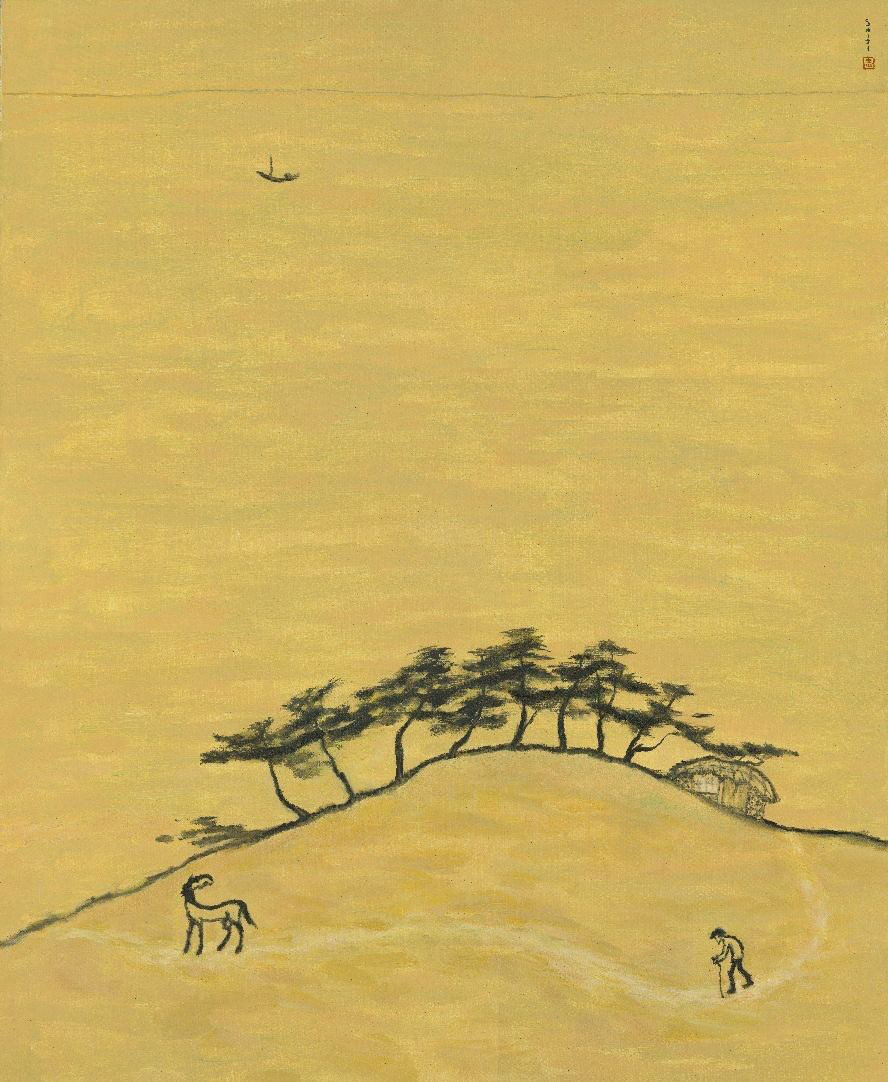
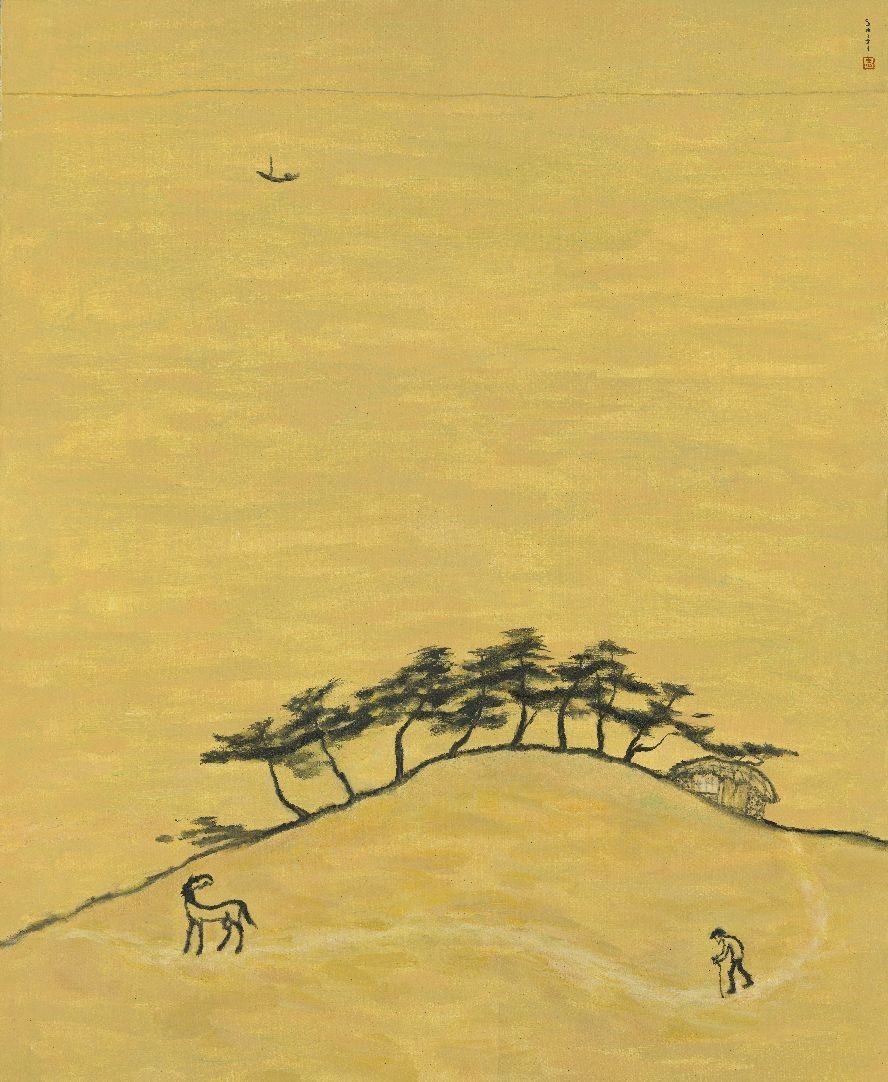
In the comparison work Going This Way, a person with a walking stick occupies the lower field. This body allows us to think about support. Receiving help is not simply the opposite of independence. A body is less a self-sufficient mass than a being placed through ground, tools and intervals.
The wisdom of descent may be closer to knowing where to share one’s weight than to carrying it alone. It can include pausing or leaning. This helps explain why a painted person need not adopt a victorious posture in order for their place to matter.
The Gaze That Calls Jeju Lower
The everyday Korean phrase for going “down” from Seoul to Jeju cannot simply be made a decline in status. Geographical direction and cultural ranking differ. Placing Osaka and Tokyo at the summit, Seoul halfway down and Jeju at the foot repeats the very hierarchy a reading may intend to question.
Byun recalled trying his earlier Biwon manner on Jeju and finding that a change of subject alone did not adequately convey life there. What matters in this account is neither promotion nor regression. It is the renewed question of what kind of painting is needed in a changed place.
Descent can serve as a metaphor for that process. It is more useful left open to mean stepping outside an earlier criterion and beginning other relations, rather than proving that a lofty state has already been attained. Just as some things appear after coming down, others appear because one has stayed.
The Distant Mountain and the Nearby House
No evidence secured for this revision identifies the mountain in Descent as a particular peak. Its role does not disappear because its name remains unknown. Distant summit and nearer trees overlap to create several distances. Among them, the house occupies a smaller, inhabitable scale.
Looking at a mountain does not necessarily announce an intention to climb it. What is distant can remain distant while attention turns to a nearby place. Mountain and house do not compete over which size is more important. Their difference allows distant landscape and the nearness of daily life to coexist.
Laozi’s image of water brings low places and benefit into the same thought. It need not be attached to this picture as its solution. What it offers is a question that does not immediately equate lowness with inferiority. Returning from the metaphor, we find the small house still below the mountain at its own scale.
Beside One Another, Not Necessarily on One Route
Pony and person in Descent can be read as companions. Yet being visible together differs from a story in which both share a destination. The small reproduction cannot tell us their subsequent steps. What it first offers is their being placed near the same trees.
The interval is clearer in Going This Way. Pony and person occupy the lower left and lower right respectively. The expanse between them allows the possibility of encounter while preserving distinct places. Companionship need not always be pictured as close bodies moving at the same speed.
Keeping company does not mean deciding another being’s direction. Being together differs from becoming identical. A community of low places would begin by refusing to make another life a supporting actor in one person’s completion.
Without Explaining the Whole Mountain
Descent need not close as merely another name for death. The house below may suggest a final resting place, but it may also be the place of daily life to which one returns today. The image does not hurry us towards either decision. The movement opened by its title can meet different times within a life.
Once the person descending is no longer made into someone who knows everything, the body’s remaining tasks become visible: attending to the nearby path, finding rest, adjusting distance from another body. Instead of ending after a grand revelation, the image continues to open towards small acts of living.
Small bodies are there beneath the trees. The roof of the house is low. A distant boat remains on the sea above them.