Research/A Hundred Years of Wind/Ⅴ Life & Place
Ⅴ Life & Place · 68 / 100
The Time of Wild Dance
The Rhythm of Scattered Marks
난무(亂舞)의 시간
From the Sky Back to the House
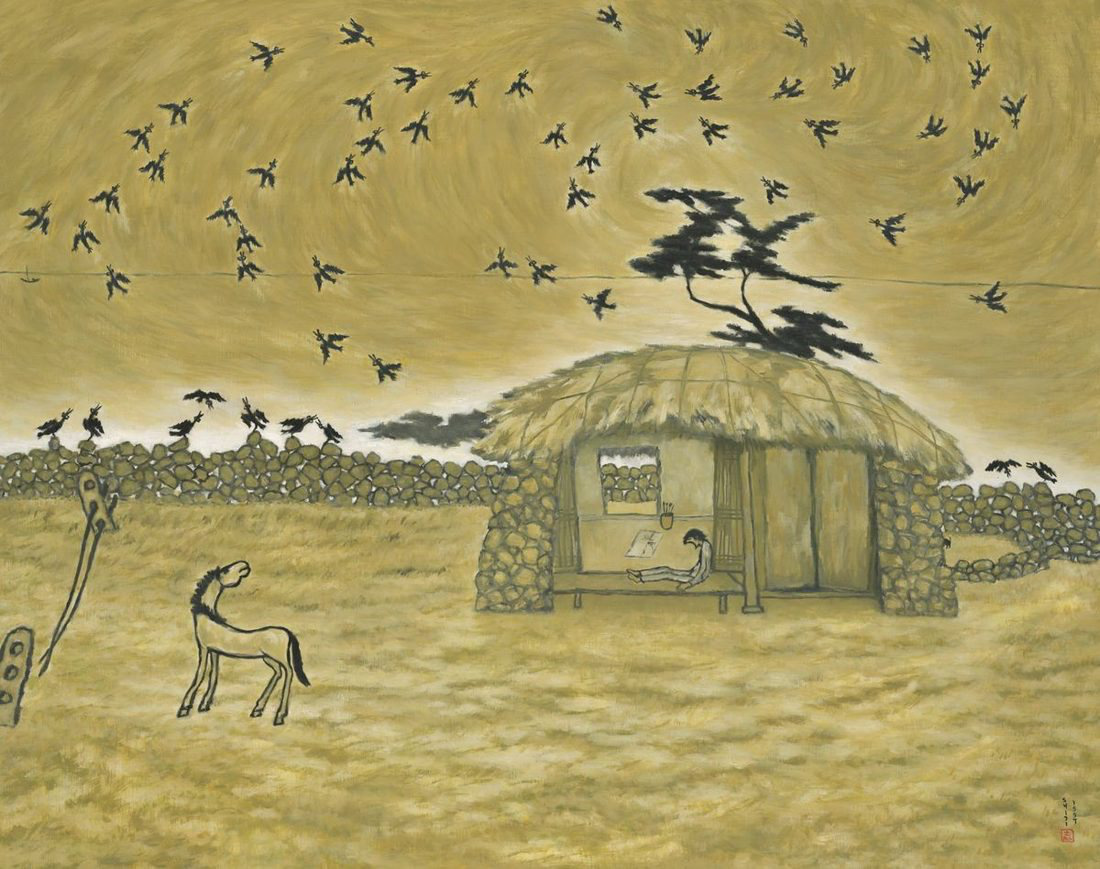
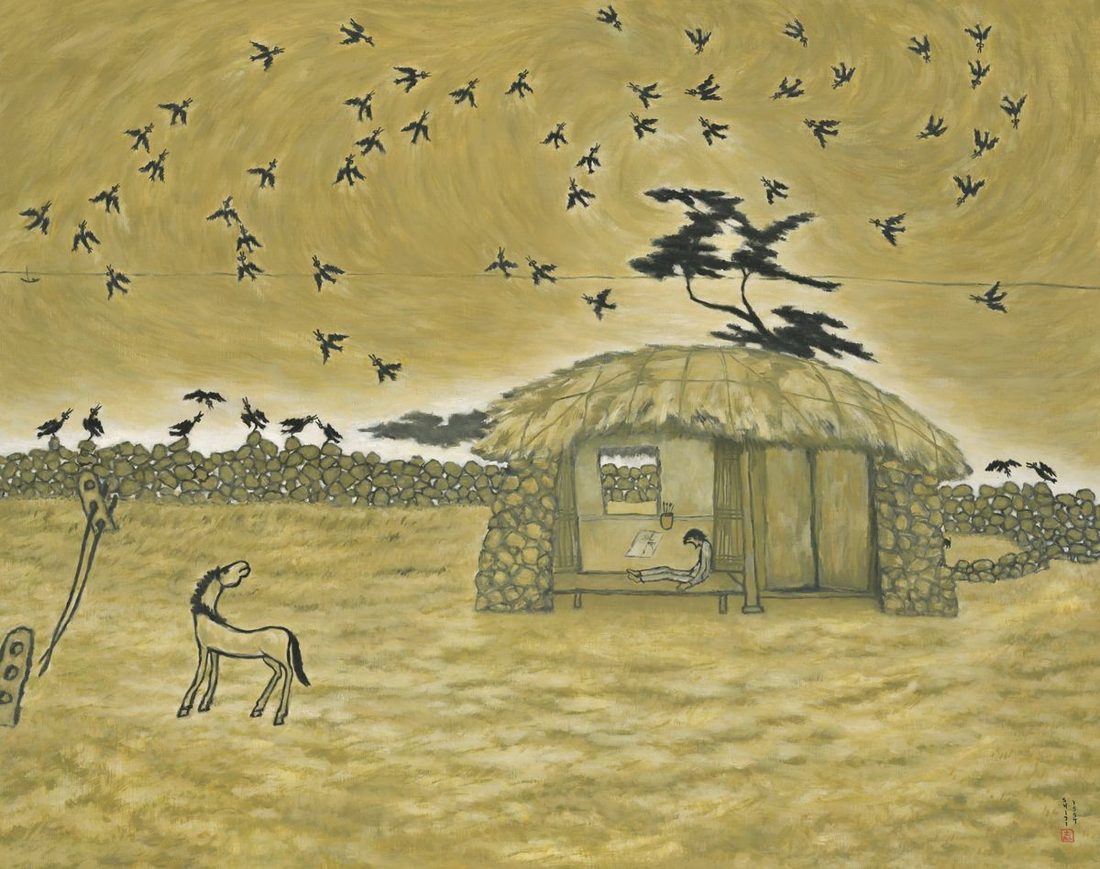
In Wild Dance (1997), birds scatter across a broad area of sky. Their wings point in different directions, and the distances between them are unequal. Below, other birds perch on a stone wall. Flight alone does not constitute the image. Flying and resting together establish its extent.
A seated person occupies the large thatched house on the right; a pony raises its neck at the lower left. The eye descends from sky to wall, then to house and pony. This is not time literally unfolding inside the painting, but the time of looking. Wild dance activates both depicted movement and the movement of viewing.
The question is not simply how fast the birds fly. It is why, amid so many directions, we do not lose the positions of house and pony. The form of wild dance begins when scattering does more than fracture the picture: it prompts us to see its different parts again.
Even Disorder Has Intervals
The title invites us to read unruly movement as dance. That dance need not have a single conductor or a prescribed beat. Here, repeated dark forms and differing gaps create rhythm together. Rather than equal intervals repeated across the image, changing intervals keep the eye moving.
In some areas birds cluster; elsewhere the lighter ground opens more widely. An eye passing over close-set forms slows briefly in an open area. Isolate a single bird’s shape and that difference disappears. The unit of wild dance is both the bird and the space between birds.
These intervals do not remove disorder in order to display order. The tension of the whole remains because differing directions survive. Pictorial order need not send everything the same way. It may consist in holding different movements together without losing them.
Observing Composition, Not Proving Chaos
Such an image can be compared with scientific accounts of emergent order. Prigogine’s work addresses the emergence of new structures under nonequilibrium conditions. But it concerns specific physical conditions and processes. A painting of an apparently irregular flock does not, by that fact alone, demonstrate the theory.
A finished reproduction does not allow us to measure flight paths or speeds. Nor does it directly reveal the birds’ behaviour or the order in which the painter moved his brush. What can be examined is the arrangement of forms: direction, interval, light and dark, and changes in density.
This limit does not diminish painting. Without equating marks with equations, we can explain how they gather and scatter attention. A work need not be an intuitive anticipation of science in order to be deep. It gains depth through precise reading within its own terms.
Differences More Important than a Shared Title
Even where the title Wild Dance groups several works, it does not establish a fixed sequence of development. A first use of the title or a declining number of birds would require a dated comparison of those works. Here the starting point is the supplied catalogue’s 1997 painting, not an invented growth narrative embracing unseen works.
Repetition and difference are already concrete within this one work. The dark bird-form recurs without occupying an identical position. The roof forms a mass larger than any bird, while the tree’s dark foliage introduces a different weight. Repetition is not decoration on a predetermined background; its arrangement changes how the background is read.
The same questions can guide a comparison with another work. What recurs, and its distance from what else changes? If there are fewer birds, what assumes their role? Does a quieter image retain tension in its intervals? Difference becomes clearest in changed relations, not merely in additions to or subtractions from a list of subjects.
The Eye That Calls It Dance
Calling flight a dance is a language for the rhythm experienced by a viewer. The reproduction cannot decide whether the birds seek food, another perch, or no particular destination. Metaphor becomes more exact when it does not erase the animal’s life. Birds do not fly only for our contemplation.
Dance remains a useful word because it need not fix movement to a single answer. The eye changes direction along the angles of wings and the gaps between birds. The viewer’s body may remain still while the gaze pauses and turns. Wild dance produces small journeys within that stationary body.
There is no need to decide between liberation and unease. Scattered forms may suggest openness, while many competing directions may produce tension. The strength of this painting may lie in holding both sensations together. A dance does not necessarily require a joyful face.
The Time of the Seated Person
The figure in the house sits with legs extended. Outside, the pony raises its neck. Read together with the birds, these two bodies alter the scale of movement. The person’s stillness sharpens the birds’ scattering, while their number makes the small space beside the person more distinct.
Sitting is not evidence of helplessness. It may be read as waiting or rest without fixing either as the artist’s certain intention. What matters is that this body does not stop the painting’s time but allows it to be felt at another pace. Beside the place of flight is a place of remaining.
Not every being living in wind adopts the same posture. Birds on the wall differ from birds in the sky; pony and person differ too. When movement is not automatically classified as freedom and stillness as defeat, wild dance opens into a landscape where different bodies have their own places.
Quiet Is Not a Final Stage
Consider the wide intervals of Going This Way (2006) alongside the dense marks of Noon (2007). A later date does not always mean greater emptiness or quiet. Dates establish sequence, but sequence is not automatically a single path from turbulence towards peace.
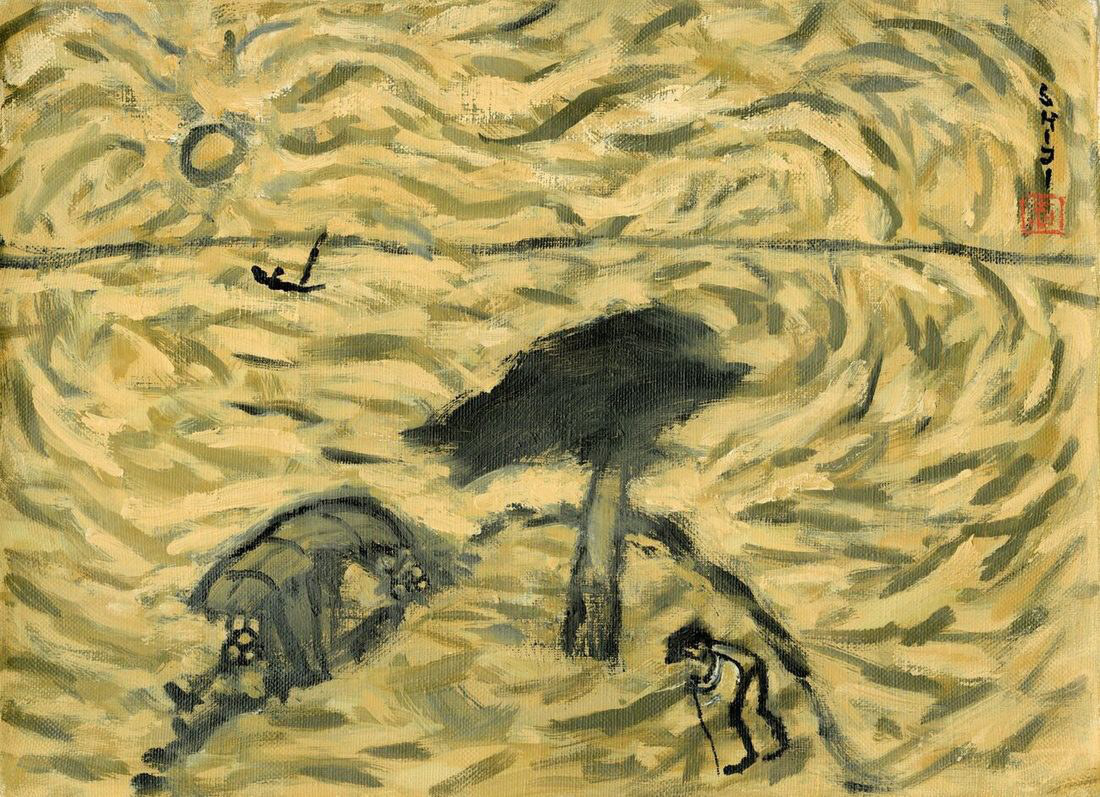
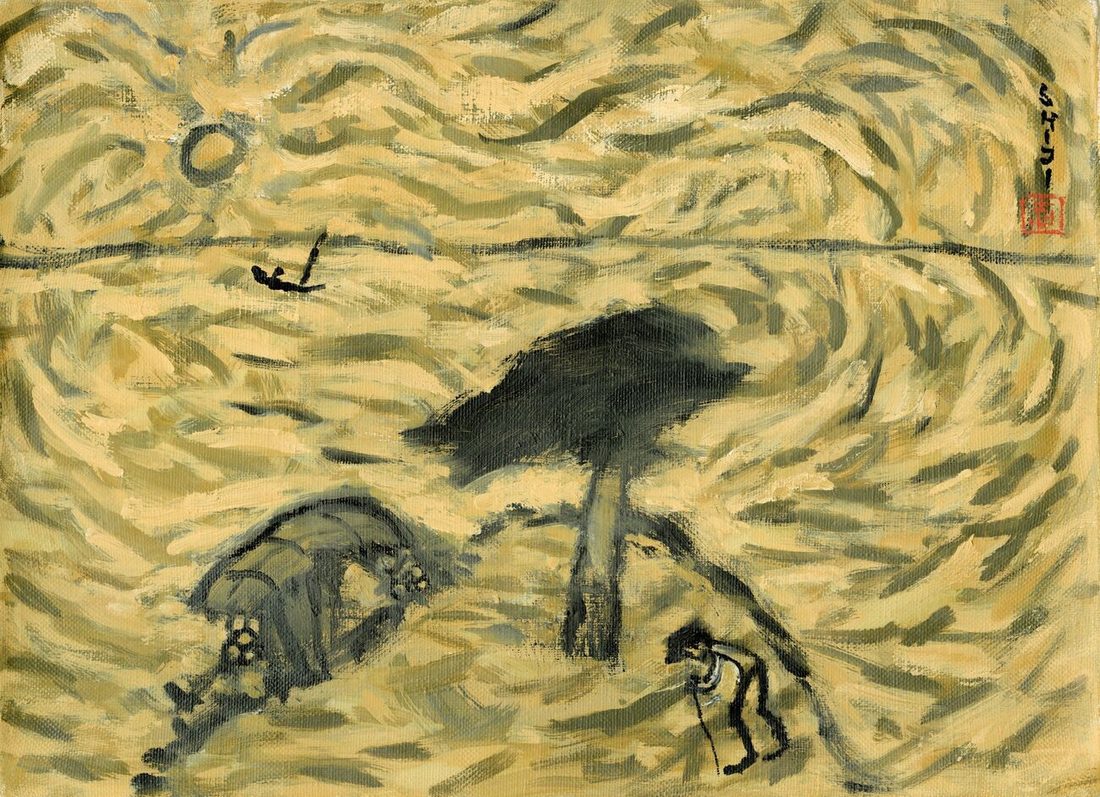
In Noon, curved marks pass densely around the house, tree and small figure. Bright ground and numerous traces remain together. Reading the work solely as peace after overcoming a storm misses forces still moving within the image. A late painting can create fresh tension.
Wild dance and quiet can be read less as successive conclusions cancelling each other than as possibilities the painter revisited and rearranged. Intervals widen in one work; marks multiply in another. Maturity does not consist only in gathering every painting into a single calm.
The Eye Descends from Sky to Wall
Return now to the sky of Wild Dance. At first there seemed simply to be many birds; sustained looking reveals places without birds too. The lighter ground separates their forms while connecting them. Once those gaps are read, disorder acquires a more specific order without disappearing.
This order is not a sign that a life has ended in victory. It is a way of encountering the image’s parts again. Looking at the same painting once more can mean discovering a relation not previously noticed. In that sense, the time of wild dance continues in the viewer.
Above, birds are flying. Below, some perch on the stone wall. The person in the house has stretched out their legs.