Research/A Hundred Years of Wind/Ⅴ Life & Place
Ⅴ Life & Place · 67 / 100
A Painter Who Stays and Travels
Looking Deeply into a Place
머무르며 여행하는 화가
Beyond the Story of Never Leaving
Byun can be called a painter who made his home on Jeju. Calling him a painter who did not travel, however, conflicts with his account. He recalled asking directions, walking and painting in Europe. On Jeju he also moved between life in Jeju City and a Seogwipo studio. Staying was not a blank left by the absence of movement.
The important question is less how often he left than what he brought back. A change of place changes the buildings and voices before us. It does not reset the eye to its beginning. Accumulated observation and habit are used again before a new landscape, and may in turn be revised by it.
Once staying and travel are no longer opposites, Byun’s relation to place opens out. Fūdo—the lived milieu of environment, history and shared habits—is not a qualification lost on departure. It remains active elsewhere and must be learnt anew after return. Living deeply in one place does not require closing every other place.
Asking Directions, Stopping to Paint
In his account of Europe, Byun recalled stopping to draw when he found a subject while walking with his companions. The French he had learnt earlier helped him find his way independently. Painting in an unfamiliar city is not made of inspiration alone. Asking, understanding and finding the route again are practical activities beside it.
In this scene the painter is not the owner of the landscape. There is a road he does not know and someone he must ask. Choosing where to paint requires reckoning with fatigue and remaining time. The freedom of travel is not freedom from all conditions, but the capacity to move while learning them.
The grand phrase “going far away” is made of small acts: asking a direction, recognising a corner, stopping long enough to paint. An eye formed on Jeju enters that street, and what the street offers enters the painter’s memory. Travel goes outside the self while testing what is already within it.
There Was an Outside to Dickinson’s Room
Even when Emily Dickinson is called a poet who wrote a universe from one room, she cannot be said never to have left it. Her museum’s biography records schooling, walks and stays in Boston for treatment. Writing at home also took place among family, friends and exchanges of letters and poems.
What this comparison offers is not a myth of isolation but sustained attention to what is near. The garden outside a window does not replace the wider world; it reveals that it too is connected to that world. A small space does not become deep automatically. What matters is what receives attention within it.
The same criterion can be applied to Byun. An island’s boundary alone does not explain a work’s density. There must be time to look again at the nearby sea, create an interval different from an earlier painting, and see a familiar tree less familiarly. What enters the painting is not merely days spent staying, but what was seen again during them.
Making a Picture in an Unfamiliar Place
When a painter depicts another region, it is not an empty stage. People already live there, with histories and uses the visitor may not know. Calling it pure nature merely because it is unfamiliar, or treating it as a place prepared for one’s own inner life, removes that particularity.
Returning to one’s birthplace does not automatically provide such knowledge either. Birth can begin a relationship, but it confers no exclusive right to understand a place. A person long absent has things to learn again. The eye of someone who stayed and the eye of someone who returned cannot replace each other.
This is why Byun’s homecoming and travels should be read together. Painting a nearby place deeply is connected with slowing one’s judgement before an unfamiliar place. An aesthetics of fūdo can ask for responsibility in how relationships with places are formed, rather than assert possession of them.
One Anchor, Memories of Many Places
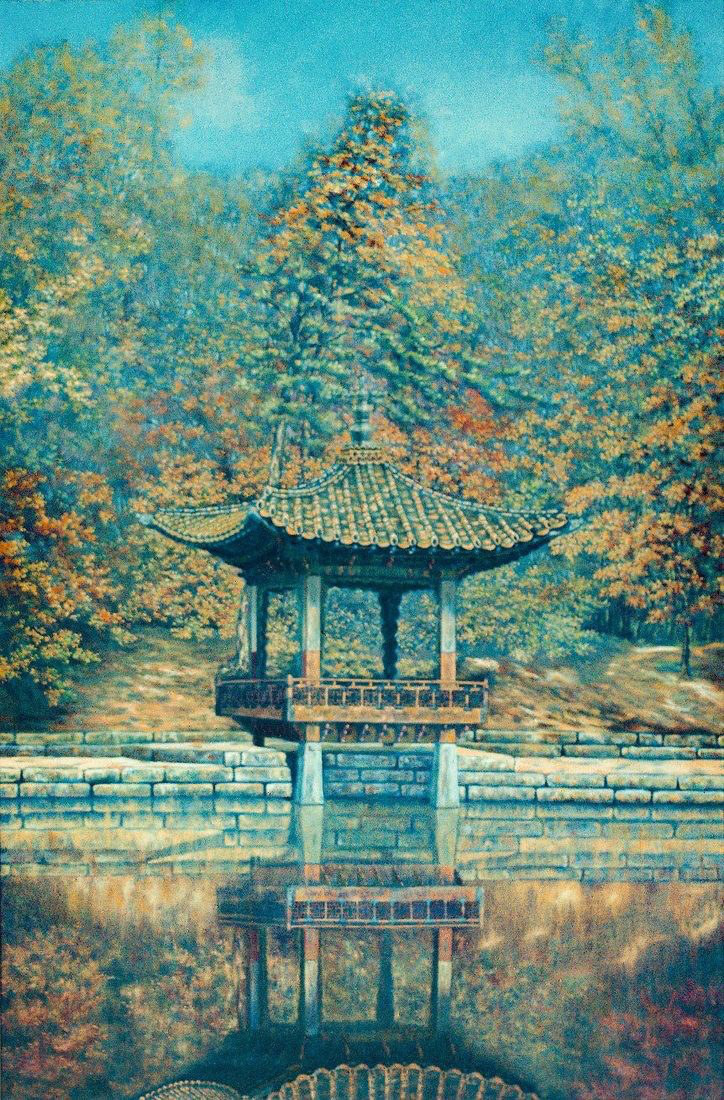
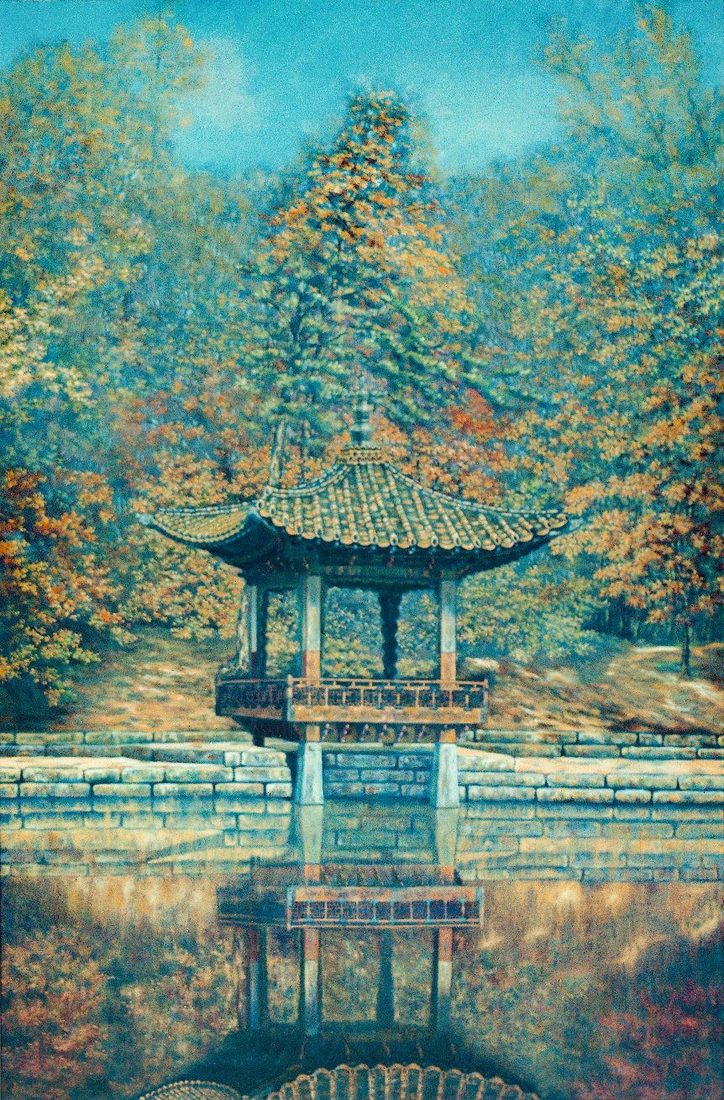
Making Jeju a centre of work did not erase Osaka, Tokyo or Seoul. The eye attending to pavilion and reflection in Aeryeonjeong Pavilion in Autumn already handles distance and repetition. Those relations may change in the later Jeju paintings, but the earlier work does not become an exercise unrelated to the artist’s life.
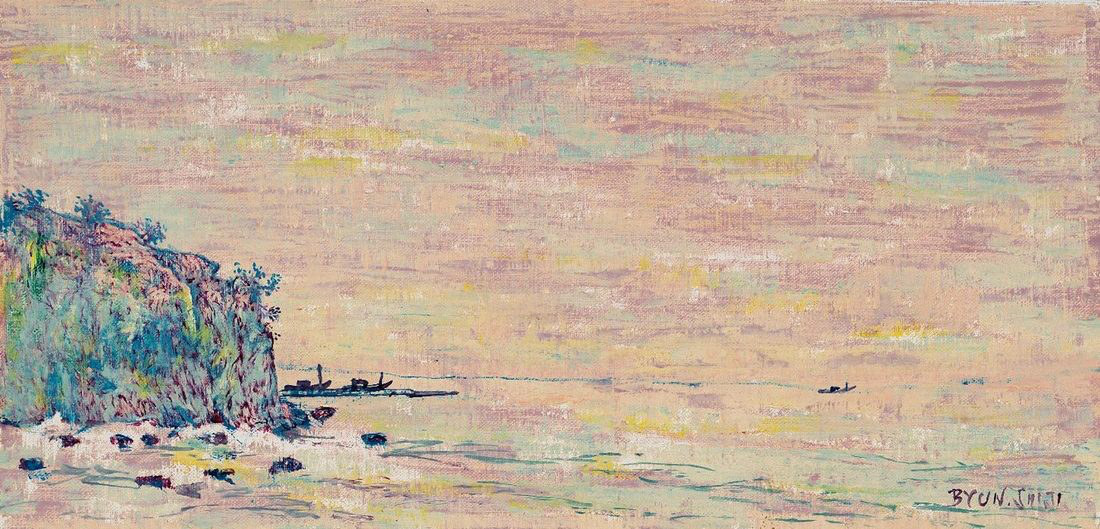
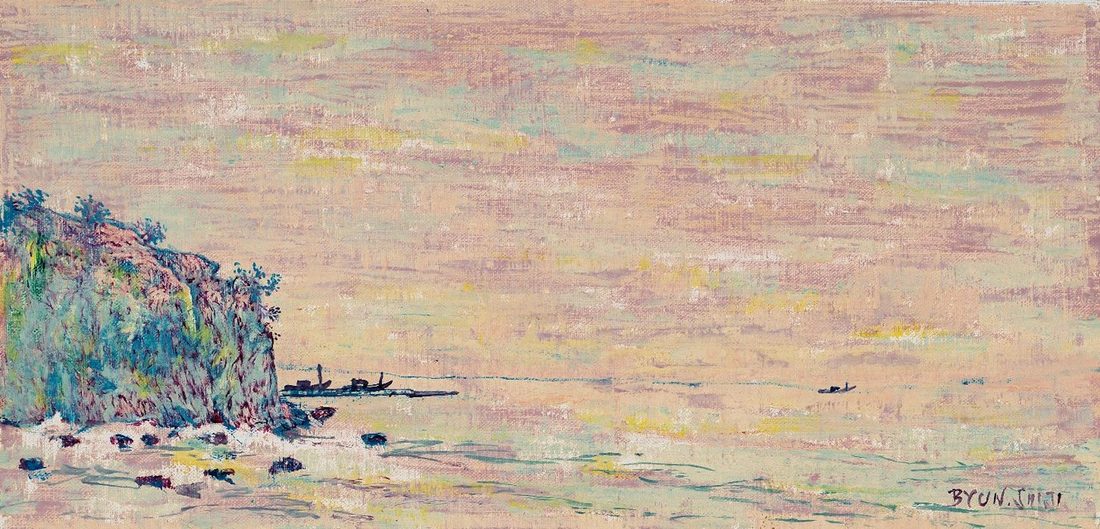
The sea and sky in Sunset (1975) retain several colours. Read beside the later dried-grass palette, the work shows that living in one place did not mean fixing a single palette from the outset. The date of a settled address cannot simply be made the date of a finished style.
Dropping anchor does not erase the route a boat has travelled. A place of return can provide room to reconsider what was seen before. One place may become a centre for arranging many memories. That centre can remain deep while staying connected to the outside.
Making the Familiar Unfamiliar Again
Staying may disclose changes missed at first. Familiarity may also become so complete that looking stops. Duration of residence does not guarantee the value of staying. When a house is painted again, the work must show what has changed from before.
Byun recalled that even a similar yellowish tone varied with what he was painting. Change does not arise only by bringing in a new subject. It can emerge by making an existing house smaller, placing a boat farther away, or leaving a different interval beside a tree.
Travel is one way of disturbing familiarity; repeated looking is another. Neither is inherently deeper. A question may follow a change of place or arise again within the same place. What a painter must renew is not a count of journeys but a way of seeing.
The Place of Return Also Changes
The door at home may open where it always did, but the returning eye is no longer exactly the same. The outline of a tree or the light beside water seen elsewhere can enter a familiar view. Return restores no untouched former scene; it places memory anew within a present situation.
Seogwipo can be read as a centre of such relations. There is no need to claim that its name foretold the painter’s whole life. The returning person and the place of welcome change together. A name may remain the same while the manner of living within it changes.
Byun said that the subjects through which he expressed an inner landscape need not be limited to Jeju. His concerns could appear when he painted Europe too. Place, in this account, is not enclosed by a border. Where he painted and what relation he made there become important together.
A Painting Set Down Again at Home
Fidelity to one place is different from proof that no other place was seen. An eye formed across several places can attend to one for a long time. Byun’s settling can be read not as the cancellation of travel but as an enduring position from which to reconsider experience.
Sending his work to another country need not mean abandoning its milieu. Accurate titles, dates and accounts of the life from which it emerged give an unfamiliar reader a route from their own experience. Sending a painting far away and preserving its point of departure can be part of the same act.
In the recollection, the painter stops on an unfamiliar road. His companions go ahead. He is looking at a place to draw.