Research/A Hundred Years of Wind/Ⅴ Life & Place
Ⅴ Life & Place · 66 / 100
Chusa’s Jeju, Byun Shi-Ji’s Jeju
Between Exile and Homecoming
추사의 제주, 변시지의 제주
What It Means to Share an Island
Placed under the name of Jeju, Kim Jeong-hui (Chusa) and Byun Shi-Ji first seem to offer related landscapes: a house, trees, few marks and wide intervals. Yet an immediate claim of resemblance can erase how each arrived. Someone sent into exile and someone who returned to make a life did not occupy the same position.
Chusa painted Sehando in 1844 during his exile on Jeju. Byun later recalled discovering a new appreciation of Chusa’s calligraphy through albums he saw on the island. What connects them is not simply a supposedly identical wind. Between them is also the eye of a later artist who actually opened the earlier artist’s work.
The comparison is not a judgement on which arrival was purer. Relationships could persist within enforced isolation, while homecoming could bring difficulties still to be worked through. A shared island does not guarantee a shared experience. It asks instead how different experiences can open the same place differently.
The Person Who Sent Books
The National Museum of Korea connects Sehando with the rare books Yi Sang-jeok sent to his exiled teacher. The painting was a gift to a pupil who had not forgotten him. It cannot therefore be understood solely as a landscape of total severance, without books or friends. A surviving relationship made the work possible and carried it onwards.
The museum describes a modest house and four trees. The absence of a painted person does not make it a work from which people have vanished. The giver and recipient surround the house from outside the image. Its open space is not simply the extent of an uninhabited island. It can also be the distance across which one person reaches another.
Restraint here does not delete relationship. Without painting a crowd, an image can preserve the fact that one person remembered another. Count only what appears and it is a small scene. Read the act of giving as well, and its space expands. Silence is not the same as saying that nobody is there.
What Remains beside an Empty House
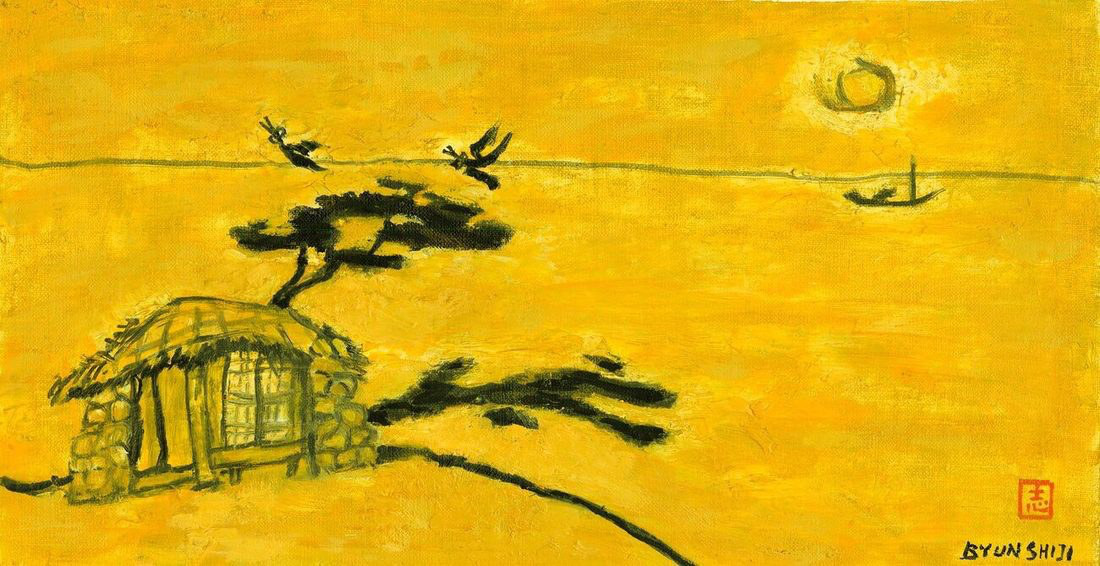
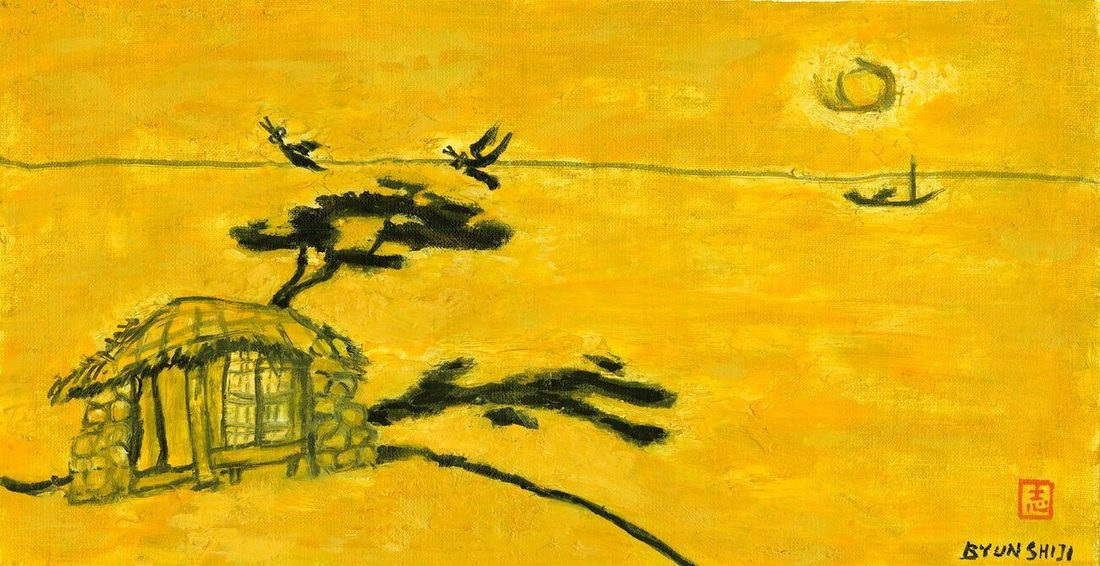
Byun’s Empty House (1987) contains a small house on the left, a tree and birds beside it, and a distant boat. The title speaks of emptiness, but the picture is not empty. A broad expanse of light lies between the house and boat. Unable to inspect the whole interior, the eye begins by tracing the distances outside.
The house is small, yet beyond it the sea recedes. The dark mass of the tree, the open ground and the black strokes extending out beside and below the house alter one another’s scale. The meaning of the empty house is not confined to a doorway. It changes with what remains nearby and what lies far away.
The useful question in reading Sehando beside this painting is not which house is lonelier. It is how relationship persists in a landscape with few or no visible people. In one case, the history of exchanged books and a painting holds that question; in the other, the intervals between house, boat and birds hold it differently.
Not Reducing Trees to a Single Posture
The contrast “Chusa is upright; Byun is bent” is easy to remember. But learning it by heart fixes meaning before looking at a tree. Uprightness does not always mean integrity, nor bending accommodation. The direction of the trunk must be read with the spread of branches and the space around them.
Byun said that Chusa’s calligraphy evoked for him the formal beauty of branches bent over time. He also distinguished his own houses and trees from those in Sehando. His account concerns an affinity of feeling encountered in different forms, rather than the transfer of an identical shape.
Following that account changes the comparison. Instead of assigning trees to two fixed characters, we attend to the eye that receives a line’s movement. A branch seen outdoors alters the reading of an album’s stroke; the stroke sends the eye back to the branch. Place and tradition meet in that exchange.
Without Measuring the Temperature of Two Spaces
It is not enough to call open paper cold and a painted ground warm. A bright colour can feel desolate; a few ink marks can suggest warmth. Emotion does not emerge directly from a colour’s name. It passes through the intervals in which forms have been placed.
The dried-grass colour of Empty House is a painted field. Within it, lighter and darker traces create a distance extending to the boat. A comparison with ink on paper must retain the difference of materials. The impression of ink does not mean that the oil painting is literally made with ink.
The paintings meet not in identical materials but in the work done by intervals. A mark establishes a house; a withholding makes that house distant. They can share a question about how open space sustains form. The surfaces answering it need not become the same.
Relations That Outlast Hardship
Saying that exile produced a masterpiece can praise the work while lightening the weight of the punishment. It can imply that suffering was necessary because a good painting resulted. A work made amid hardship is not evidence that the hardship was needed for art.
What matters in Sehando’s history is not only the severity of isolation but that someone sent books into it. Byun’s recollection likewise contains albums, mounting shops and trees seen on journeys. To explain a painting’s depth, we must attend not only to the person who endured but to the relationships and things that person encountered.
A place is not a vast machine for tempering a person in solitude. Between weather and terrain there is daily life, and within daily life the help of others. Even a reading centred on loneliness must not erase those connections. Sometimes a book arriving from afar changes the size of an island.
Looking and Studying
Byun qualified the claim that he had studied Chusa extensively. He described looking in mounting shops, opening calligraphy albums and responding to their beauty. His testimony supports neither complete lack of contact nor the claim that research into Chusa generated every formal feature of his Jeju paintings.
Between those extremes lies the broad field of reception. Looking at an earlier work need not mean copying it. A familiar name may become newly visible, or an existing feeling may acquire another language. In Byun’s recollection, life on Jeju and the experience of viewing an album illuminate each other.
Their relationship is better read as an exchanging gaze than as a single arrow of descent. Byun senses Jeju in Chusa’s strokes and returns to those strokes through Jeju. In between, he paints his own houses and leaves his own trees. To feel resemblance is not to surrender difference.
The Meeting Takes Place before Us
Connecting Chusa and Byun does not require inventing a meeting in the past. It means placing surviving works and records together now. Retaining the difference between exile and homecoming makes the questions posed by houses, trees and intervals more concrete: what leaves someone alone, and what continues to connect them?
One house cannot simply be translated into the other. The history of a painting given to a pupil and the space of a small house facing a distant boat hold us differently. A comparison that retains this difference gives both works room. It does not impoverish one in order to understand the other.
In Empty House, the tree reaches a little beyond the house. Birds remain beside it. The boat is still far away.